

⚡ Active Balancing Hardware Topologies: Choosing the Right Architecture for Advanced BMS Design
Cell imbalance is one of the biggest challenges affecting LiFePO₄ battery pack performance, usable capacity, cycle life, and safety.
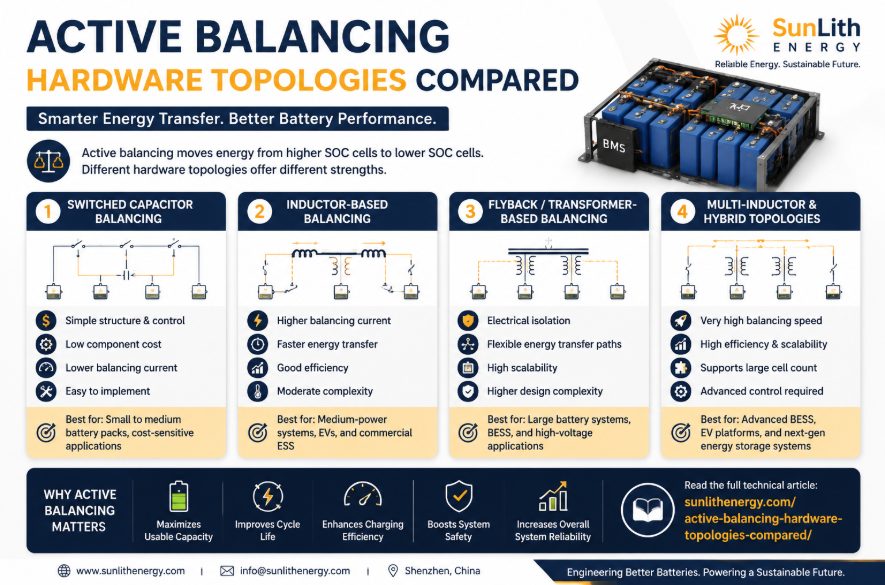
While passive balancing simply burns excess energy as heat, active balancing transfers energy from higher SOC cells to weaker cells, improving battery utilization and system efficiency.
🔋 Different active balancing architectures offer different advantages:
✅ Switched Capacitor Balancing
• Simple structure
• Lower cost
• Suitable for smaller battery packs✅ Inductor-Based Balancing
• Faster energy transfer
• Higher balancing current capability
• Better for medium-power applications✅ Flyback / Transformer-Based Balancing
• Electrical isolation
• Flexible energy transfer paths
• Suitable for large battery systems✅ Multi-Inductor & Hybrid Topologies
• Improved scalability
• Higher balancing speed
• Designed for advanced ESS and EV applicationsFor large-scale BESS and industrial LiFePO₄ systems, selecting the right balancing topology is critical to maximize:
⚡ Available energy
⚡ Battery lifetime
⚡ Charging efficiency
⚡ System reliabilityAt SunLith Energy, we focus on advanced battery architecture, intelligent BMS design, and energy storage solutions engineered for long-term performance.
Read the full technical comparison:
🔗#BatteryManagementSystem #BMS #ActiveBalancing #LithiumBattery #LiFePO4 #BESS #EnergyStorage #BatteryTechnology #ESS #RenewableEnergy #SolarStorage #BatteryEngineering #CleanEnergy #EnergyTransition
![]()