

🔋 DOD + C-Rate = Battery Stress
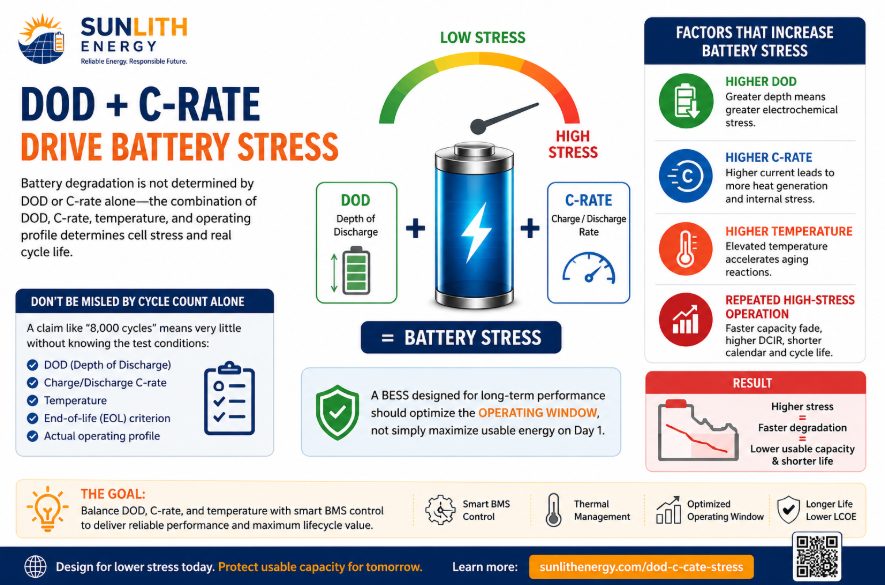
Why do two BESS projects using the same LiFePO4 cells sometimes show very different degradation?
Because cycle life is not just about the number of cycles.
Depth of Discharge (DOD) determines how deeply the cells are cycled.
C-rate determines how quickly energy moves in and out.
When both become aggressive, battery stress increases.
For example:
➡️ Higher DOD → greater electrochemical stress
➡️ Higher C-rate → higher current and heat generation
➡️ Higher temperature → faster aging
➡️ Repeated high-stress operation → faster capacity fade and rising DCIRThat is why a datasheet claim such as “8,000 cycles” means very little without knowing:
• DOD
• Charge/discharge C-rate
• Temperature
• End-of-life (EOL) criterion
• Actual operating profileA BESS designed for long-term performance should optimize the operating window, not simply maximize usable energy on Day 1.
👉 Read the full technical guide:
Design for lower stress today. Protect usable capacity for tomorrow.
#BESS #BatteryEnergyStorage #LiFePO4 #BatteryDegradation #DOD #CRate #BatteryManagementSystem #EnergyStorage #ESS #RenewableEnergy #BatteryTechnology
![]()