

🌡️ Why Temperature Can Quietly Destroy BESS Lifetime
We often say: “Keep the battery cool.”
But the real issue is more interesting—and more important.
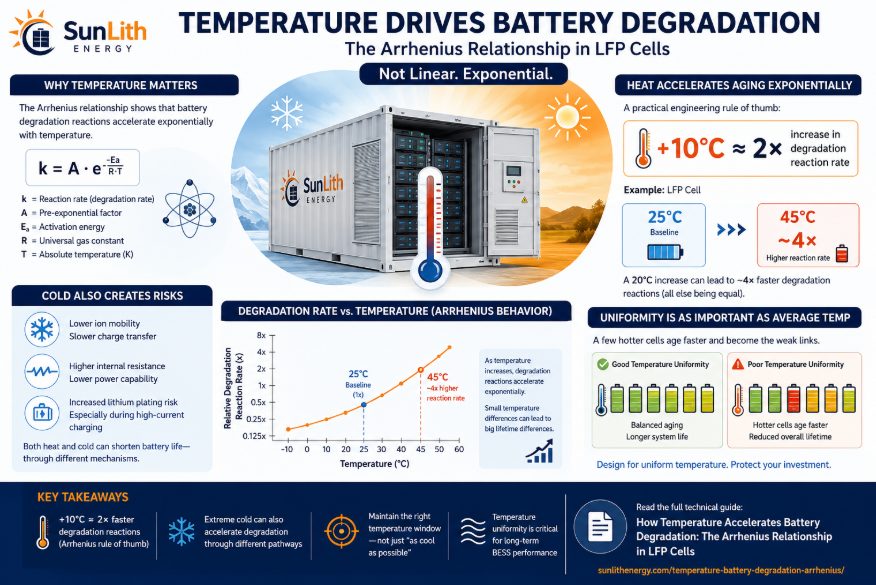
The Arrhenius relationship shows that battery degradation reactions accelerate exponentially with temperature.
A useful engineering shorthand is:
🔥 +10°C → roughly 2× degradation rate
So, comparing two otherwise identical LFP cells:
25°C vs. 45°C
That 20°C difference can mean roughly 4× the degradation reaction rate under the simplified 10°C-doubling assumption.
But heat isn’t the only concern.
❄️ Excessive cold can also accelerate degradation through a different pathway—reduced ion mobility, higher internal resistance, and increased lithium-plating risk under high-current conditions.
For BESS designers, there is another critical lesson:
Temperature uniformity matters.
A few hotter cells inside a rack don’t simply “average out.” Over time, those cells can age faster and become persistent weak points.
That makes thermal design, airflow, cooling strategy, and cell-to-cell temperature spread critical to long-term BESS performance.
🔬 In our latest technical guide, we explain:
• The Arrhenius relationship
• Activation energy and chemistry dependence
• Why both heat and cold matter
• Calendar vs. cycle aging
• Why temperature uniformity matters at BESS scale
• A practical 25°C vs. 45°C comparison👉 Read the full technical guide:
Temperature isn’t just a thermal-management issue. It’s a battery-life issue.
#BESS #BatteryEnergyStorage #LFP #LiFePO4 #BatteryDegradation #EnergyStorage #BatteryManagement #ThermalManagement #RenewableEnergy #EnergyStorageSystem #Arrhenius #BatteryTechnology #SunLithEnergy
![]()