

Buddies Buzz Blog

In the Buddies Buzz blog, you'll find the latest news about the community, tutorials, helpful resources, and much more! React to the news with the emotion stickers and have fun!

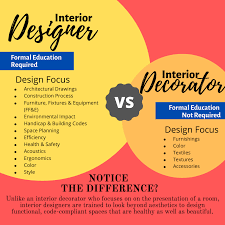
Difference Between Interior Designer and Interior Decorator

Difference Between Interior Designer and Interior Decorator 

Many individuals confuse the expressions “Interior Designer” and “inside decorator,” yet the two positions are actually quite unique and there is an immense distinction between inside architects and inside decorators. Assume, you’ve decided to make a few changes at home, and you’ve understood you’ll require some help. At the point when you begin searching for forthcoming administrations, you find that a few experts call themselves inside architects, while others call themselves inside decorators. You’re abruptly going up against new requests, for example, “What’s the distinction?” “Which one do I require?” is a seriously squeezing question. Here in this article, we divided the data for the distinction between inside originators and inside decorators.

Carrier In Interior Designer 

Land costs continue to take off step by step. Furthermore, they are not simply expanding as a result of an expansion in the worth of the actual land, but since individuals need better and better conveniences and more delightful areas. 


Besides, this isn’t limited to only the outside of the house. Individuals need their homes to have the greatest usefulness and stylish worth. They need their homes to be wonderful, but have all that they can oblige in the present unassuming estimated abodes. This blog discusses the extent of inside planning soon and how you might seek after one. 


Interior Designer 

In shortsighted terms, an inside architect is an individual who plans the inside of individuals’ homes. However, the work doesn’t end there. An inside architect doesn’t just plan something extremely creative to be finished with a house, yet he/she finds some kind of harmony among accommodation and excellence for their clients. 

They consider all goods that essentially must be available in the house, and how best to spread them out in a vacant level to make it an enthusiastic home that is satisfying to the eyes. 


Overview 

Contingent on the reason for which he/she is employed, an inside originator might be involved right from the hour of planning the diagram for the structure, or solely after the structure has been finished. Inside Designers are relied upon to have a little information on engineering for the previous reason.


  • The creator considers the motivation behind the space or room and what goods will be required and what is superfluous; 


  • In case they’re required from the beginning, they plan the situation of windows, entryways and implicit furniture, for example, shelves; 


  • They consider angles, for example, regular light and natural air accessible in the room; 


  • A few architects work specifically in rooms (like washrooms/kitchens, and so forth) or specifically styles, (for example, feng shui, eco-accommodating plans, and so on)


All things to consider, an inside planner should know about design, Shading plans, materials utilized in making the insides their expense and where to get them, and what styles are moving. He/she doesn’t force this information on the client yet attempts to perceive what is best for the client’s taste. The client is preeminent in this calling, and just those inside planners will flourish who can fulfill their clients the most. 


Career path 

After your 10+2 instruction, you can straightforwardly go for a Bachelor of Design (B.Des.) in Interior Designing/Furniture Design/Ceramic and Glass Design and other comparative courses. They have various names yet a glance at their prospectus will let you know the unpretentious contrasts and what you ought to be seeking after. The National Institute of Design (NID) and Arch Academy are two well-known schools.


These are likewise postgraduate M.des. Courses and a few confirmations that you can seek after. One thing to be remembered is that these schools have their own placement tests/ fitness tests. It is vital for a vocation in an inside plan to be acceptable at drawing/outlining, and it is important for an inside planning degree from a decent school to have a decent portfolio! You can likewise select an overall BDes course in a renowned school and afterward go for a particular post-graduate course in the inside plan. For more inside plan profession data read the tables given beneath.


Fee structure 

The charges change from one college to another, contingent on whether it is private or government-claimed and how renowned it is. For instance, the charge for furniture plan in NID is around 1.8-2 lakhs for every annum. Simultaneously, a school like CEPT University has a charge of around 1 lakh for each annum. The charges for the most part differ between 75,000-2,50,000 for every annum.


SUMMARY

Inside beautifying is the specialty of enhancing a private home or business as per a customer’s very own inclinations and style. It incorporates choosing shading plans, flooring materials, furniture, work of art, and embellishments. It changes a region into a stylishly satisfying financial plan.


Website Security Made Easy with a DDoS Protection Plan

You may not know the name, but the term DDoS means Distributed Denial of Service. It can happen when too many people use your site and they all try to access it at the same time. If you find this happening, then you need to protect yourself with a DDOS protection plan. 

  • Having a DDoS protection plan in place for a website is a sound investment. 
  • The basic plan provides cyber security services to mitigate all attacks. 
  • More expensive plans offer various options to suit the business’ needs. 
  • DDoS prevention service will mitigate the effects of DDoS attacks. 
  • This service will defend against these attacks by filtering traffic that is flagged as malicious. 
  • They also offer protection for search engine optimization. 

A DDOS protection plan can be broken down into two parts, with the first part being DDoS mitigation, and the second part being DDoS prevention. DDoS Mitigation is the act of taking a DDoS attack that has already started and neutralizing it with the use of external DDoS mitigation services. DDoS mitigation is the process of blocking the DDoS traffic before it even gets to your web server. This is a stop-gap measure. The goal is to keep your web server from being knocked offline by the DDoS attack, and this involves setting up a firewall that has rules which block all incoming traffic except for your website’s IP address. 

The second part is to build internal systems that are designed to prevent an attack before it even starts. DDoS Prevention is the act of building internal systems and external security services to prevent a DDoS attack from even happening. When you purchase a DDOS protection plan, they can provide you with any combination of their services that will match the needs of your business. 

DDoS Mitigation 

A DDoS mitigation plan is a security strategy that focuses on reducing the impact of a distributed denial-of-service attack by decreasing the number of incoming requests to the target, typically by identifying and blocking the attacking IP addresses. Many people have been wondering how to protect their websites from DDoS attacks. Fortunately, there are DDoS protection services that specialize in mitigating these attacks for a low monthly cost. There are various types of packages, so you can find one that suits your needs. 

Many DDoS mitigation services will protect your website from the overwhelming effect of a massive DDoS attack, as well as other types of cyber-attacks. There are some advantages to DDoS protection services: 

  • They are inexpensive. 
  • They provide you with a long list of potential attacking IP addresses. 
  • They will work around the clock, helping you get a DDoS attack under control. 
  • DDoS Prevention 

Recent attacks on major websites like Amazon, Facebook, and Twitter have made the need for DDoS prevention services obvious. A DDoS protection plan can help businesses of all sizes stay online and maintain their good reputation. These plans are typically custom-tailored to each business. 

Content delivery networks (CDNs) can help you protect your website from DDoS attacks. They’re used to ensure that your site’s content reaches your users in the fastest, most efficient way possible. 

A common type of DDoS attack relies on UDP packets sent to port 80. Because many applications listen to that port, they’re vulnerable to DDoS attacks from a single source. 

Conclusion

Do you worry about a DDoS attack? You should because it can bring your website to its knees. Fortunately, a lot of web hosts offer a DDoS protection plan as an additional service for a low monthly fee. There are a few other things you can do to make your site less vulnerable to a DDoS attack as well. For example, you can use a CDN to distribute traffic evenly. You can also install a firewall and a web application firewall to protect your site from attacks. 

The Changing Face of Corporate Training During the Pandemic

The transformation of corporate training in the pandemic — why is this an issue of concern? Well, say 2019, when training and development in the workplace used to be relatively simple. Large corporations would just send their brightest executives to MBA or other specialized degree programs. External certification programs, professional development courses, or bringing individuals together in a conference room or off-site venue to go over off-the-shelf training material with an instructor — there were other measures to close additional gap areas.

Before the pandemic, the changing nature of technology and the workplace was already causing firms to rethink and tweak their business models. But now, many traditional beliefs about how to address skill gaps through regular corporate training and development have been thrown out of the water by COVID-19. So, what’s the changing face of corporate training in the pandemic? Let’s get started!

What’s the changing face of corporate training in the pandemic?

When the COVID-19 pandemic took the globe by storm, many managers had to adjust to totally remote work teams almost overnight. This transition instantly necessitated new and complex project management abilities. 2021 and any concept that this would be a one-time thing has vanished! Now, many businesses are preparing to go entirely or partially remote permanently.

For years, businesses and educational institutions have realized that corporate training’s future lies outside of traditional degree programs. They can no longer wait to put that into practice because of the pandemic — and its consequences.

Due to the rapid rate of change, companies require corporate training alternatives that are both readily available and teach material that is directly relevant to positions and company culture.

That isn’t to say that company-sponsored MBAs or project management credentials are obsolete. Instead, we require alternative learning methods to enforce corporate training in the pandemic. These methodologies should be faster, more flexible, and more targeted than traditional programs.

What are the alternatives to corporate training in the pandemic?

The ability to add a credential to their résumé or own a certificate with their name on it is a massive motivation for employees to take traditional courses outside of a degree. That has its place, but increasingly, businesses want workers to be trained rapidly on skills having a direct and immediate impact on their jobs, rather than having to complete a course and exam. Companies must find a means to reconcile their own needs with the growth ambitions of their personnel as a part of training in the pandemic.

For instance, a company may have identified a group of managers who are strong in their functional areas and want to invest in corporate training in the future. But who is willing to lose two years to an MBA program? Many of them may hold a master’s degree already.

Microlearning

Hence, finding short-burst learning choices that focus on practical skills is necessary. This situation is where organizations can incorporate the concept of microlearning – where you can segment the curriculum into concise, small learning units or short-term learning activities to enable quick delivery of corporate training content.

Digitization

The rapid digitalization of work, as well as the sudden transition to remote work, has produced a significant skills vacuum in project management. Many middle managers want quick corporate training to learn how to manage performance in a remote-work environment, deal with the impact on business culture, and navigate rapidly changing IT demands.

Mobile Optimization

Remote learning mostly translates to online corporate training. Now, when you go digital, you cannot only think of desktops and laptops. You need to consider flexibility, and this is where the concept of mobile learning comes in. M-learning is learning via the internet through portable devices like smartphones and tablets that let learners learn on the go.

Many organizations traditionally used classroom sessions or e-learning for training, but now they are slowly moving into m-learning. Through m-learning, corporate training can be made more engaging, exciting, and intuitive for the employees. It merges work and life — a virtual space with services and information on demand. For employees, this means access to technology and training they need, when they need it, on whichever device they prefer to use.

Competent eLearning providers

Employers are the ones who sense and observe the pain areas and training requirements of their staff members. However, when seeking partners to help implement training needs, firms should keep a few key characteristics in mind.

It is best to work with partners who have a proven track record in education and corporate training. Colleges and universities aren’t the only options. You can also go for valuable collaborators with a track record of educational and training success.

Employers must choose vendors who truly understand their company requirements. A standard approach will not adequately meet the growing needs of any organization. Employers should look for providers who can deliver a “one-size-fits-one” strategy rather than “one-size-fits-all.”

For instance, a technology- and an app-based learning platform like PlayAblo can deliver faster corporate training and learning reinforcement. It enables effective learning through its engaging platform, resulting in improved employee skills and business performance.

Assessments

It is critical to choose training courses with a robust assessment component. The coursework should be designed to ensure proper absorption of the subject rather than just participation and completion, as is frequently the case.

Measuring corporate training effectiveness enables you to justify your investment in a training program. It is not possible to talk your way out by convincing management to adopt a new learning tool. You must substantiate your proposal with data points and objective key performance indicators (KPIs). Most importantly, you must be ready to present irrefutable evidence that this investment will positively impact the workforce’s productivity.

In addition, after attending the corporate training session on the suggested learning platform, the learners must demonstrate information retention, confidence in their roles & responsibilities, and the ability to apply the newly acquired knowledge in solving real-life problems at the workplace. In short, showcasing training effectiveness and proving the impact of learning is not a luxury but a necessity.

Conclusion

As the pace of business and technology development intensifies, the necessity to turn on corporate training in this manner will only grow. Organizations that can analyze needs, quantify them, and roll out the appropriate training mix — either internally or through partnerships with third parties — will be more successful.