
Business

6 Steps You Must Take Before Starting A Business

Businesses can be a great source of income, but they require a lot of work and dedication. There are many struggles that businesses face when starting out, such as finding the right marketing strategy, maintaining a good customer base, and creating a successful product. It can be difficult to get started, but with dedication and hard work, businesses can be successful.

Starting a business can be an exciting and fulfilling experience, but it’s not easy. There are a lot of steps you need to take before you can even begin, and not all of them are obvious. In this article, we’ll outline the most important steps you need to take before starting your own business.

Research: 

Before starting a business, you should do your research to ensure that there is a market for your product or service and that you have the necessary skills to run the business. You should also develop a business plan and get funding from a bank or an investor. You should also register your business with the state and obtain any necessary licenses or permits.

Plan: 

One of the most important things to remember when starting your own business is to plan ahead. This means having a clear vision for your business and developing a roadmap to get you there. Without proper planning, you may find yourself directionless and struggling to maintain progress. 

A well-developed business plan is key to keeping your business on track. You can use it to set goals, develop strategies, and implement tactics. Additionally, it can be used as a tool to measure progress and make necessary adjustments along the way. 

There are many different types of business plans, so it’s important to choose one that is best suited for your company. The best place to initiate your business is with the U.S. Small Business Administration’s (SBA) free template.

Funding: 

There are a few key things to remember when it comes to funding your business. First, it’s important to have a realistic idea of how much money you will need and what you will use it for. Second, make sure you have a solid business plan and track record that can be presented to potential investors. And finally, always be prepared to negotiate terms and be open to different sources of funding.

Execution: 

Successful people work hard to achieve their goals. This means dedicating yourself to your business before it even starts. You have to take the time to learn about the industry and what you’re getting into. You also need to make a plan and figure out what you need to do in order to achieve your goals. And finally, you need to execute that plan flawlessly.

There’s no room for error when it comes to starting a business. If you don’t have a solid foundation, your business will crumble before it even has a chance to succeed. That’s why it’s so important to take the time to get everything right before you launch.

Sure, things may not go perfectly every time, but if you put in the effort beforehand, you’ll be much more likely to succeed.

Marketing: 

It is important for a business to have a plan for marketing before starting up. This plan should outline the goals of the company in terms of marketing, as well as how they will be achieved. Without a solid marketing plan, it can be difficult for a business to succeed. There are many different methods of marketing, and it is important to find the right one for your company. You should also consider your budget when creating your marketing plan. There are many different ways to market a business on a budget, and it is important to find the ones that work best for you.

Automate tasks: 

It’s tempting to think that you don’t need to automate tasks before starting your own business. After all, you’re a one-man (or woman) show, and you can do everything yourself, right?

Wrong.

Automating even the simplest tasks can free up time and energy for more important things – like growing your business. In fact, automating just 10% of your daily tasks can save you up to two hours each day. That’s ten hours each week!

Here are some tips for automating your work: 

1) Use tools like IFTTT or Zapier to automate routine tasks. 

2) Create templates for common documents or emails. 

3) Use appointment scheduling software like Picktime to manage your calendar and deadlines. 

4) Automate payments and bookkeeping.

In conclusion, starting a business can be an extremely rewarding experience, but it is important to take the proper steps beforehand in order to increase your chances of success. By following the five tips outlined in this article, you can give your business the best possible chance to thrive. So what are you waiting for? Get started today!

GST: Everything You Need to Know

WHAT EXACTLY IS GST?

The GST (Goods and Services Tax) is a tax on goods and services. This is a unified indirect tax in India that went into effect on July 1, 2017.

In essence, an indirect tax is one that is imposed on products and services rather than on income and profits.

The government collects taxes on business sales, and firms collect taxes from their consumers indirectly by charging the same tax on invoices. 

GST must be paid whether you offer goods, services, or both.

WHEN IS GST REGISTRATION REQUIRED BY LAW?

  • If your annual revenue is more than INR 40 lakhs. When your turnover surpasses INR 20 lakhs in the North Eastern States, you must register for GST.
  • If you sell items outside of the state where you live (inter-state trade), regardless of turnover.
  • If you’re selling your item on an e-commerce site like Amazon, Flipkart, or Snapdeal,
  • If you’re a buyer or a seller,
  • If you wish to send your customers a tax invoice,
  • If your company participates in an exhibition or event outside of the state as a casual taxpayer.

WHO SHOULD REGISTER FOR GST?

Despite the necessary provisions mentioned above, GST Registration can be done on a voluntary basis. GST registration not only allows you to be recognized as a legal registrant, but it also provides you with a number of advantages.

REGISTRATION FOR GST BENEFITS

  • Improve your competitiveness: Because you have a legal tax registration, such as a GSTIN, your business will be more competitive than unregistered competitors.
  • Online business expansion: You can’t sell goods or services on an e-commerce site until you’ve registered for GST. A GSTIN is required if you plan to sell on an e-commerce platform like Flipkart, Amazon, Paytm, Shopify, or your own website.
  • The input tax credit is available: Only registered GST holders can use the GST tax paid on their purchases as input and save money.
  • No limitations on selling throughout India: You can’t trade between states without a GSTIN. Only if your business is GST registered can you do this.
  • There are government tenders available: GSTIN is necessary when applying for government contracts. You can miss out on a business opportunity if you don’t have it.

IS THERE A PENALTY FOR FAILING TO REGISTER FOR GST?

If a business entity that is required to register under GST fails to do so or deliberately ignores the requirement, the business faces a penalty of either 100 percent of the tax payable or INR 10,000, whichever is higher.

WHAT EXACTLY IS GSTIN?

The GSTIN (Goods and Service Tax Identification Number) is a number that identifies a person’s tax status. When you have successfully applied for GST registration, this will be generated by the government.

WHEN DOES A COMPANY REQUIRE MULTIPLE GST REGISTRATIONS?

  • If a company entity supplies products and services in many states, it is necessary to register for GST in each state.
  • Furthermore, any company organization can apply for several GST registrations even if they operate under multiple verticals from a single state to prevent accounting complications.

AFTER GST REGISTRATION, WHAT ARE THE COMPLIANCES?

  • Increase the GST Invoices: Following GST registration, every business must issue a Tax Invoice for all products and services sold.
  • GST return submission: Businesses must file GST Returns on time after registering for GST. If you are registered under the standard GST plan, you must file your return on a monthly or quarterly basis. If you are registered under the composition system, you must file a quarterly GST return, subject to certain circumstances.
  • Taxes to be paid: Pay taxes on a monthly/quarterly basis depending on invoices sent to consumers on a monthly/quarterly basis.

Why mHealth Apps Market Exhibited A CAGR of 34.8%

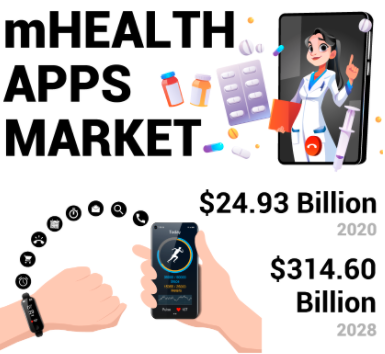
The global mHealth apps market size is expected to showcase exponential growth by reaching USD 314.60 billion by 2028 while exhibiting a CAGR of 34.8% between 2021 and 2028. This information is published by Fortune Business Insights in its report, titled “mHealth Apps Market, 2021-2028.” The report further observes that the market stood at USD 24.93 billion in 2020. The increasing prevalence of chronic ailments and the rapid-paced development in the telecommunication sector is anticipated to propel the demand for the product worldwide.

The negative effect of the global pandemic, COVID-19, has been felt across several economies facing unprecedented loss. Owing to the lockdown announced by the government agencies, several industries have been at a standstill with limited operational activities. However, a collective effort from the government and the industries is likely to bring the economy back on track and aid in the resumption of industrial activities.

Based on the app type, the market is classified into disease & treatment management, wellness management, and others.

  • Based on app type, the disease & treatment management segment held a global mHealth apps market share of about 25.5% in terms of revenue in 2020. This is due to the increasing adoption of advanced fitness apps that aid in eliminating the communication barrier between healthcare professionals and doctors.

On the basis of application, the market is divided into monitoring services, fitness solutions, diagnostic services, treatment services, and others. Moreover, based on the market place, the market is categorized into Google Play Store, Apple App Store, and others. Lastly, on the basis of region, the market is segregated into North America, Europe, Asia-Pacific, Latin America, and the Middle East and Africa.

What does the Report Include?

The market report includes qualitative and quantitative analysis of several factors such as the key drivers and restraints that will impact growth. Additionally, the report provides insights into the regional analysis that covers different regions, which are contributing to the growth of the market. It includes the competitive landscape that involves the leading companies and the adoption of strategies by them to announce partnerships, introduce new products, and collaboration that will further contribute to the growth of the market between 2021 and 2028. Moreover, the research analyst has adopted several research methodologies to extract information about the current trends and industry developments that will drive the market growth in the forthcoming years.

Increasing Focus on Advanced of Telecommunication Systems to Augment Growth

The emergence of LTE and 4G technologies has led to the development of communication services that provide faster communication abilities and better experience for patients using fitness apps. In March 2020, Google Cloud announced its collaboration agreement with AT&T to develop 5G edge computing solutions. The introduction of advanced telecommunication systems has led to the development of advanced apps that aid in the treatment and management of the patient. Moreover, the increasing prevalence of chronic ailments is anticipated to boost the demand for the product worldwide, favoring the global mHealth apps market growth in the forthcoming years. According to the Centers for Disease Control and Prevention (CDC), Americans are at high risk for heart disorders due to the increasing prevalence of high blood cholesterol and high blood pressure. On-time management and treatment can save several lives.

North America – The region is expected to showcase considerable growth during the forecast period. This is due to the increasing prevalence of chronic ailments and the high impact of sedentary lifestyles leading to several health problems amongst the people. The market in North America stood at USD 7.44 billion in 2020.

Asia-Pacific – The market is expected to experience significant growth backed by the increasing healthcare expenditure in countries such as India, Japan, and China. This is likely to propel the demand for mHealth apps in the region.

Merger and Acquisition by Key Companies to Brighten Their Market Prospects

The market is witnessing massive competition among the players that are highly focused on strengthening their footprint. These players are acquiring other smaller enterprises to expand their mHealth apps portfolio and further boost sales revenue. Furthermore, the other key companies are leveraging the opportunities provided by the market by adopting proactive organic and inorganic strategies that will aid in maintaining their presence in the forthcoming years.

Industry Development:

  • August 2020 – Livongo and Teladoc Health Inc announced the completion of their merger agreement. The two companies collaborated to enhance the user’s experience in virtual healthcare by adopting user-friendly programs to treat various chronic diseases.

List of the Companies Profiled in the Global Market:

  • Fitbit, Inc. (San Francisco, United States)
  • Apple Inc. (California, United States)
  • Omada Health, Inc. (California, United States)
  • Livongo Health (California, United States)
  • Boston Scientific Corporation (Marlborough, United States)
  • Omron Healthcare, Inc. (Kyoto, Japan)
  • Abbott (Illinois, United States)
  • Jawbone Health Hub, Inc. (California, United States)
  • Other prominent players