

🔋 Calendar Aging vs. Cycle Aging: What Really Degrades a BESS?
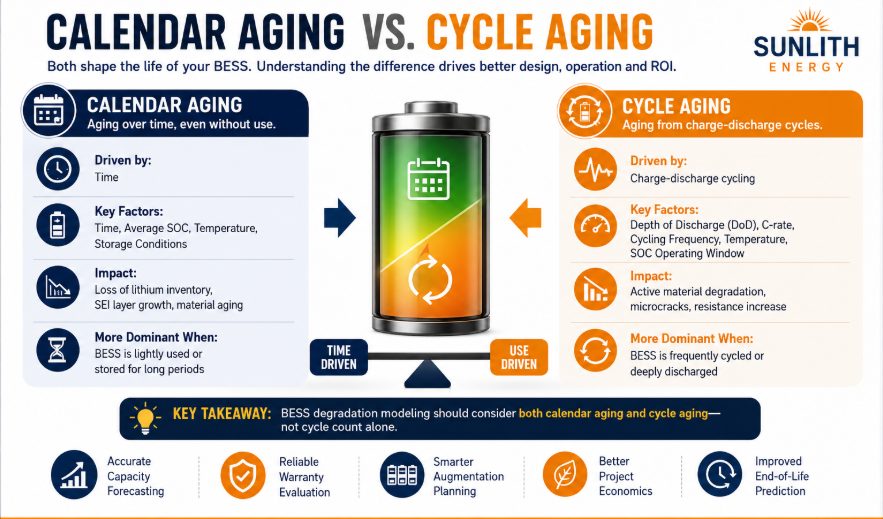
A battery does not degrade only because you charge and discharge it.
Even when a BESS is sitting idle, its cells continue to age. This is calendar aging.
At the same time, repeated charge-discharge operation causes cycle aging.
The challenge for BESS engineers is understanding how these two mechanisms interact.
⚡ Cycle aging is influenced by:
• Depth of discharge (DoD)
• C-rate and charging power
• Cycling frequency
• Temperature
• SOC operating window🕒 Calendar aging is strongly influenced by:
• Time
• Average SOC
• Temperature
• Storage conditionsFor example, a high-utilization BESS may be dominated by cycle aging, while a lightly cycled backup system may experience a greater contribution from calendar aging.
👉 The key takeaway: BESS degradation modeling should consider both mechanisms—not cycle count alone.
Understanding the difference helps with:
✅ Accurate capacity forecasting
✅ Warranty evaluation
✅ Augmentation planning
✅ End-of-life prediction
✅ Better project economicsRead the full technical guide from SunLith Energy:
#BESS #BatteryEnergyStorage #EnergyStorage #BatteryDegradation #CalendarAging #CycleAging #LFP #LiFePO4 #BatteryTechnology #RenewableEnergy #EnergyTransition #SunLithEnergy
![]()