
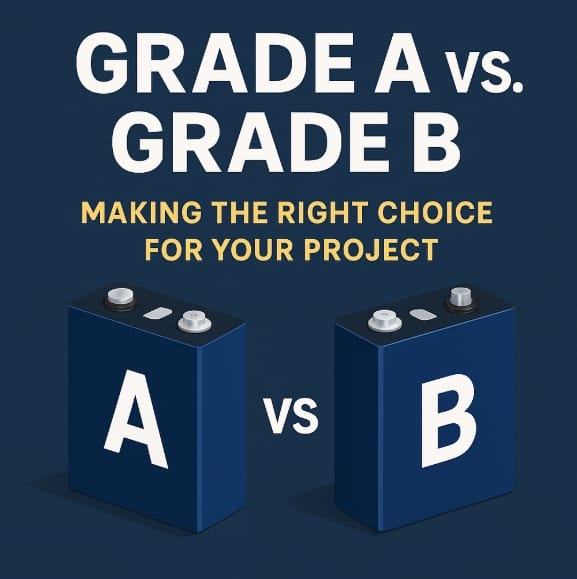

Grade A vs Grade B LiFePO4: LiFePO4 (Lithium Iron Phosphate) batteries have earned their reputation for stability, safety, and long cycle life. But if you’ve ever searched for LiFePO4 cells, you’ve probably stumbled upon the terms Grade A and Grade B.
The difference might seem minor — until it isn’t. While Grade A promises top-tier performance, Grade B cells lure buyers with tempting price tags. The result? Many buyers get stuck in the budget vs. performance dilemma.
Should you splurge for Grade A every time, or are Grade B cells sometimes a smart, cost-effective choice? Let’s break it down with facts, use cases, and practical tips.
Detailed Comparison: Grade A vs Grade B LiFePO4
1. What Defines the Grades?
- Grade A Cells:
✔️ Direct from reputable cell manufacturers.
✔️ Fully compliant with manufacturer specifications for capacity, internal resistance (IR), cycle life, and consistency.
✔️ Typically come with traceable QR codes and valid test reports. - Grade B Cells:
✔️ Often factory seconds, excess inventory, or cells with minor deviations.
✔️ May have slightly lower capacity, higher IR, or less consistency.
✔️ Less documentation, sometimes relabeled.
2. Key Metrics Side-by-Side for Grade A vs Grade B LiFePO4
| Metric | Grade A | Grade B |
|---|---|---|
| Cycle Life | 3500–6000+ full cycles | 1500–3000 cycles (may vary widely) |
| Capacity Retention | 95–100% of rated capacity | 85–95% of rated capacity |
| Internal Resistance (IR) | Low and consistent | May be slightly higher and vary more |
| Consistency | High — matched cells for balancing | Variations may cause imbalance |
| Warranty & Traceability | Usually verifiable | Rarely offered or less reliable |
Use Case Scenarios for Grade A vs Grade B LiFePO4
When to Always Choose Grade A
Some applications simply can’t afford to gamble on lower-grade cells. If you depend on reliability, longevity, and maximum safety, Grade A is worth every extra penny.
✅ Off-Grid Homes: Your solar or wind storage must deliver consistent power every day, often in harsh conditions. Low-grade cells failing prematurely can put you in the dark — literally.
✅ Mission-Critical Systems: Medical backup, telecom base stations, and security setups must work flawlessly. Failure could mean legal liabilities or safety risks.
✅ Electric Vehicles (EVs): High current draws, fast charging/discharging, and deep cycles demand cells that perform at peak specs.
When Grade B Might Be a Smart, Cost-Effective Choice
Grade B isn’t automatically “bad” — it depends on the project and your risk tolerance.
✅ Hobby Projects: DIY power banks, test setups, or prototyping — if a cell underperforms, it’s not a disaster.
✅ Occasional-Use Backups: For infrequently used backup systems where top performance isn’t critical, Grade B can stretch your budget.
✅ Short-Term Applications: If you only need the cells for a limited time, a lower upfront cost could make more sense than paying for cycles you’ll never use.
Long-Term Costs: Think Beyond the Sticker Price
Buying Grade B cells may save you money upfront — but will they cost you more over time?
Example:
- 4 Grade A cells ($100 each) last 10 years → Total cost: $400
- 4 Grade B cells ($60 each) last 4–5 years → May need replacing twice in 10 years → Total cost: $480
When you add labor, downtime, and potential system failure, Grade A often pays for itself in the long run — especially for demanding or hard-to-access installations.
Tips for Sourcing Reliable Grade B Cells
If you decide Grade B is right for you, follow these best practices to avoid costly surprises:
✔️ Ask for Test Reports: Request actual capacity and IR test results for each batch — not generic data.
✔️ Check Visuals: Inspect for dents, swelling, or damaged terminals.
✔️ Buy from Reputable Resellers: Look for sellers with transparent sourcing, clear grading policies, and consistent customer reviews.
✔️ Test Yourself: Use a battery tester to confirm capacity, IR, and voltage consistency.
✔️ Document Everything: Keep records of your purchase, including test results and any warranties.
Final Thoughts: Know Your Needs, Know Your Risk
Choosing between Grade A and Grade B LiFePO4 cells isn’t about right or wrong — it’s about aligning your choice with your needs and risk tolerance.
- Critical, long-term, or high-cycle applications? Grade A is your safest bet.
- Budget-limited, low-demand, or experimental projects? Grade B might make sense if sourced carefully.
Whatever you choose, do your homework — and don’t let a cheap deal cost you more in the end.
Grade A vs Grade B LiFePO4 FAQs
Q: Is Grade B always recycled or used?
A: Not always. Grade B can include new but off-spec cells, or cells from canceled orders. But some sellers mix used or reclaimed cells — so always ask for clear proof.
Q: Can I mix Grade A and Grade B cells in one battery pack?
A: It’s strongly discouraged. Inconsistent IR and capacity lead to imbalance, which can cause early failure or safety issues.
Q: How can I test cells myself?
A: Use a battery analyzer to check capacity, IR, and charge/discharge curves. Tools like the ZKE Tech or similar DIY testers are popular among hobbyists.
Ready to Decide?
Knowing the real difference between Grade A vs Grade B LiFePO4 can help you make a smart, confident choice — one that matches your project’s goals, budget, and peace of mind.





You must be logged in to post a comment.