

**BESS Power Factor: The Number That Can Change Your PCS Sizing ⚡🔋**
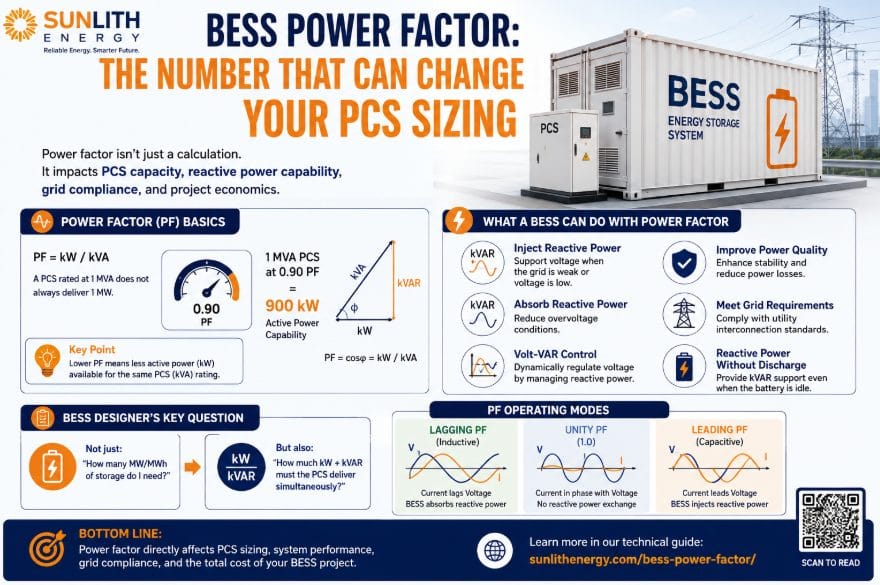
Power factor is not just an electrical calculation. In a Battery Energy Storage System (BESS), it directly affects **PCS capacity, reactive power capability, grid compliance, and project economics**.
For example, a **1 MVA PCS operating at 0.90 PF** can deliver only about **900 kW of active power** when the remaining capacity is required for reactive power support.
That means PF requirements can have a direct impact on PCS sizing and system cost.
A modern BESS can do much more than charge and discharge batteries. The PCS can:
🔹 Inject reactive power when voltage is low
🔹 Absorb reactive power during overvoltage
🔹 Support Volt-VAR control
🔹 Improve power quality
🔹 Support weak-grid conditions
🔹 Meet utility interconnection requirements
🔹 Provide reactive power even when the battery is not dischargingThe key question during BESS design is therefore not simply:
**“How many MW of battery storage do I need?”**
It is also:
**“How much kW + kVAR must the PCS deliver simultaneously?”**
I covered BESS power factor, PF modes, leading vs. lagging PF, PCS sizing, utility requirements, and reactive power operation in this technical guide:
👉
#BESS #BatteryEnergyStorage #PowerFactor #PCS #ReactivePower #EnergyStorage #GridStability #VoltageRegulation #BESSDesign #RenewableEnergy #GridSupport #EnergyStorageSystem
![]()