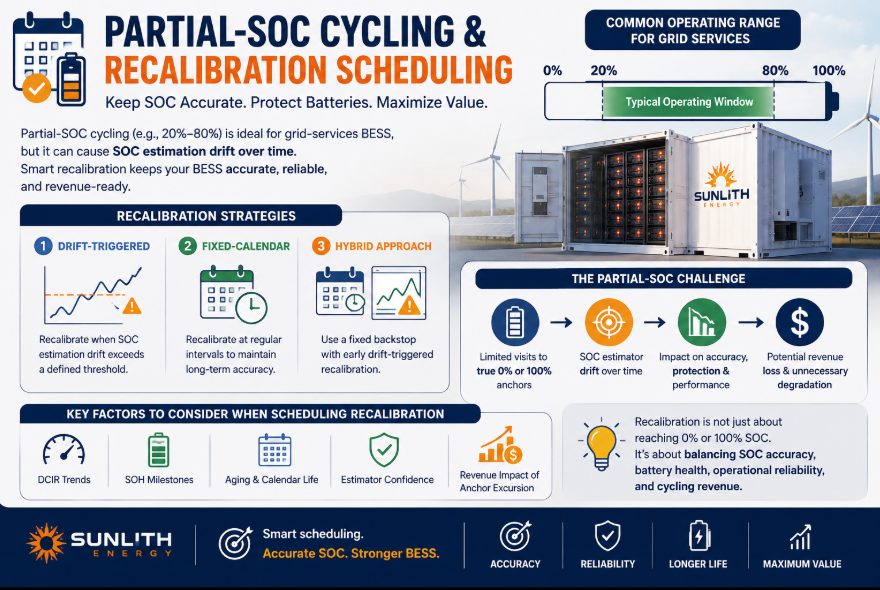


🔋 Partial-SOC cycling protects LFP batteries, but it can also create a hidden SOC estimation challenge.
Grid-services BESS often operate within a 20%–80% SOC range for frequency regulation, peak shaving, and other applications. While this helps avoid deep discharge, the system may rarely reach the true SOC anchor points needed to correct Coulomb-counting drift.
So, how should operators schedule recalibration?
Three practical approaches:
🔹 Drift-triggered: Recalibrate when estimator divergence reaches a defined threshold.
🔹 Fixed-calendar: Schedule recalibration at regular intervals.
🔹 Hybrid: Combine a fixed backstop with early drift-triggered recalibration.The best strategy should also consider DCIR, SOH milestones, aging, estimator confidence, and the revenue impact of taking a system through a true SOC anchor excursion.
A good recalibration strategy is not simply about reaching 0% or 100% SOC. It is about balancing SOC accuracy, battery condition, operational reliability, and cycling revenue.
Read the full article:
Partial-SOC Cycling and Recalibration Scheduling for LFP BESS
#BESS #EnergyStorage #BatteryManagementSystem #BMS #LFP #LiFePO4 #SOC #SOCEstimation #BatteryDegradation #GridServices #PeakShaving #BatteryTechnology #RenewableEnergy #SunLithEnergy
![]()