Education

7 Teaching Tools for the Savvy Educator

Gone are the days when educators’ teaching tools consisted of elaborate blackboard designs and overhead projectors. As any savvy educator will tell you, utilizing technology in their teaching methods has gone from being a nice-to-have to an absolute necessity.

Educators who embrace up-to-date teaching tools create a strong and relevant foundation for their student’s educational journey. Changing our mindsets about technology being merely a distraction to students will open up a whole new world of opportunities for enhanced learning.

A New Way of Teaching

As the world changes and evolves, it becomes necessary for educators to adapt their teaching tools in a way that keeps students interested in the material. To some educators, this might mean simply replacing physical worksheets with digital ones. However, to a dedicated educator, the way forward is about finding the right tool in each task, to ensure maximum engagement.

Let’s have a look at a few popular teaching tools that savvy educators are using to facilitate the modern learning experience.

DesignMantic

The DesignMantic website is one of the most popular graphic design platforms. An added advantage of DesignMantic is that it teaches students about the fundamentals of creating effective logos. This is particularly handy for students studying business, marketing or even advertising.

Using a platform that also serves as a logo maker for educators significantly enhances the student’s design skills. Students can learn and practice ways to create logos. This can even help students studying other subjects. In today’s digitally driven world, knowing the fundamentals of web design and logo creation is a skill that will serve them well throughout their lives.

Padlet

A very fundamental way to engage with students is to create brainstorming sessions. Padlet is a virtual whiteboard app that allows educators and students to brainstorm ideas and theories. Students working together on a project or class assignment can easily gather information, submit input, discuss ideas, and even outline the general direction of the project.

Educators can also use the Padlet app to create a “parking lot” where questions and queries relating to the subject matter can be placed to be addressed later.

edPuzzle

As any educator knows, providing students with the material is only the first step. Assessing their understanding is crucial to the success of the lesson. edPuzzle is an app that allows the educator to insert questions into TED videos to assess each student’s comprehension. This is an excellent way to test understanding of National Geographic or YouTube video clips.

Flipboard

For students to understand how their education fits into the real world it’s often necessary to source current news and content articles. Instead of spending hours searching the internet for news or educational articles, the Flipboard app “grabs” the articles that match the required topic.

An educator can select a few topics relevant to the current subject matter and the app will extract articles that match. For instance, an educator teaching a business class could select entrepreneurship as a topic to search for.

Thrively

Educators the world over will agree the way teaching is done these days has changed considerably. One of the most progressive changes is the realization that education should not be a “one size fits all” experience. Students, regardless of age, learn and understand material differently. Embracing this difference enhances the learning experience for each student.

Thrively is a progressive app that enables educators to identify their student’s weaknesses and strengths. This gives the educator more insight into what educational points need to be focused on. Students complete an 80-question multiple-choice assessment which identifies strengths across 23 different areas. The outcome of this particular assessment then provides the direction in which the student’s focus needs to be.

WeVideo

Video-related platforms have become very popular with students because it allows them to view and observe how certain tasks are done. It’s sometimes easier for students to understand an instruction if they can see an actual example as opposed to just reading it.

As an online video editing app, WeVideo is a brilliant tool for video creation. Educators can easily make a video and upload it to the app. Since the app offers free accounts for students, it has become a popular tool for virtual collaboration.

An added advantage of WeVideo is it eliminates the need for many printed notes trying to explain how something should be done. Like a voice note, a video takes a few minutes to create and is more engaging than a written explanation.

Talk and Comment

A positive learning experience is not only about the material that is presented, but how it’s presented. With high volumes of students, it may not always be possible for an educator to give concise, written feedback to each learner. Talk and Comment is an interactive app that allows educators to leave voice notes on any of the students’ digital work.

Since it’s easier to record a spoken comment than it is to type a long list of points to focus on, this app improves educator-student exchange tenfold! It also speeds up the feedback process. For instance, an educator grading an essay submitted on Google docs will easily be able to record a voice note, highlighting changes needed or new focal points.

A Final Thought

To be a relevant educator, you need to embrace the many teaching tools available. Not only do the right tools keep educators connected to students, but it also allows them to provide the best education possible. It’s every educator’s dream to provide a type of education that adds value to their student’s lives. By using the right tools, this can easily be achieved!

Gas Turbine Types: Overview of Types and Profitable Applications

The four major types of gas turbine engines are discussed here. In the aviation sector, the most common propulsion technology is the aircraft turbine engine. There are different varieties of turbine engines, each with its own unique set of maintenance and overhaul requirements. As a result, choosing the correct business to do repairs and maintenance on your aircraft turbine engine is critical. Keep in mind that such a wide range of gas turbine designs can only be found in aircraft gas turbines. The configuration of gas turbines used in power plants is similar to that of turbojet engines, which will be addressed later.

Turbojet Engines

Turbojet engines were the first form of the gas turbines. Even though they don’t seem like reciprocating engines, they work on the same principle: intake, compression, power, and exhaust. Air is pushed at a rapid rate to the fuel inlet and ignitor of the combustion chamber in this type of engine. By expanding air, the turbine causes faster exhaust gases.

Turboprop Engines

A turboprop engine is the second type of gas turbine. It is a turbojet engine with a propeller coupled via a gear system. The operation of a gas turbine of this sort is as follows:

  • A shaft connected to a transmission gearbox spins while the turbojet spins.
  • A transmission box slows the spinning process, and the transmission mechanism is coupled to the slowest moving gear.
  • The air propeller spins, creating thrust.

Turbofan Engines

Turbofan engines are combined with the world’s top turbojets and turboprops. A duct fan can link a turbofan engine to the front of a turbojet engine. The fan then provides an extra push, which aids in cooling and decreases engine noise.

Turboshaft Engines

Turboshaft engines, the fourth gas turbine type, are mostly employed in helicopters. The most significant distinction is that turboshaft engines use the majority of their power to spin turbines rather than propel them out the back. A turbojet engine with a big shaft attached to the back is known as a turboshaft engine.

Components of a Gas Turbine Engine

Propulsive thrust can be generated using a gas turbine engine. In the case of a pure jet engine, this can power a generator, pump, or propeller while also creating thrust through the nozzle. While the gas turbine engine is a basic system, due to the high operating temperatures and strains, components for a powerful machine must be carefully constructed and produced from expensive materials. As a result, gas turbine engines are often limited to big units where they are cost-effective. A compressor (takes in and compresses the air), combustor (applies fuel to the air and ignites it), turbine (converts high-speed gas energy into rotary power through expansion), gearbox and shaft (provides rotary power to the driven devices), and exhaust nozzle are the main components of a gas turbine (runs out of the turbine part the low emissions of spent gas).

Gas turbine gearboxes are widely used in today’s gas turbine designs. Based on the turbine’s rotational speed and power output, this component is responsible for effectively delivering the turbine’s produced power to the moving parts. However, recent versions use direct drive, which means there is no gearbox inside the gas turbine engine and the turbine rotational power is sent directly to where it is needed.

Gas turbine control system

The gas turbine control system monitors and safeguards the gas turbines. With integrated control system solutions, you may get superior performance for a connected plant. It scales and adapts to changing requirements in thermal and renewable power generation, oil and gas, and safety applications with ease. IS200VCMIH1B and IS200VCRCH1B are some examples of GE control system parts.

Etiquette

Etiquette

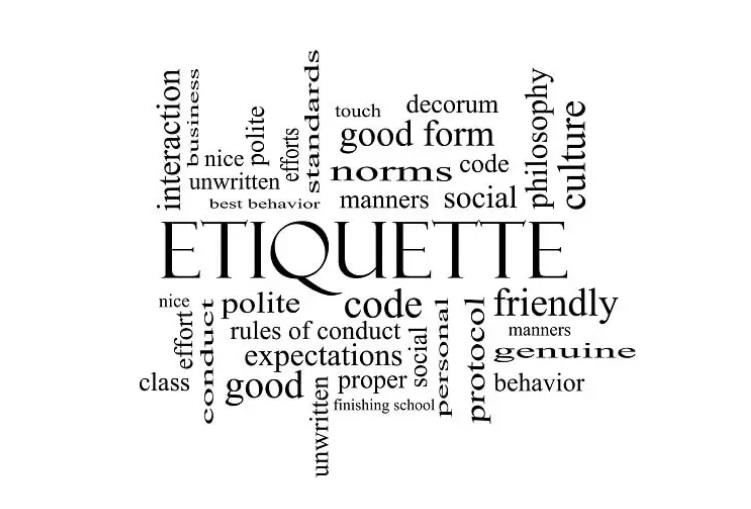
Etiquette is the set of conventional rules of personal behavior in polite society.
Usually in the form of an ethical code that delineates the expected and accepted social behaviors that accord with the conventions and norms observed by a society, a social class, or a social group.

You can say “Etiquette” is merely a set of guidelines for politeness and good manners, the kindnesses with which we should always treat each other. It will always matter! Etiquette, the complex network of rules that govern good behavior and our social and business interactions, is always evolving and changing as society changes.

The word “Etiquette” comes from the French word “etiqueta”


The French word “etiqueta” means “ticket” or “label attached to something for identification.”.

In 16th-century Spain, the French word was borrowed (and altered to “etiqueta”). To refer to the written protocols describing orders of precedence and behavior demanded of those who appeared at court.
Eventually, “etiqueta” came to be applied to the court ceremonies themselves as well as the documents which outlined the requirements for them. Interestingly, this then led to French speakers of the time attributing the second sense of “proper behavior” to their étiquette,
And in the middle of the 18th century English speakers finally adopted both the words

The Ancient Egyptian vizier Ptahhotep wrote The Maxims of Ptahhotep (2375–2350 BC).
A didactic book of precepts extolling civil virtues, such as truthfulness, self-control, and kindness towards other people.
Recurrent thematic motifs in the maxims include learning by listening to other people. Being mindful of the imperfection of human knowledge, and avoiding open conflict, whenever possible, should not be considered a weakness.

That the pursuit of justice should be foremost.
Yet acknowledged that, in human affairs, the command of a god ultimately prevails in all matters; thus some of Ptahhotep’s maxims indicate a person’s correct behaviors in the presence of great personages (political, military, religious). Instructions on how to choose the right master and how to serve him.

Moreover, other maxims teach the correct way to be a leader through openness and kindness. That greed is the base of all evil and should be guarded against. And that generosity towards family and friends is praiseworthy.

Confucius (551–479 BC) was a Chinese intellectual and philosopher.
Whose works emphasized personal and governmental morality. The correctness of social relationships, the pursuit of justice in personal dealings, and sincerity in all personal relations.

Baldassare Castiglione (1478–1529), count of Casatico, was an Italian courtier and diplomat, soldier, and author of The Book of the Courtier (1528).
An exemplar courtesy book dealing with questions of the etiquette and morality of the courtier during the Italian Renaissance.

Louis XIV (1638–1715), King of France.
Used a codified etiquette to tame the French nobility and assert his supremacy as the absolute monarch of France.
In consequence, the ceremonious royal court favorably impressed foreign dignitaries whom the king received at the seat of the French government, the Palace of Versailles, to the southwest of Paris.

Etiquette reflects our cultural norms, generally accepted ethical codes, and the rules of various groups we belong to. It helps us show respect and consideration to others and makes others glad that we are with them.

Without etiquette, members of society would show far too much impatience and disrespect for one another. Which would lead to insults, dishonesty, cheating, road rage, fistfights, and a rash of other unfortunate incidents