

⚡ Frequency Restoration Reserve (FRR): The Next Step in Grid Balancing
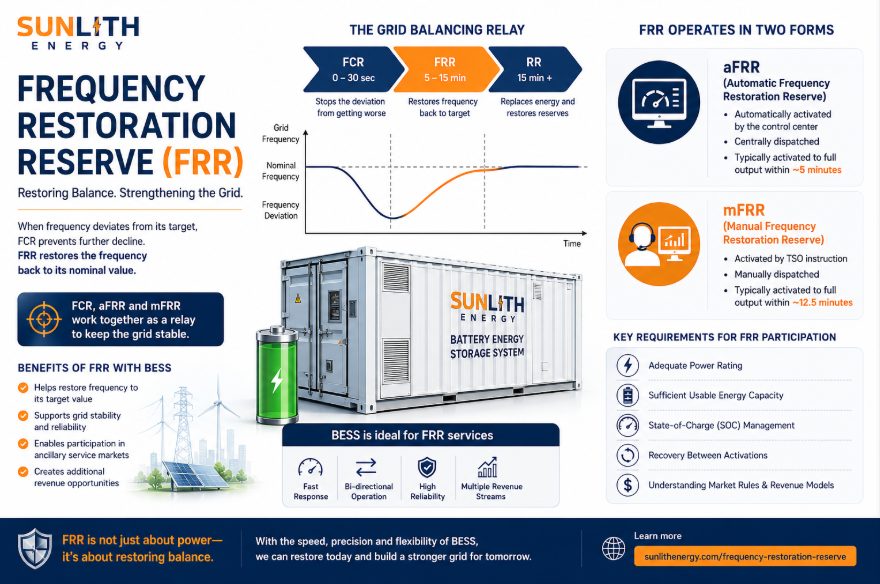
When grid frequency moves away from its target, the first response is to stop the deviation from getting worse. However, the system still needs to restore frequency back to its nominal value.
That is where Frequency Restoration Reserve (FRR) comes in.
FRR operates in two forms:
🔹 aFRR (Automatic Frequency Restoration Reserve) — centrally dispatched and typically activated to full output within about 5 minutes.
🔹 mFRR (Manual Frequency Restoration Reserve) — activated by TSO instruction and typically reaches full output within about 12.5 minutes.
For Battery Energy Storage Systems (BESS), FRR creates an important opportunity. BESS can respond quickly, operate in both charging and discharging modes, and support grid balancing while potentially participating in multiple ancillary-service revenue streams.
But power alone is not enough. Effective FRR participation requires careful consideration of:
⚙️ Power rating
🔋 Usable energy capacity
📊 State-of-charge management
🔄 Recovery between activations
💰 Capacity and energy market structuresFCR, aFRR, and mFRR work as a coordinated relay to keep the grid stable.
Read the full guide:
#BESS #EnergyStorage #FrequencyRestorationReserve #FRR #aFRR #mFRR #GridStability #AncillaryServices #BatteryEnergyStorage #RenewableEnergy #SmartGrid
![]()