

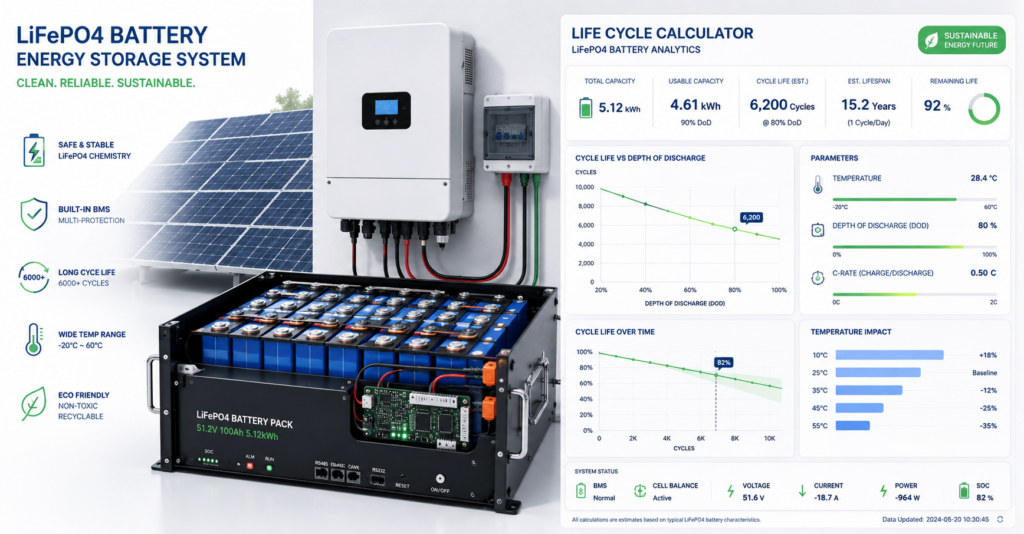
An LFP Battery Life Cycle Calculator helps estimate how long a Lithium Iron Phosphate battery will last under real-world conditions. While manufacturers often advertise 4,000 to 8,000 cycles, actual battery life depends on temperature, depth of discharge, and charging rates. Therefore, using an LFP Battery Life Cycle Calculator provides a more realistic lifespan estimate than relying on datasheet values alone.
Whether you use a battery for solar energy storage, backup power, or a Battery Energy Storage System (BESS), understanding battery degradation can help reduce costs and improve performance.
Advanced LFP Battery Life Cycle Calculator
Adjust temperature, Depth of Discharge (DoD), and charge/discharge currents to see how they impact your battery’s lifespan relative to its datasheet rating.
Estimated Operational Lifetime
Fill in the fields and click calculate to view the breakdown.
What Is an LFP Battery Life Cycle Calculator?
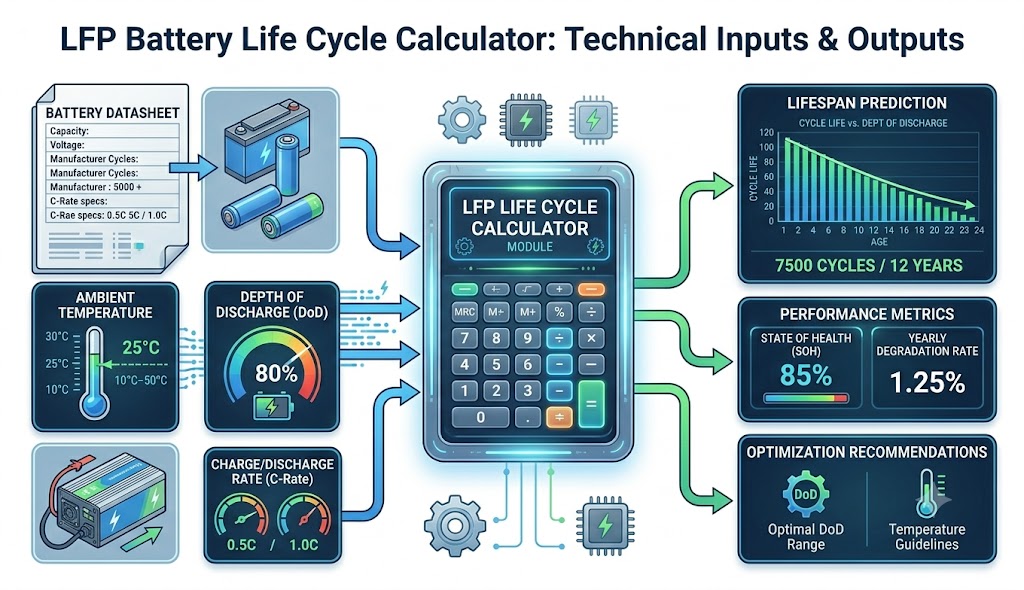
An LFP Battery Life Cycle Calculator is a tool that estimates battery lifespan based on actual operating conditions.
Most battery manufacturers publish cycle-life ratings using laboratory testing. However, batteries rarely operate under perfect conditions in the real world.
For example, batteries may experience:
- High summer temperatures
- Cold winter weather
- Deep daily discharges
- Fast charging sessions
- Heavy load demands
As a result, actual battery lifespan can be very different from the advertised cycle count.
An LFP Battery Life Cycle Calculator accounts for these factors and provides a more accurate prediction.
Why Use an LFP Battery Life Cycle Calculator?
Many battery owners assume their battery will achieve the cycle life shown on the datasheet.
However, several operating conditions can shorten battery lifespan.
Therefore, estimating real-world performance is important before investing in a battery system.
An LFP Battery Life Cycle Calculator can help you:
- Estimate battery lifespan
- Compare operating scenarios
- Improve battery maintenance
- Reduce replacement costs
- Optimize charging behavior
Consequently, users can make better energy storage decisions.
How Temperature Affects LFP Battery Life Cycle Calculator Results
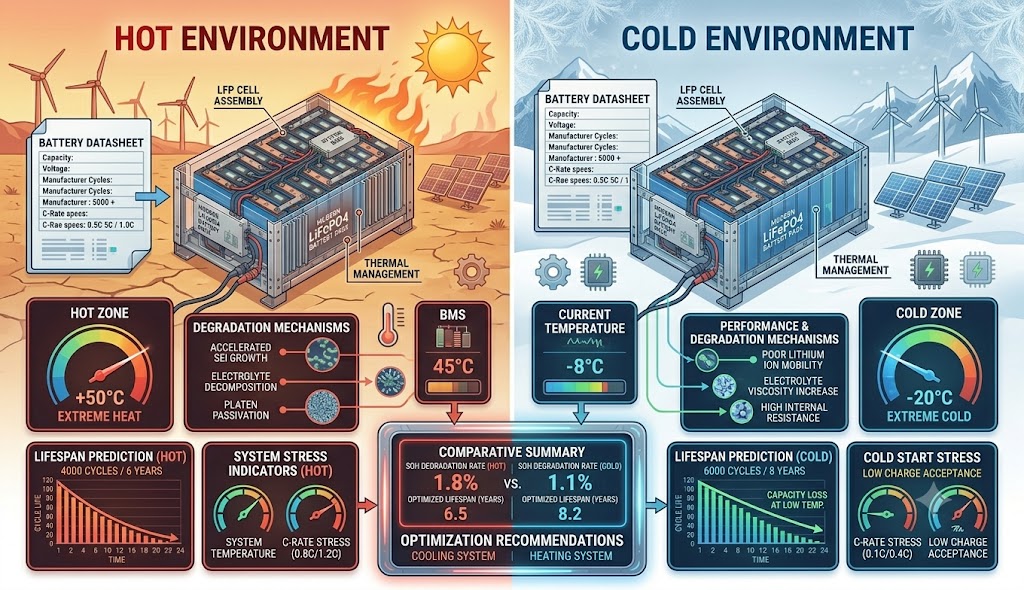
Temperature is one of the most important factors affecting battery health.
When temperatures rise, chemical reactions inside the battery accelerate. As a result, battery aging occurs faster.
High Temperatures Reduce Battery Life
Batteries operating above 35°C often experience faster degradation.
In addition, excessive heat increases:
- Internal resistance
- Capacity fade
- Energy losses
Therefore, cooling systems are commonly used in commercial battery projects.
For example, modern Battery Energy Storage Systems use thermal management systems to maintain safe operating temperatures. Learn more about the engineering differences in our guide to Liquid vs Air Cooling System Use in BESS
Cold Temperatures Can Also Cause Damage
Cold weather creates different challenges.
When charging occurs below 10°C, lithium plating can develop inside the cell.
Consequently, battery capacity may decline more quickly.
Therefore, maintaining moderate temperatures is essential for maximizing lifespan.
How Depth of Discharge Affects LFP Battery Life Cycle Calculator Results
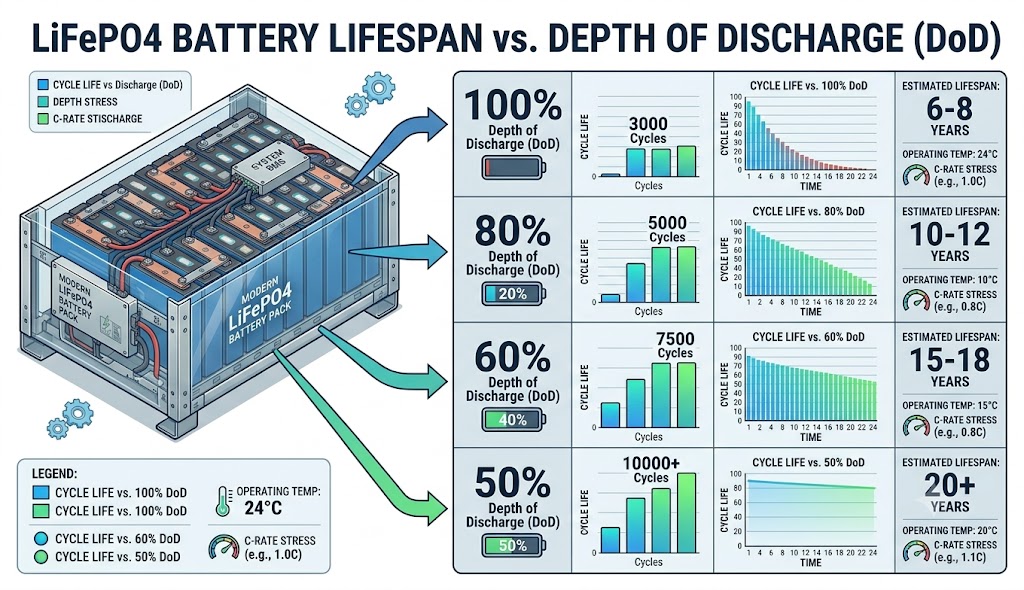
Depth of Discharge (DoD) measures how much battery capacity is used during each cycle.
For example:
- 100% DoD = Full discharge
- 80% DoD = Partial discharge
- 50% DoD = Shallow discharge
Generally, deeper cycles create more stress on battery materials.
As a result, batteries cycled at 100% DoD usually have shorter lifespans.
By comparison, batteries cycled at 80% DoD often achieve significantly more cycles.
Therefore, many energy storage operators limit discharge depth to extend battery life.
How C-Rate Affects LFP Battery Life Cycle Calculator Results
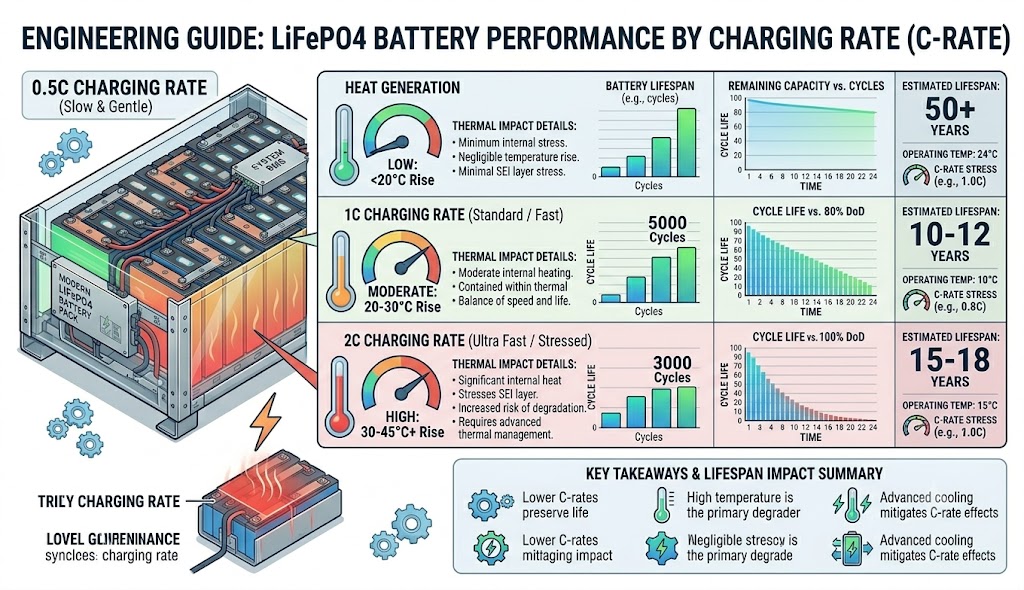
C-rate describes how quickly a battery charges or discharges.
For example:
- 0.5C = Two-hour charge
- 1C = One-hour charge
- 2C = Thirty-minute charge
Higher C-rates increase heat generation inside the battery.
Consequently, battery degradation accelerates over time.
Although LFP batteries are known for durability, excessive charging currents still reduce lifespan. Therefore, moderate charging rates are usually recommended to preserve your system’s State of Health. For a complete deep-dive on how current affects system performance and pricing, see our comprehensive guide on BESS C-Rate Explained.
How Our LFP Battery Life Cycle Calculator Works
Our LFP Battery Life Cycle Calculator combines several battery aging factors into a single estimate.
The calculator considers:
- Rated cycle life
- Operating temperature
- Depth of discharge
- Charge rate
- Discharge rate
Users simply enter their battery specifications and operating conditions.
The calculator then estimates:
- Expected cycle life
- Remaining battery lifespan
- Capacity retention trends
As a result, users gain a clearer picture of long-term battery performance.
LFP Battery Life Cycle Calculator Examples
Consider two identical LFP batteries.
Example 1
Operating conditions:
- Temperature: 25°C
- DoD: 80%
- Charge Rate: 0.5C
Expected lifespan:
- Close to manufacturer rating
Example 2
Operating conditions:
- Temperature: 40°C
- DoD: 100%
- Charge Rate: 2C
Expected lifespan:
- Significantly lower than manufacturer rating
Therefore, operating conditions have a major impact on battery longevity.
How to Increase LFP Battery Lifespan
Fortunately, there are several ways to improve battery life.
Keep Batteries Cool
Whenever possible, keep battery temperatures below 35°C.
Avoid Deep Daily Discharges
Operating between 20% and 80% state of charge often improves lifespan.
Limit Fast Charging
Although fast charging is convenient, moderate charging rates generally reduce battery stress.
Choose High-Quality Battery Systems
Battery quality plays a major role in long-term performance.
Therefore, selecting premium cells and professionally engineered systems is vital for maximizing ROI. If you are designing a commercial project, explore advanced containerized battery storage solutions built specifically for long-term real-world durability.
FAQs About LFP Battery Life Cycle Calculator
What is an LFP Battery Life Cycle Calculator?
An LFP Battery Life Cycle Calculator estimates battery lifespan based on operating conditions such as temperature, depth of discharge, and charging rate.
What is an LFP Battery Life Cycle Calculator?
An LFP Battery Life Cycle Calculator estimates battery lifespan based on operating conditions such as temperature, depth of discharge, and charging rate.
How many cycles does an LFP battery last?
Most LFP batteries last between 4,000 and 8,000 cycles under standard testing conditions.
Does temperature affect battery lifespan?
Yes. High temperatures accelerate battery aging, while very low temperatures can increase charging-related damage.
Does fast charging reduce battery life?
Yes. Higher charging currents create additional heat and stress, which can shorten battery lifespan over time.
Are LFP batteries good for solar storage?
Yes. LFP batteries offer long cycle life, excellent safety, and high reliability for solar energy storage systems.
Conclusion: Use an LFP Battery Life Cycle Calculator Before You Buy
An LFP Battery Life Cycle Calculator provides a realistic estimate of battery lifespan based on actual operating conditions.
Temperature, depth of discharge, and charging rates all affect battery performance. Therefore, understanding these factors can help you maximize battery value and reduce replacement costs.
Before choosing a battery system, use the LFP Battery Life Cycle Calculator to compare different operating scenarios and make smarter energy storage decisions. For more technical guides, product updates, and clean energy insights, keep up with the latest articles on the SunLith Energy Blog


