
Branding

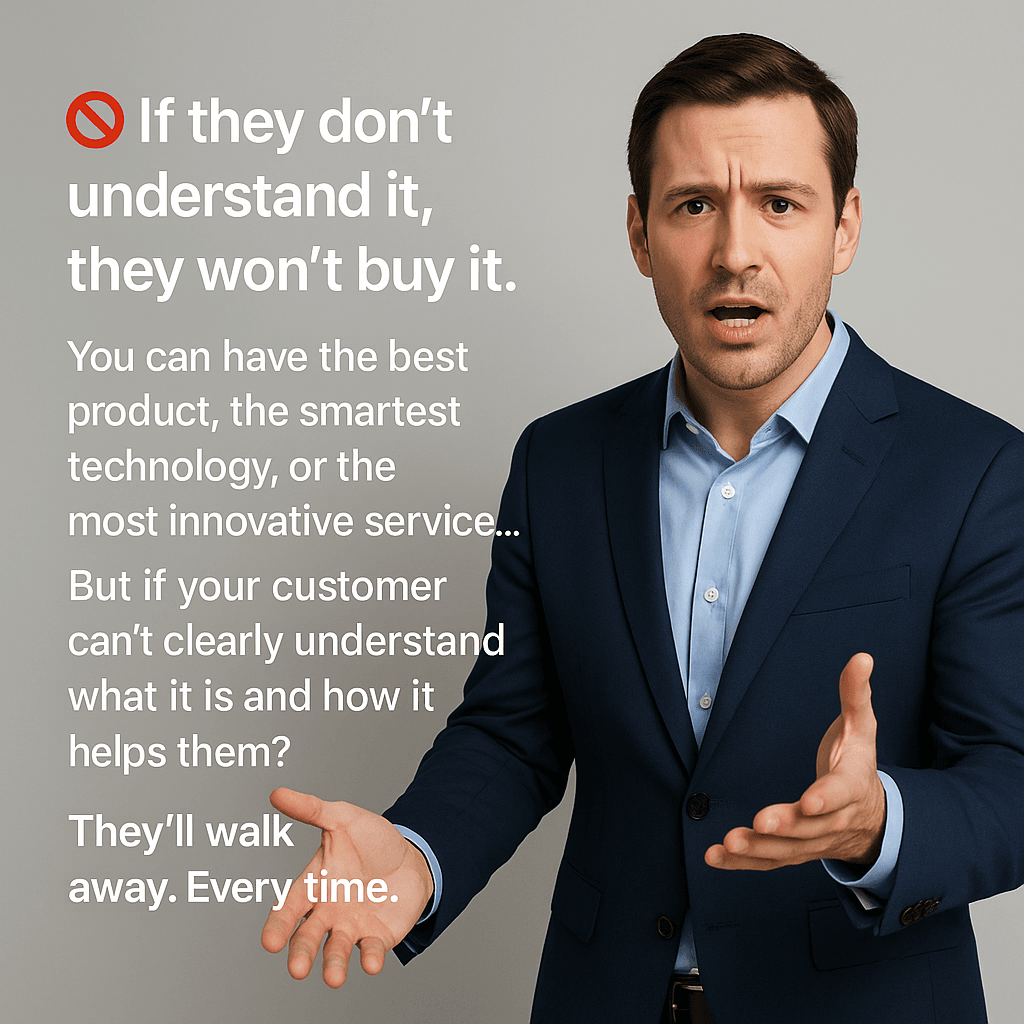
🧠 People Don’t Buy What They Don’t Understand – Here’s Why It’s Costing You Sales

People Don’t Buy What They Don’t Understand

Don’t Buy What They Don’t Understand: Have you ever poured your heart into an amazing product or service, only to hear crickets when it comes time to close the sale? You’re not alone. One of the biggest mistakes businesses and professionals make is assuming that value speaks for itself.

It doesn’t.

In reality, people don’t buy what they don’t understand. No matter how good your product is, if your customer can’t clearly grasp what it is, how it helps them, or why they need it—they won’t buy it.

Let’s break this down.


đŸš« Confusion Kills Conversion

Imagine walking into a high-end electronics store and seeing a futuristic device with glowing buttons, blinking lights, and a name like “XTR Quantum-7 System.” No explanation. No context.

Would you buy it?

Of course not. Because you don’t understand what it is.

This is exactly what happens when businesses bombard customers with technical jargon, vague language, or overly complex pitches.

Real Talk:

People won’t spend their money on something that makes them feel stupid. If your customer feels confused, they walk away. Every time.


đŸ§© Clarity = Confidence = Conversion

When a potential buyer understands what you offer and how it solves their problem, a few magical things happen:

  • ✅ They feel confident in their buying decision.
  • ✅ They feel safe because they “get it.”
  • ✅ They feel smarter, not overwhelmed.
  • ✅ They begin to trust your brand.

Clarity is not optional. It’s the foundation of trust and the fuel for conversion.


đŸ’„ The Power of a Simple Message

Let’s take a look at some winning examples:

  • Apple doesn’t say, “256GB flash storage, A17 Bionic chip with 16-core Neural Engine.”
    Instead, they say: “The world’s most powerful smartphone.”
  • Dropbox doesn’t say, “Cloud-based file synchronization and storage platform.”
    They say: “Your stuff, anywhere.”

Simplicity wins. Every time.


đŸ› ïž How to Make Your Message Clearer

Here’s a practical checklist to simplify your offer:

1. Use Simple, Everyday Language

Don’t say “sustainable lithium-ion energy storage solutions.”
Say “batteries that save energy and lower your electricity bills.”

2. Focus on Benefits, Not Features

Customers don’t care that your product has “military-grade aluminum.”
They care that “it’s tough enough to last a lifetime.”

3. Show, Don’t Just Tell

Use visuals, analogies, or quick videos. Demonstrations break down barriers and turn confusion into clarity.

4. Answer the “So What?” Question

For every feature or offer, ask yourself:
“So what? Why should they care?”


🧠 The Psychology Behind It

People make buying decisions based on emotion, not logic. But they justify those decisions with logic.

If you fail to help them understand what you do, their brain throws up a red flag:

“This might be a scam.”

“This feels risky.”

“I don’t get it
 I’ll think about it.”

Translation: No sale.

But when your message is clear, you help their brain say:

✅ “I get it.”
✅ “I see how this helps me.”
✅ “Let’s go for it.”


🔁 Confused Minds Don’t Convert

This quote by Donald Miller (author of Building a StoryBrand) says it best:

“If you confuse, you’ll lose.”

Your job isn’t to sound smart.
Your job is to make your customer feel smart for choosing you.


🔍 SEO and Clarity Go Hand in Hand

Clarity isn’t just for humans—Google loves it too.

When your messaging is simple, focused, and uses keywords your audience actually searches for, your content ranks better. That means more traffic and higher conversions.

🧠 Pro Tip: Use clear headlines, bullet points, and short paragraphs to help both your reader and the search engines understand your value.


🔄 Simplify to Multiply

Want to multiply your sales, impact, and brand recognition?
Start by simplifying your message.

  • Ditch the jargon.
  • Talk like a human.
  • Make your customer feel smart.
  • Solve one clear problem.

Because in the end, people don’t buy what they don’t understand. But when they do understand—they buy, they refer, and they come back.


đŸ—Łïž Final Thought

You might have the best solution in the world, but if you don’t express it in a way your audience understands, it will never reach its full potential.

So the next time you present your product, pitch your idea, or write your website copy, ask yourself:

“Would my customer understand this instantly?”

If not—rewrite it. Simplify it. Clarify it.

Because clarity doesn’t just lead to understanding.
Clarity sells.

8 Tips to Construct A Personal Brand!

Good personal branding is an important strategy to make you stand out from competitors. Personal branding is done to market your skills to the world. It can be done for an individual. Personal branding helps in communicating the values of an individual to its clients. It helps create a unique identity and represents the value an individual, a company, or a brand has to offer. The consumer often goes for an individual who stands out from the crowd. Personal branding can be done by yourself or with the help of Branding Firms in Delhi.

Tips to construct a personal brand

1) Discovering your brand
Personal branding is no different from regular branding. The first thing in personal branding is knowing why you want to create a personal brand. Discovering your brand is all about knowing your target audience in detail. Choosing a niche helps a lot. You can design your branding, such as a logo. Remember that people will know you through your logo, pictures, videos, or work sample.

2) Setting objectives
Having a set of objectives helps you determine definite goals for your branding. Objectives help you reflect on your skills and also tell the audience the objectives you want to achieve in the future. Assessment enables you to understand your weaknesses and strengths. Branding Firms in Delhi help individuals create their brands.

3) Know your target audience
Knowing your target audience helps you a great deal in creating an excellent personal brand. Audiences differ from each other in many ways. Some will like your branding, and some will dislike it. So you need to track your audience and plan your branding as their requirements.

4) Creating a framework
After the above tips, you should work on your brand framework. The brand framework depends on the target audience, and you need to be precise in choosing what story you want to tell your audience about your brand. You need to describe the skills you have to the audience and how these skills can help them. There are online PR services that help create a personal brand.

5) Ensure that your brand is visible
If your brand is not visible to the audience, your efforts to create a personal brand will fail. Having a website and social media profiles create your brand’s credibility. Optimizing your website and social media profiles helps make your brand visible to the audience. Digital marketing agencies can also help you manage your website and social media profiles to make them visible to the audience.

6) Research and apply
Before creating your brand framework, you should thoroughly research personal brands and how they are managed. After studying and incorporating them into your brand framework, you can choose the good parts of a personal brand. Do not copycat personal brands. It would help if you focused more on creating your style. This you can do by creating your brand with a touch of personalization.

7) Do offline personal branding as well.
It would help if you did not rely on online personal branding. You can also create your brand offline. Do face-to-face interactions such as in informal gatherings, seminars, or events. Offline, personal branding should tell your brand’s story, such as what you do, who you are, what your strengths are, and your future goals. It would help if you kept your interaction concise and interesting to the listener. You can do that by focusing on key points and skills.

8) Get endorsements
Reviews from colleagues, relatives, and friends about your knowledge, hard work, and skills will help your brand look credible to the audience. You can use your former client’s reviews and include the projects you have worked on for them. It will create the trustworthiness of your brand image.

Conclusion
The present digital world scenario requires everyone to have a personal brand strategy in place. Personal branding helps you to be on top of new trends and helps you in advancing in your career. You can follow the tips mentioned above for creating a personal brand. These tips will help you achieve your goals and keep you up to date. Many online PR services can help you create your brand.