
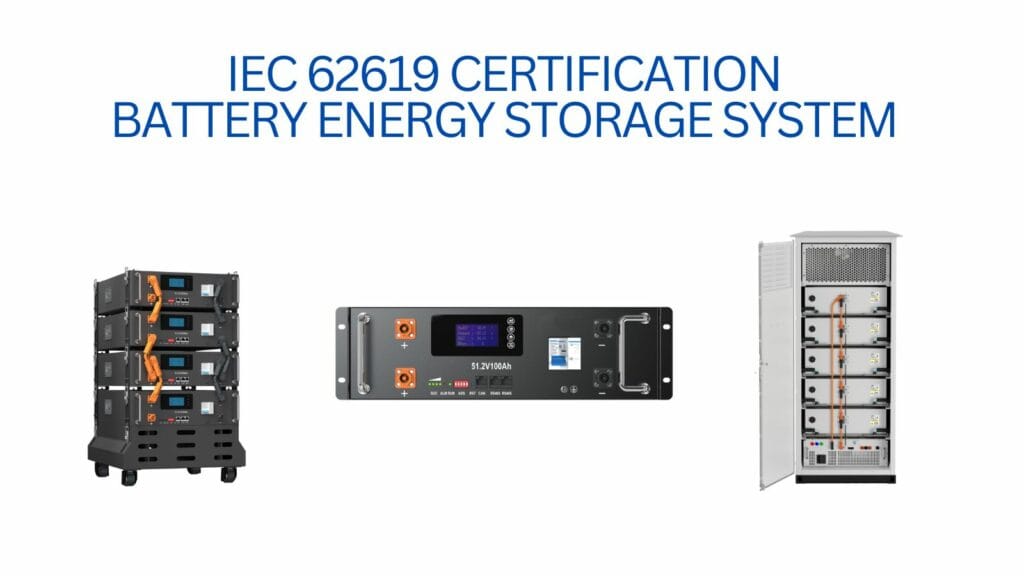
Worried about the safety of your battery energy storage system? Discover why IEC 62619 certification is critical for protecting your investment, your people, and your peace of mind.
Imagine Losing Everything in Seconds
Think about it.
You buy a beautiful energy storage battery for your home or business.
You believe it’s safe.
But one night, without warning, it overheats.
It starts a fire.
You lose your home. Your business. Maybe even lives are at risk.
All because of one missing thing: a proper safety certification.
This is not a horror story—it’s a real risk many people unknowingly face when they buy uncertified batteries.
In this post, I’ll show you why IEC 62619 Certification is not just another boring standard.
It’s the single most important thing you should look for before buying or installing any battery system.
What Is IEC 62619 Certification?
IEC 62619 is an international safety standard created by the International Electrotechnical Commission (IEC).
It’s designed specifically for rechargeable lithium batteries used in industrial and stationary energy storage applications.
In simple words:
If you are using a battery for solar energy storage, UPS systems, backup power, or commercial energy storage—IEC 62619 should be non-negotiable.
This certification means the entire battery system (not just individual cells) has been:
✅ Stress-tested
✅ Abuse-tested
✅ Verified to shut down safely under failure conditions
The tests check if the battery can survive real-world problems like short circuits, overheating, crushing forces, and even fire exposure.
Why Is IEC 62619 Certification So Important?
Here’s why you should never ignore it:
1. Your Family’s Safety Depends on It
Energy storage batteries are powerful.
Without proper protections, they can catch fire, explode, or leak dangerous chemicals.
IEC 62619 ensures that:
- If the battery gets too hot, it shuts down safely.
- If there’s a short circuit, it won’t explode.
- If it’s damaged or overcharged, it won’t cause a disaster.
Would you really risk your family’s life just to save a little money on an uncertified battery?
Of course not.
2. You Deserve Peace of Mind
You worked hard to install clean energy or backup power solutions.
You deserve to sleep peacefully at night—not stay awake worrying if your battery is a ticking time bomb.
When you choose an IEC 62619-certified system, you’re choosing peace of mind.
You’re telling yourself:
“I did everything I could to protect my people and property.”
3. Protect Your Business Reputation
If you install or sell uncertified batteries and something goes wrong, your reputation could be ruined overnight.
One bad fire, one lawsuit, one insurance denial—and years of hard work can be destroyed.
An IEC 62619 certification shows your customers and partners that you take safety seriously.
That you are professional and responsible.
It’s not just a certificate.
It’s a trust badge.
4. Avoid Legal Trouble and Insurance Headaches
In many countries, insurance companies require proof that your energy storage system meets proper safety standards.
IEC 62619 is often one of those standards.
Without it:
- Your insurance claims could be rejected.
- You might face penalties or shutdowns during inspections.
- You could even face lawsuits if an accident happens.
Would you risk everything you built just to save a few dollars?
What Exactly Does IEC 62619 Test?
IEC 62619 is not an easy certificate to get.
The battery must pass a brutal list of tests that simulate real-life disasters, including:
- Overcharge Tests: Checks if the battery can survive being charged too much.
- Short Circuit Tests: Simulates internal shorts without causing explosions.
- Crush Tests: Sees if the battery stays safe even when physically crushed.
- Thermal Abuse Tests: Exposes batteries to extreme heat.
- Fire Exposure Tests: Sees how the battery reacts if caught in a fire.
- External Force Tests: Tests against impacts, drops, and mechanical shocks.
- BMS Functionality Tests: Verifies the Battery Management System’s response to faults.
The battery is tortured in ways that it would never face in normal use—to make sure that even in a worst-case scenario, it protects you.
Why Cell Certificates Alone Are Not Enough
Some battery suppliers try to fool customers by showing cell-level certificates like IEC 62133 or UL 1642.
While those are important, they only prove that individual battery cells are safe.
But your energy storage system is much more complex than just cells!
It includes:
- A Battery Management System (BMS)
- Electrical circuits
- Enclosures
- Cooling systems
- Safety control software
If the entire system isn’t tested, you have no guarantee that it’s safe.
IEC 62619 tests the complete battery pack—not just the cells.
That’s the real protection you need.
Real-Life Disasters That Could Have Been Prevented
Let’s be real—battery fires happen.
They make headlines almost every month.
- ???? Fires in energy storage farms
- ???? Explosions in battery-powered forklifts
- ???? Home battery systems overheating and causing property damage
In many of these cases, investigations showed that proper safety certification was missing.
Would you really want to end up in a newspaper headline like that?
Common Myths About IEC 62619 (Busted!)
“It’s Just a Piece of Paper.”
Wrong.
IEC 62619 involves actual laboratory tests by accredited third parties. It’s proof that your battery has been battle-tested against disaster scenarios.
“It’s Too Expensive to Get Certified Batteries.”
Wrong again.
Yes, certified batteries might cost 5–10% more. But compare that to the cost of:
- Fire damage
- Legal claims
- Loss of business reputation
- Insurance losses
Certification is cheap insurance for your future.
“I Only Need It for Big Projects.”
No.
Whether your battery is 5 kWh for home backup or 2 MWh for commercial use—safety doesn’t care about size.
Every battery that stores significant energy should meet IEC 62619.
How to Verify a Real IEC 62619 Certificate
Because it’s so important, some suppliers might fake certificates.
Here’s how to check:
✅ Ask for a copy of the full IEC 62619 test report—not just the certificate page.
✅ Make sure the testing lab is recognized (like TUV, SGS, UL, Intertek).
✅ Check that the report includes the full battery pack model number, not just cells.
If they refuse or give vague answers? Walk away.
What Happens If You Skip IEC 62619?
Here’s the brutal truth:
- Your insurance may be voided.
- You might face regulatory penalties.
- Your project may fail inspections.
- You may cause fires, explosions, or injuries.
- Your reputation and business could collapse.
All for trying to save a little bit of money.
My Personal Advice to You
As someone deeply involved in energy storage consulting and sourcing, I have seen what happens when companies ignore safety standards.
It’s heartbreaking.
It’s unnecessary.
And it’s avoidable.
If you are buying, selling, or installing a Battery Energy Storage System, always demand IEC 62619 certification.
Not just for legal reasons—but for your own safety, and the safety of everyone around you.
You deserve better.
Your family deserves better.
Your customers deserve better.
Conclusion: Don’t Gamble With Safety
In the world of energy storage, you can choose safety or choose regret.
IEC 62619 is not an optional extra.
It’s the basic foundation of a safe, smart energy future.
Before you buy or install your next battery system, ask one simple question:
“Is it IEC 62619 certified?”
If the answer is yes—you’re making a smart, responsible choice.
If not—run the other way.
Need Help Sourcing Certified Battery Systems?
I help businesses and individuals around the world source genuine IEC 62619-certified batteries from top-quality factories.
✅ I check factories personally.
✅ I verify real certifications.
✅ I protect your time, money, and peace of mind.
Ready to make your energy future safe?
???? Contact me today for trusted sourcing, consulting, and inspections!