

| Quick Answer: What Are Peak Sun Hours? Peak sun hours measure the amount of usable solar energy a location receives during a day. One peak sun hour represents solar radiation equivalent to 1,000 watts per square metre (W/m²). Peak sun hours are different from daylight hours because weather, clouds, atmosphere and sun angle affect actual solar generation. |
Introduction
Peak Sun Hours Australia is one of the most important factors when planning a solar energy system.
Two homes can install the same solar panels, the same inverter and the same battery system, yet produce different amounts of electricity every year.
The reason is simple: location matters.
A solar system installed in Darwin will usually generate more electricity than an identical system installed in Hobart because the two cities receive different levels of solar radiation.
Likewise, Auckland, Wellington, Christchurch and other New Zealand cities have different solar conditions due to their geographical location, climate and seasonal sunlight variation.
Why Peak Sun Hours Matter for Solar Planning
Understanding peak sun hours helps homeowners, installers and businesses make better decisions about:
- Solar panel capacity
- Inverter selection
- Battery storage size
- Expected annual energy generation
- Long-term renewable energy savings
Solar equipment specifications are important, but the available solar resource at a location determines how much electricity the system can actually produce.
Therefore, accurate local peak sun hour data should always be considered before designing a solar energy system.
Australia and New Zealand Solar Potential
Australia and New Zealand are both growing solar energy markets. However, solar production is not equal across all regions.
Northern Australia benefits from some of the strongest solar resources because of higher annual sunlight availability. Cities such as Darwin, Brisbane and Perth generally achieve higher peak sun hours compared with southern locations.
In New Zealand, cities such as Gisborne, Auckland and Tauranga receive favourable solar conditions, while southern areas experience greater seasonal variation.
What This Guide Covers
This guide explains:
- What peak sun hours mean
- How peak sun hours affect solar panel output
- Peak Sun Hours Australia by major cities
- Peak Sun Hours New Zealand by major cities
- How solar resources influence battery storage design
- Where to find worldwide peak sun hour data
By understanding local solar conditions, homeowners and businesses can make better decisions when investing in solar panels and battery energy storage systems.
| Quick Answer: Which Cities Have the Highest Peak Sun Hours in Australia and New Zealand? Among major cities in Australia and New Zealand, Darwin has the highest peak sun hours with approximately 6.0–6.8 hours per day. Brisbane and Perth also receive excellent solar resources. In New Zealand, Auckland generally has the highest peak sun hours among major cities with around 4.3–5.3 hours per day. |
| Rank | City | Country | Peak Sun Hours |
|---|---|---|---|
| 1 | Darwin | Australia | 6.0–6.8 hrs/day |
| 2 | Brisbane | Australia | 5.5–6.5 hrs/day |
| 3 | Perth | Australia | 5.0–6.2 hrs/day |
| 4 | Adelaide | Australia | 4.5–5.8 hrs/day |
| 5 | Sydney | Australia | 4.5–5.5 hrs/day |
| 6 | Auckland | New Zealand | 4.3–5.3 hrs/day |
| 7 | Wellington | New Zealand | 4.0–5.0 hrs/day |
| 8 | Christchurch | New Zealand | 3.8–4.8 hrs/day |
| 9 | Melbourne | Australia | 3.5–4.2 hrs/day |
| 10 | Queenstown / Dunedin | New Zealand | 3.5–4.5 hrs/day |
| 11 | Hobart | Australia | 3.0–4.0 hrs/day |
What Are Peak Sun Hours and How Are They Measured?
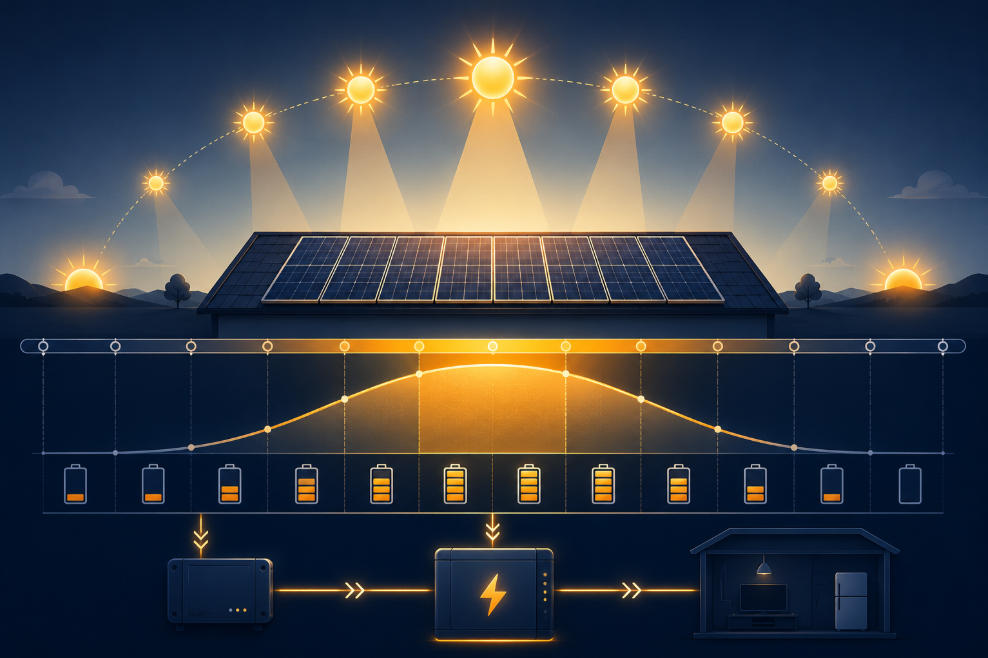
Peak sun hours measure the amount of usable solar energy a location receives during a day. They are one of the most important values used when designing solar photovoltaic (PV) systems because they indicate how much electricity solar panels can realistically generate.
One peak sun hour equals one hour of solar irradiance at 1,000 watts per square metre (1 kW/m²). This standard allows engineers and solar installers to compare different locations using the same benchmark.
Unlike daylight hours, peak sun hours only count the periods when sunlight is strong enough to produce significant electricity. As a result, they provide a far more accurate estimate of solar energy production.
For example, two cities may both receive 12 hours of daylight. However, if one city experiences frequent cloud cover or a lower solar angle, it may only receive 4 peak sun hours, while the other receives 6.5. Consequently, the second city can generate much more electricity from the same solar system.
Quick Example
Imagine two homeowners each install a 6.6 kW rooftop solar system.
| City | Peak Sun Hours | Estimated Daily Energy Production* |
|---|---|---|
| Darwin | 6.5 hrs | ~42.9 kWh/day |
| Hobart | 3.5 hrs | ~23.1 kWh/day |
*Example calculation before system losses. Actual generation depends on panel orientation, shading, inverter efficiency, temperature, and other site-specific factors.
Although both homeowners purchased the same equipment, the Darwin system is expected to generate significantly more electricity because it receives more peak sun hours.
Peak Sun Hours vs Daylight Hours
Many people mistakenly assume that longer days automatically mean more solar power. However, daylight hours and peak sun hours are not the same.
| Factor | Peak Sun Hours | Daylight Hours |
|---|---|---|
| Measures | Usable solar energy | Time between sunrise and sunset |
| Unit | Equivalent hours at 1 kW/m² | Total hours of daylight |
| Used for Solar Design | ✔ Yes | ✘ No |
| Affected by Clouds | ✔ Yes | ✘ No |
| Used to Size Solar Systems | ✔ Yes | ✘ No |
For instance, a winter day may still have several hours of daylight, but weak sunlight and a low sun angle reduce the number of peak sun hours available for electricity generation.
Therefore, solar professionals always use peak sun hours rather than daylight hours when estimating system performance.
How Are Peak Sun Hours Calculated?
Peak sun hours are calculated using daily solar irradiance, which measures the total solar energy received on a square metre of surface over one day.
The standard formula is:
Peak Sun Hours = Daily Solar Irradiance (kWh/m²/day) ÷ 1 kW/m²
Example
If a city receives:
- Daily solar irradiance: 5.8 kWh/m²/day
Then:
Peak Sun Hours = 5.8 hours/day
This value becomes the foundation for estimating solar panel output, selecting inverter capacity, and sizing battery storage systems.
Why Peak Sun Hours Matter
Peak sun hours affect almost every aspect of a solar energy project.
1. Solar Panel Sizing
The number of peak sun hours determines how much electricity a solar array can generate each day.
For example, if your household uses more electricity than your panels can produce based on local peak sun hours, you may need to install a larger PV system.
Therefore, using location-specific data helps avoid undersized or oversized systems.
2. Battery Storage Sizing
Battery systems rely on surplus solar energy for charging.
Locations with fewer peak sun hours may require:
- Larger PV arrays
- Higher charging efficiency
- Careful energy management
- Greater attention to winter performance
Consequently, understanding local solar conditions helps ensure batteries are adequately charged throughout the year.
3. Inverter Selection
The inverter converts the electricity generated by solar panels into usable AC power.
Peak sun hours influence:
- Daily energy production
- Peak power periods
- Export capacity
- Self-consumption rates
Choosing an inverter without considering local solar conditions may limit system performance.
4. Electricity Bill Savings
Homes located in areas with higher peak sun hours generally generate more electricity from the same installed capacity.
As a result, homeowners in regions such as Darwin, Brisbane and Perth often achieve faster returns on investment than those in locations with lower solar resources.
However, solar energy remains financially beneficial in many southern regions when systems are correctly designed.
Factors That Influence Peak Sun Hours
Several environmental conditions affect the number of peak sun hours a location receives.
| Factor | Effect on Solar Production |
|---|---|
| Latitude | Lower latitudes generally receive stronger annual sunlight. |
| Cloud Cover | Frequent clouds reduce usable solar radiation. |
| Seasonal Changes | Winter usually provides fewer peak sun hours than summer. |
| Temperature | High temperatures can reduce panel efficiency, although they do not directly reduce peak sun hours. |
| Air Pollution | Dust, smoke and haze reduce the amount of sunlight reaching solar panels. |
| Panel Orientation | Incorrect tilt or azimuth lowers energy generation even if peak sun hours are high. |
| Shading | Trees, buildings and other obstructions reduce effective solar production. |
Therefore, both local climate and installation quality influence the final energy yield.
Common Misunderstandings About Peak Sun Hours
Many first-time solar buyers confuse several important terms.
Myth 1: More daylight always means more electricity.
Reality: Electricity generation depends on peak sun hours, not simply the length of the day.
Myth 2: Every Australian city receives the same amount of sunlight.
Reality: Peak sun hours vary significantly between regions. Northern Australia generally receives higher values than southern Australia.
Myth 3: The same solar system produces identical results everywhere.
Reality: Local climate, solar resource, and installation conditions all influence energy production.
Myth 4: Solar batteries eliminate the need to consider peak sun hours.
Reality: Batteries store energy—they do not create it. Their performance still depends on how much solar energy is available for charging.
Key Takeaways
✔ Peak sun hours measure usable solar energy, not daylight hours.
✔ One peak sun hour equals 1,000 W/m² of solar irradiance for one hour.
✔ Peak sun hours are essential for sizing solar panels, inverters and battery storage systems.
✔ Local climate, cloud cover, latitude and seasonal changes all affect peak sun hours.
✔ Using accurate city-specific peak sun hour data helps homeowners maximise energy production and improve the long-term return on their solar investment.
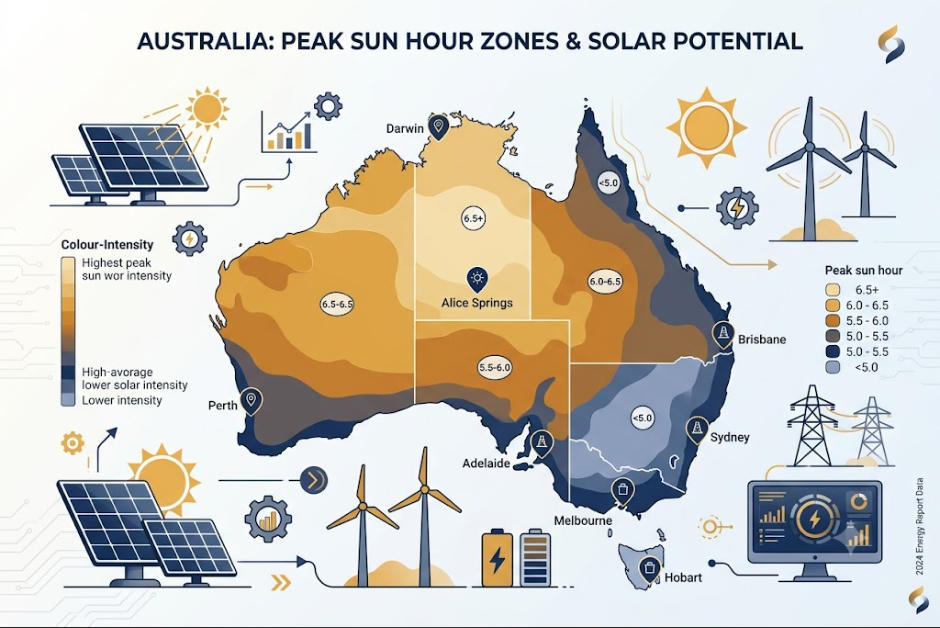
Peak Sun Hours Australia by Major Cities
Australia is one of the best countries in the world for solar energy. However, Peak Sun Hours Australia vary significantly between regions due to latitude, climate, cloud cover, and seasonal weather patterns.
Northern Australia generally receives the highest peak sun hours, making it ideal for residential, commercial, and utility-scale solar installations. Meanwhile, southern states receive fewer peak sun hours but still offer excellent opportunities for solar power when systems are designed correctly.
The table below provides typical average peak sun hours for major Australian cities. These values are useful for preliminary solar system sizing and performance estimation. Actual values may vary depending on the season, panel orientation, shading, and local weather conditions.
Peak Sun Hours by Major Australian Cities
| City | State/Territory | Typical Peak Sun Hours (hrs/day) | Solar Potential |
|---|---|---|---|
| Darwin | Northern Territory | 6.0–6.8 | ★★★★★ Excellent |
| Alice Springs | Northern Territory | 6.0–6.7 | ★★★★★ Excellent |
| Broome | Western Australia | 5.8–6.5 | ★★★★★ Excellent |
| Cairns | Queensland | 5.7–6.3 | ★★★★★ Excellent |
| Townsville | Queensland | 5.7–6.3 | ★★★★★ Excellent |
| Rockhampton | Queensland | 5.6–6.2 | ★★★★★ Excellent |
| Mackay | Queensland | 5.6–6.2 | ★★★★★ Excellent |
| Brisbane | Queensland | 5.5–6.5 | ★★★★★ Excellent |
| Gold Coast | Queensland | 5.3–6.1 | ★★★★☆ Very Good |
| Sunshine Coast | Queensland | 5.3–6.1 | ★★★★☆ Very Good |
| Toowoomba | Queensland | 5.2–6.0 | ★★★★☆ Very Good |
| Perth | Western Australia | 5.0–6.2 | ★★★★★ Excellent |
| Kalgoorlie | Western Australia | 5.2–6.3 | ★★★★★ Excellent |
| Adelaide | South Australia | 4.8–5.8 | ★★★★☆ Very Good |
| Port Augusta | South Australia | 5.0–6.0 | ★★★★★ Excellent |
| Sydney | New South Wales | 4.5–5.5 | ★★★★☆ Very Good |
| Newcastle | New South Wales | 4.5–5.4 | ★★★★☆ Very Good |
| Wollongong | New South Wales | 4.4–5.3 | ★★★★☆ Very Good |
| Canberra | ACT | 4.4–5.2 | ★★★★☆ Very Good |
| Melbourne | Victoria | 3.5–4.2 | ★★★☆☆ Good |
| Geelong | Victoria | 3.6–4.3 | ★★★☆☆ Good |
| Ballarat | Victoria | 3.5–4.2 | ★★★☆☆ Good |
| Bendigo | Victoria | 3.8–4.5 | ★★★☆☆ Good |
| Hobart | Tasmania | 3.0–4.0 | ★★★☆☆ Good |
| Launceston | Tasmania | 3.2–4.1 | ★★★☆☆ Good |
Note: These are typical annual averages for educational and planning purposes. Actual peak sun hours vary with season, weather conditions, panel tilt, orientation, and shading.
Peak Sun Hours Australia by State
The average peak sun hours also vary across Australia’s states and territories.
| State / Territory | Typical Peak Sun Hours | Best Performing Region |
|---|---|---|
| Northern Territory | 6.0–6.8 | Darwin, Alice Springs |
| Queensland | 5.5–6.5 | Cairns, Townsville, Brisbane |
| Western Australia | 5.0–6.3 | Broome, Kalgoorlie, Perth |
| South Australia | 4.8–5.8 | Port Augusta, Adelaide |
| New South Wales | 4.5–5.5 | Sydney, Newcastle |
| Australian Capital Territory | 4.4–5.2 | Canberra |
| Victoria | 3.5–4.5 | Bendigo |
| Tasmania | 3.0–4.1 | Launceston |
Overall, Northern Territory offers the strongest solar resource in Australia, while Tasmania generally records the lowest peak sun hours. Nevertheless, solar systems remain effective across all Australian states when designed using accurate local data.
Darwin vs Hobart: Why the Difference Is So Large
Darwin and Hobart provide an excellent example of why Peak Sun Hours Australia matter.
Although both cities can install the same solar panels, inverter, and battery system, the annual electricity generation can differ substantially.
| Comparison | Darwin | Hobart |
|---|---|---|
| Peak Sun Hours | 6.0–6.8 | 3.0–4.0 |
| Solar Resource | Excellent | Good |
| Seasonal Variation | Low | High |
| Winter Performance | Strong | Moderate |
| Typical Solar Payback | Faster | Longer |
The higher solar resource in Darwin is mainly due to its tropical latitude and consistently strong sunshine throughout the year. Hobart, located much farther south, experiences shorter winter days and greater seasonal variation.
However, this does not mean solar is unsuitable for Tasmania. Modern high-efficiency solar panels and correctly sized battery systems can still provide excellent long-term savings.
Which Australian Cities Are Best for Solar?
Based on typical peak sun hours, the leading Australian cities for solar energy are:
🥇 Darwin – Outstanding year-round solar conditions.
🥈 Alice Springs – Extremely high solar irradiance with clear inland skies.
🥉 Broome – Excellent sunshine and strong annual solar production.
🏅 Brisbane – One of Australia’s most popular residential solar markets.
🏅 Perth – Long sunny days support high annual electricity generation.
These cities are particularly well suited for:
- Residential rooftop solar
- Commercial solar installations
- Battery Energy Storage Systems (BESS)
- EV charging systems
- Off-grid solar applications
Peak Sun Hours New Zealand by Major Cities
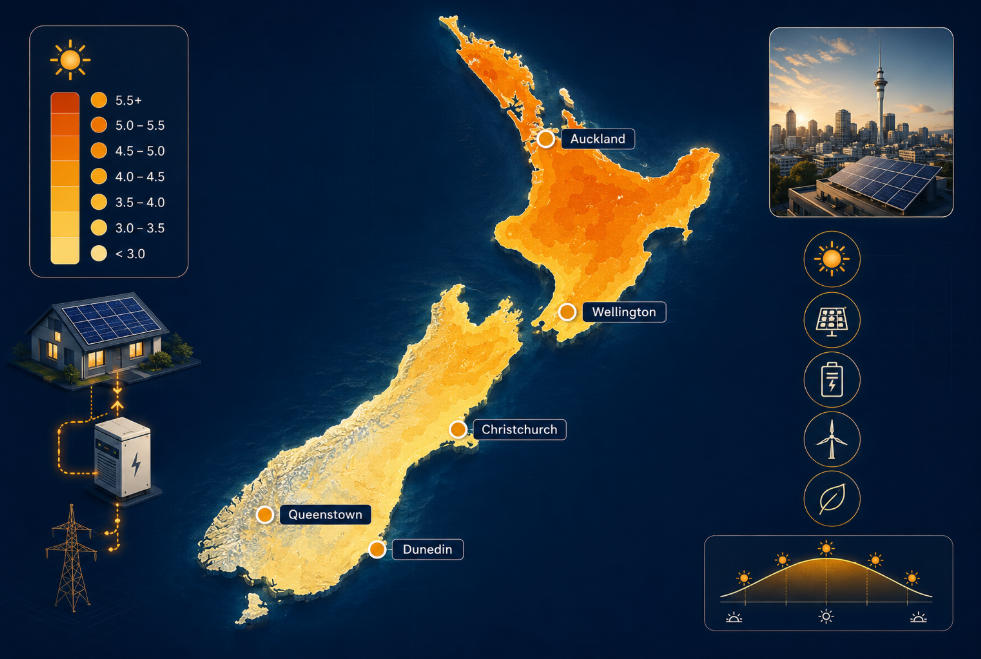
New Zealand has excellent solar potential, although average peak sun hours are generally lower than Australia’s northern regions. Solar performance varies between the North Island and South Island because of differences in latitude, climate, weather patterns, and seasonal sunlight availability.
The North Island generally receives higher annual solar resources, while southern regions experience greater seasonal changes. However, with correct system design, solar energy can provide significant benefits across New Zealand.
The table below shows typical average Peak Sun Hours New Zealand by major cities.
Peak Sun Hours by Major New Zealand Cities
| City | Region | Typical Peak Sun Hours (hrs/day) | Solar Potential |
|---|---|---|---|
| Auckland | North Island | 4.3–5.3 | ★★★★☆ Very Good |
| Tauranga | North Island | 4.4–5.4 | ★★★★☆ Very Good |
| Hamilton | North Island | 4.2–5.2 | ★★★★☆ Very Good |
| Napier | North Island | 4.3–5.3 | ★★★★☆ Very Good |
| Gisborne | North Island | 4.5–5.5 | ★★★★★ Excellent |
| New Plymouth | North Island | 4.0–5.0 | ★★★★☆ Good |
| Rotorua | North Island | 4.0–5.0 | ★★★★☆ Good |
| Wellington | North Island | 4.0–5.0 | ★★★★☆ Good |
| Nelson | South Island | 4.2–5.2 | ★★★★☆ Very Good |
| Christchurch | South Island | 3.8–4.8 | ★★★★☆ Good |
| Queenstown | South Island | 3.5–4.5 | ★★★☆☆ Good |
| Dunedin | South Island | 3.5–4.5 | ★★★☆☆ Good |
| Invercargill | South Island | 3.3–4.2 | ★★★☆☆ Moderate |
Note: Peak sun hour values are typical annual averages. Actual solar generation depends on season, weather conditions, roof orientation, panel tilt, shading, and system efficiency.
Best Solar Cities in New Zealand
Based on average peak sun hours, some of the strongest solar locations in New Zealand include:
1. Gisborne
Gisborne is one of New Zealand’s strongest solar regions because it receives high sunshine levels and favourable weather conditions.
Advantages:
- High annual solar radiation
- Good summer generation
- Suitable for rooftop solar systems
- Strong potential for battery storage
2. Tauranga
Tauranga benefits from a warm climate and good solar exposure.
It is well suited for:
- Residential solar
- Commercial rooftop systems
- Solar + battery installations
3. Auckland
Auckland is New Zealand’s largest city and has a growing solar market.
Although it does not receive Australia’s solar intensity, it provides good conditions for:
- Home solar systems
- EV charging
- Energy storage systems
4. Wellington
Wellington has slightly lower peak sun hours compared with northern cities because of its latitude and weather patterns.
However, solar systems can still perform well when designed with:
- Correct roof orientation
- Efficient panels
- Appropriate battery sizing
5. Christchurch
Christchurch receives good sunlight, especially during summer months.
It is one of the stronger South Island locations for solar energy due to:
- Relatively dry climate
- Good sunshine availability
- Large residential solar adoption
New Zealand North Island vs South Island Solar Comparison
| Factor | North Island | South Island |
|---|---|---|
| Peak Sun Hours | Generally Higher | Generally Lower |
| Winter Solar Output | Better | More Seasonal |
| Best Solar Cities | Gisborne, Tauranga, Auckland | Nelson, Christchurch |
| Battery Importance | Moderate | Higher due to seasonal variation |
| Solar Potential | Very Good | Good |
Australia vs New Zealand Peak Sun Hours Comparison
| Location | Country | Peak Sun Hours |
|---|---|---|
| Darwin | Australia | 6.0–6.8 |
| Brisbane | Australia | 5.5–6.5 |
| Perth | Australia | 5.0–6.2 |
| Auckland | New Zealand | 4.3–5.3 |
| Wellington | New Zealand | 4.0–5.0 |
| Christchurch | New Zealand | 3.8–4.8 |
| Hobart | Australia | 3.0–4.0 |
How Peak Sun Hours Affect Solar Panels and Batteries
Peak sun hours influence much more than daily electricity production. They play a critical role in designing efficient solar energy systems, selecting battery capacity, and estimating long-term energy savings.
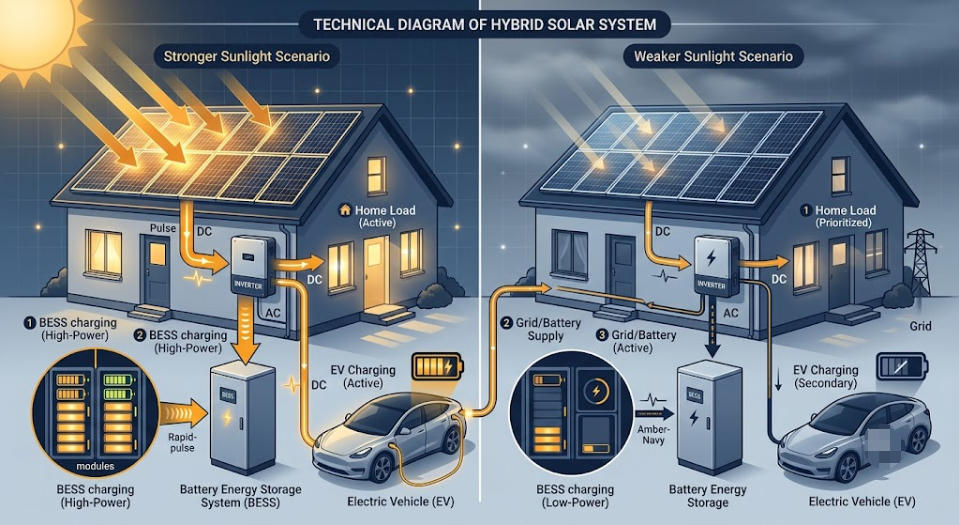
Whether you are installing a small residential rooftop system or a commercial Battery Energy Storage System (BESS), understanding local peak sun hours helps ensure every component is correctly sized and operates efficiently.
Solar Panel Performance
Solar panels convert sunlight into electricity. The more peak sun hours a location receives, the more energy the panels can generate each day.
For example, a 6.6 kW solar system installed in Darwin will generally produce more electricity than the same system installed in Hobart because Darwin receives significantly higher peak sun hours.
However, solar panel output also depends on several additional factors, including:
- Panel efficiency
- Roof orientation
- Tilt angle
- Shading from nearby buildings or trees
- Seasonal weather conditions
- System maintenance
Using accurate peak sun hour data allows homeowners to estimate annual energy production more realistically before purchasing a solar system.
Battery Storage Performance
Battery storage systems rely on excess solar energy for charging. Therefore, peak sun hours directly influence how much energy can be stored during the day.
Locations with higher peak sun hours generally allow batteries to:
- Recharge more quickly
- Reach full capacity more often
- Supply more renewable energy during the evening
- Reduce dependence on the electricity grid
In areas with lower peak sun hours, larger solar arrays or smarter energy management strategies may be required to achieve similar battery performance.
Inverter Selection
The inverter converts the DC electricity produced by solar panels into AC electricity for household or commercial use.
Peak sun hours help determine:
- Expected daily energy generation
- Peak power production
- Optimum inverter size
- Export capacity to the electricity grid
Selecting an inverter without considering local solar conditions may reduce system efficiency or limit future expansion.
Electric Vehicle (EV) Charging
Many homeowners now use rooftop solar systems to charge electric vehicles.
Higher peak sun hours increase the amount of solar energy available for daytime EV charging, reducing reliance on grid electricity and lowering running costs.
Homes in regions with lower solar resources can still support EV charging, although battery storage or time-of-use charging strategies may improve overall efficiency.
Commercial Solar and Battery Energy Storage Systems (BESS)
Businesses often design commercial solar systems using detailed peak sun hour data to maximise return on investment.
For commercial and industrial projects, peak sun hours influence:
- Solar array sizing
- Battery Energy Storage System (BESS) capacity
- Inverter selection
- Peak shaving strategies
- Load shifting
- Demand charge reduction
- Backup power capability
Modern solar systems often combine photovoltaic panels with a Battery Energy Storage System (BESS) to improve renewable energy utilisation.
Accurate solar resource assessment helps businesses optimise system performance while reducing energy costs and improving energy resilience.
Why Local Peak Sun Hours Matter
Using national averages can lead to inaccurate solar system designs because solar conditions vary considerably between cities.
For example:
| Location | Typical Peak Sun Hours | Design Consideration |
|---|---|---|
| Darwin | 6.0–6.8 hrs/day | Smaller PV system may achieve high annual generation. |
| Brisbane | 5.5–6.5 hrs/day | Excellent conditions for residential and commercial solar. |
| Perth | 5.0–6.2 hrs/day | Strong solar resource supports solar + battery systems. |
| Sydney | 4.5–5.5 hrs/day | Balance PV size with household consumption. |
| Melbourne | 3.5–4.2 hrs/day | Consider larger PV arrays for similar annual output. |
| Hobart | 3.0–4.0 hrs/day | Optimise roof orientation and battery capacity for winter performance. |
| Auckland | 4.3–5.3 hrs/day | Well suited for rooftop solar with battery storage. |
| Christchurch | 3.8–4.8 hrs/day | Seasonal variation should be considered during system design. |
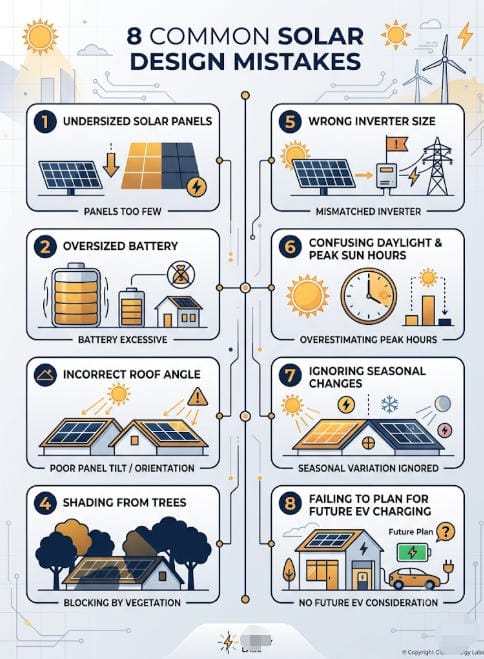
Common Solar Design Mistakes
Choosing the right solar energy system involves more than selecting high-efficiency panels or the largest battery. Many homeowners and businesses overlook local solar conditions, leading to systems that generate less electricity than expected or deliver a lower return on investment.
Understanding Peak Sun Hours Australia and Peak Sun Hours New Zealand helps avoid these common design mistakes.
1. Using National Average Solar Data
One of the biggest mistakes is designing a solar system using a national average instead of city-specific solar data.
For example, the solar resource in Darwin is significantly higher than in Hobart. Likewise, Auckland receives different peak sun hours compared with Christchurch.
Using local peak sun hour values results in more accurate system sizing and energy production estimates.
Best Practice: Always use peak sun hour data for your specific city or region.
2. Confusing Daylight Hours with Peak Sun Hours
Many people assume that more daylight automatically means more electricity generation.
However, daylight hours simply measure the time between sunrise and sunset. Peak sun hours measure the amount of usable solar energy available for electricity production.
A city may receive long summer days but still have lower peak sun hours because of cloud cover, atmospheric conditions, or lower solar intensity.
Best Practice: Base solar calculations on peak sun hours rather than daylight hours.
3. Installing an Undersized Solar Array
An undersized solar array may not generate enough electricity to meet household or business demand, particularly during winter.
In locations with lower peak sun hours, a slightly larger PV array may be required to achieve the desired annual energy output.
Best Practice: Match solar panel capacity to both your electricity consumption and your local peak sun hours.
4. Oversizing Battery Storage
A larger battery is not always better.
If the solar array cannot produce enough surplus energy to recharge the battery, much of its capacity may remain unused.
Battery size should always be balanced with expected daily solar generation.
Best Practice: Size battery storage based on actual solar production rather than maximum electricity demand alone.
5. Ignoring Roof Orientation and Tilt
Even in cities with excellent peak sun hours, poor roof orientation or incorrect panel tilt can reduce electricity generation.
Factors that influence performance include:
- Roof direction (azimuth)
- Panel tilt angle
- Shading from trees or nearby buildings
- Local climate
- Seasonal sun angle
Best Practice: Optimise panel placement to maximise annual solar exposure.
6. Choosing the Wrong Inverter Size
An inverter that is too small may limit energy production during periods of high solar generation, while an oversized inverter may increase project costs without improving performance.
Best Practice: Select an inverter based on expected peak solar output and future expansion plans.
7. Ignoring Seasonal Variations
Solar production changes throughout the year.
Northern Australia generally experiences smaller seasonal differences, while southern Australia and much of New Zealand have greater variation between summer and winter.
System design should account for these seasonal changes, especially when battery storage or off-grid operation is planned.
Best Practice: Consider annual solar production rather than focusing only on summer performance.
8. Forgetting Future Energy Needs
Many homeowners install solar systems based only on their current electricity usage.
Future energy consumption may increase due to:
- Electric vehicle (EV) charging
- Home battery installation
- Heat pumps
- Air conditioning
- Home extensions
Planning for future demand can reduce the need for costly system upgrades later.
Best Practice: Design your solar system with future energy requirements in mind.
Solar Design Checklist
Before investing in a solar energy system, check the following:
✔ Use city-specific peak sun hour data.
✔ Compare seasonal solar production.
✔ Size solar panels based on annual electricity consumption.
✔ Match battery capacity with expected solar generation.
✔ Select the correct inverter size.
✔ Optimise roof orientation and panel tilt.
✔ Consider future energy needs, such as EV charging or home expansion.
✔ Work with qualified solar professionals for detailed system design.
Why These Mistakes Matter
Avoiding these common mistakes can improve:
- Annual solar energy production
- Battery charging performance
- Electricity bill savings
- Return on investment (ROI)
- Long-term system reliability
Whether you live in Darwin, Sydney, Hobart, Auckland, or Christchurch, using accurate peak sun hour data is one of the simplest ways to design a more efficient solar energy system.
Frequently Asked Questions About Peak Sun Hours Australia and New Zealand
What Are Peak Sun Hours?
Peak sun hours measure the amount of usable solar energy a location receives each day. One peak sun hour equals 1,000 W/m² of solar irradiance for one hour.
Is 5 peak sun hours good for solar?
Yes. Around 5 peak sun hours per day is considered very good and can support efficient residential and commercial solar systems.
Which Australian city has the highest peak sun hours?
Darwin has the highest peak sun hours among major Australian cities, averaging 6.0–6.8 hours per day.
Which New Zealand city has the highest peak sun hours?
Gisborne and Auckland receive some of New Zealand’s highest peak sun hours, typically around 4.3–5.5 hours per day, depending on the season.
What is the best roof direction for solar panels?
In Australia and New Zealand, north-facing solar panels generally produce the highest annual energy output.
Are peak sun hours the same as daylight hours?
No. Daylight hours measure the time between sunrise and sunset, while peak sun hours measure usable solar energy for electricity generation.
Why are peak sun hours important?
Peak sun hours help estimate solar panel output, battery charging performance, and the correct size of a solar energy system.
How do peak sun hours affect solar panels?
Higher peak sun hours allow solar panels to generate more electricity each day. Lower peak sun hours may require a larger solar system to achieve the same energy output.
Do peak sun hours affect battery storage?
Yes. More peak sun hours allow batteries to recharge faster and store more solar energy for use at night or during power outages.
Which Australian states have the best solar potential?
The Northern Territory, Queensland, and Western Australia generally receive the highest peak sun hours and offer excellent conditions for solar energy.
Does solar work well in New Zealand?
Yes. Although New Zealand receives fewer peak sun hours than northern Australia, well-designed solar systems still provide excellent long-term performance.
How do I calculate solar panel output using peak sun hours?
Multiply the solar system size (kW) by the average peak sun hours, then adjust for system efficiency to estimate daily electricity generation.
Can peak sun hours change throughout the year?
Yes. Peak sun hours vary by season because of changes in sunlight angle, weather conditions and daylight duration.
Where can I find peak sun hours for other countries?
For worldwide peak sun hour data by city and country, visit Sunlith Energy’s Peak Sun Hours Database.
Conclusion: Understanding Peak Sun Hours Helps Build Better Solar Systems
Peak Sun Hours Australia and New Zealand demonstrate why location is one of the most important factors in solar energy design.
The same solar panels, inverter and battery system can produce very different results depending on where they are installed.
Cities such as Darwin, Brisbane and Perth benefit from some of the strongest solar resources in the region. Meanwhile, cities such as Melbourne, Hobart, Queenstown and Dunedin receive fewer peak sun hours but can still achieve excellent solar performance with proper system design.
Understanding peak sun hours helps homeowners and businesses make better decisions about:
- Solar panel sizing
- Battery storage capacity
- Energy independence goals
- Expected electricity generation
- Long-term renewable energy investments
As solar adoption continues to grow across Australia and New Zealand, accurate location-based solar data will become increasingly important.
Before installing a solar or battery system, always consider your local solar resource rather than relying only on equipment specifications.

For readers comparing locations worldwide, check Worldwide Peak Sun Hours by City Database.
By combining accurate solar data with suitable technology, homeowners, businesses and renewable energy developers can maximise the value of solar energy investments.
Planning a solar project and want to understand how your location affects energy production? Check your city’s peak sun hours before choosing a solar panel or battery system. Accurate solar data is the first step toward a more efficient renewable energy future.