
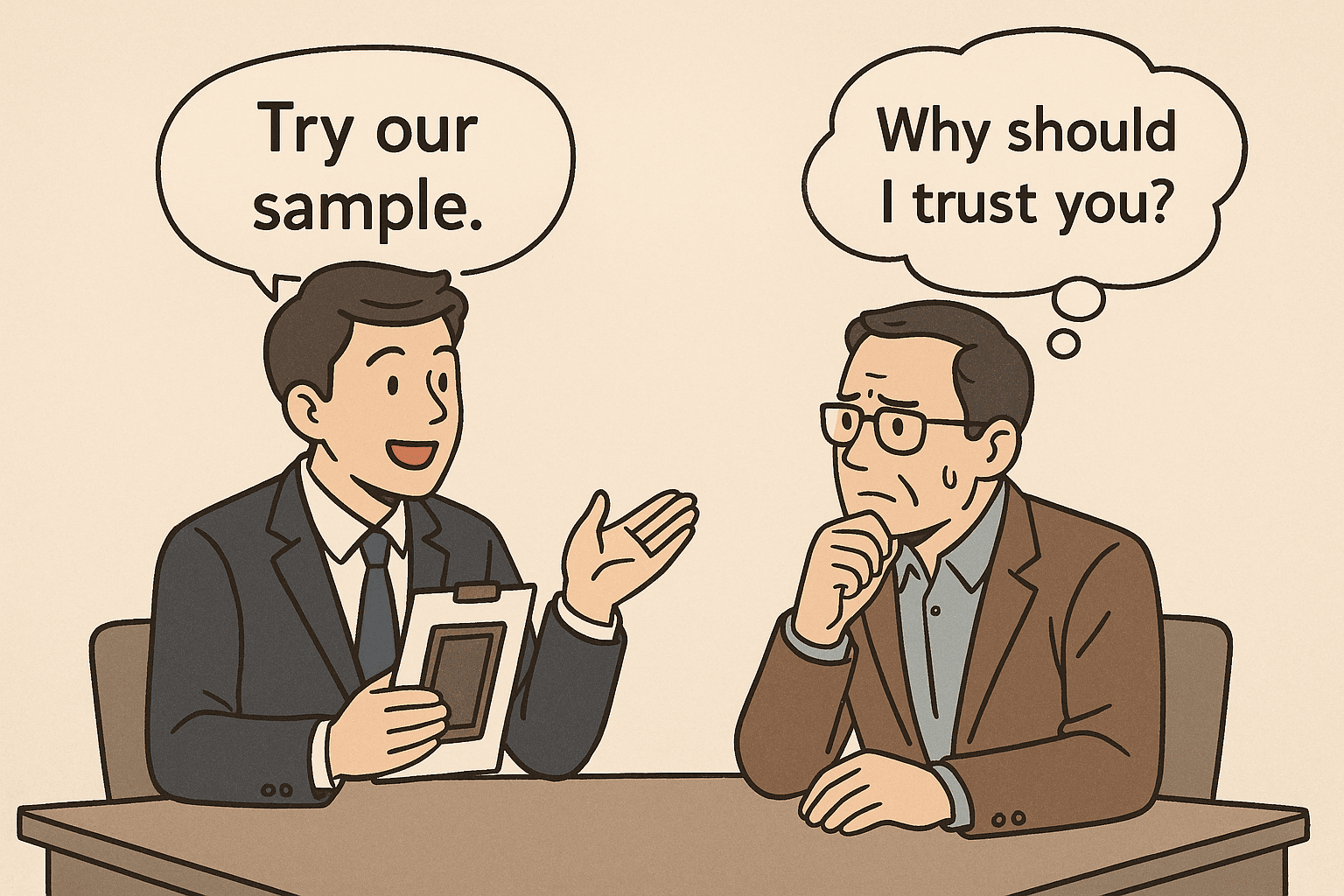
sales person

🔍 Why Good Salespeople Don’t Just Say “Try My Product”

Try our Product

Stop Saying “Just Try our Product” – It Doesn’t Work Anymore

Every week, I get messages from salespeople who’ve seen the products I deal with. Their first line?

“We also have the same model. Buy a sample and test it.”

Or they say:

“Try our product. Our quality is good.”

That’s it. That’s their pitch.

But here’s the truth: buyers don’t change suppliers just because someone else claims to have a similar product.


Changing a Supplier Is a Big Decision

Let me make this clear:
No business owner or sourcing manager wakes up thinking, “Let me try a new supplier today.”
It doesn’t happen.

Here’s when we even think about changing a supplier:

  • The current supplier is delivering bad quality
  • There are frequent complaints from end customers
  • The supplier has a rude or careless attitude
  • Orders are always delayed
  • The price is too high with no added value
  • The supplier’s issues are hurting our business or reputation

Otherwise, why would we risk changing a smooth-running system? Peace of mind in business is priceless.


Salespeople Are Missing the Point

Most sales reps don’t try to understand what the client really needs.
They don’t bother to ask:

  • What is working well with your current supplier?
  • What are the problems you’re facing?
  • What are your goals with this product?
  • How do you define “good quality”?

They jump straight to selling without listening.

And when they don’t even know the buyer’s pain points…
How can they offer a real solution?


“Good Quality” Is Not a Sales Strategy

Every supplier says the same thing:

“Our quality is good.”

But here’s the problem:

Saying “my product is good” is like saying “I’m a good person.”
It means nothing without proof.


If You Want to Win the Client, Do This Instead:

1. Understand Their Business Deeply

Before you pitch anything, do your homework.

  • What industry is the client in?
  • What type of clients do they serve?
  • What is their product positioning—premium, mid-range, or budget?

If you don’t know this, your pitch will always sound generic and weak.


2. Learn About Their Current Supplier

Ask smart questions:

  • What’s going well with your current supplier?
  • What challenges are you facing lately?
  • Are there areas where you want better performance?

This opens the door for meaningful conversation.


3. Present Specific Advantages of Your Product

Not general claims. Be clear and sharp.

Say things like:

  • “Our model offers 10% higher energy efficiency, which reduces heating.”
  • “We can guarantee 20-day lead times, even in peak season.”
  • “We offer real-time production tracking with photo/video updates.”

Now you’re showing value. Now you’re giving the client a reason to think.


4. Give Logical Reasons to Try You

Saying “Try a sample” isn’t enough.
Say why they should try your sample.

Example:

“Your current model has a 15% complaint rate in the field. Our model uses a different cell technology which cuts that in half. I can show you test data.”

This makes the offer relevant, not random.


5. Make It Low Risk for the Buyer

Help them feel safe:

  • Offer small trial orders
  • Provide warranty support
  • Show case studies
  • Be available and responsive

When a client knows they won’t be left hanging, they’re more willing to listen.


6. Samples Cost Time, Money, and Trust

Salespeople often say:

“Just try our product’s sample.”

But they forget one thing:
It’s not free for the buyer.

When a client agrees to test a sample, they must:

  • Pay for the product
  • Pay for international shipping
  • Pay customs duty and tax
  • Spend time testing
  • Take attention away from current work
  • Risk internal conflict if the trial goes wrong

All this, just because someone says “our quality is good”?

Why should they trust you that easily?

Clients are careful because they’ve been burned before—fake specs, over-promising, poor follow-up, no after-sales support.

So if you’re not giving a strong reason, a real advantage, and clear value, they won’t waste time and money.


Relationships Drive Business – Not Just Products

In this industry, people work with people.
If the client and their current supplier have a good relationship, you must respect that.

Don’t try to break it. Instead, position yourself as a better choice if things ever go wrong.
Be professional. Be patient. Be ready.


Final Thoughts

📌 A client will never change suppliers just because your sample “looks similar.”
📌 They’ll only change when they feel something is missing—and you can clearly show how you’ll fill that gap.
📌 The key is: Learn. Listen. Understand. Solve. Then Sell.


Let’s Redefine Sales

Don’t be another “me too” supplier.
Be the partner who studies the client’s business like it’s your own.
That’s how you win real, long-term, profitable deals.


🔥 11 Common Sales Mistakes New Salespeople Make — And How to Avoid Them

Common Sales Mistakes

Why do most new salespeople fail? It’s usually not because of a lack of opportunities—but because of basic, preventable sales mistakes.

Whether you’re just starting your sales journey or leading a team, avoiding these common sales mistakes is crucial. In this post, we’ll explore the biggest reasons why many new or unprofessional salespeople fail, and how to turn those errors into winning habits that boost sales performance.

1. Poor Client Greetings – A Bad Start

A weak or cold greeting is one of the first mistakes new salespeople make.

What’s the Sales Mistake?

Jumping into a sales pitch without a proper greeting or polite introduction. It shows a lack of people skills and professionalism.

How to Sell Effectively:

Always greet the client warmly, use their name, thank them for their time, and make the opening positive. This simple move sets the tone for trust.

2. Not Asking About the Client’s Business

One of the worst bad sales techniques is not understanding who you’re selling to.

Common Sales Mistake:

Failing to ask the client about their company, products, problems, or goals.

Sales Tip:

Ask thoughtful questions like:

  • What products do you currently use?
  • What’s your biggest sourcing challenge?
  • Who are your main customers?

Salespeople who ask smart questions close smarter deals.

3. No Research Before the Meeting

This is one of the most damaging sales mistakes to avoid.

Mistake:

Walking into a sales call or sending emails without researching the client’s company, website, or product range.

Fix:

Spend 15–30 minutes researching. Use tools like LinkedIn, the company website, or even Google Translate if there’s a language barrier. Knowing your client = earning their trust.

4. Can’t Promote Their Own Company

Just saying “We are factory, good price” is not a sales strategy. It’s a red flag.

Unprofessional Salesperson Habit:

They don’t know how to express their company’s unique value proposition.

Solution:

Learn to explain:

  • What makes your company reliable?
  • What certifications do you hold?
  • How are your products different?

This is a key part of sales training for new salespeople.

5. Never Highlight Product Advantages

Common Sales Mistake:

New reps forget to compare their products to competitors or show how they’re better than what the client is already using.

Fix:

Highlight benefits like:

  • Better quality
  • Faster delivery
  • Lower return rates
  • Customization options

This helps clients clearly understand why switching to your product is worth it.

6. Don’t Understand Their Own Product

Yes, it still happens. One of the most damaging unprofessional salesperson habits is not knowing the products they’re trying to sell.

Mistake:

They can’t explain the product’s features, benefits, or technical specifications.

Sales Tip:

Master your product. Know the advantages and limitations. Be ready to teach the client and answer questions confidently.

7. Know Nothing About Competitors

If the client knows your competitor better than you do—you’re already losing.

Common Sales Mistake:

Ignoring the competition or pretending they don’t exist.

How to Improve Sales Performance:

Study your top competitors. Know their pricing, quality, delivery times, and key selling points. Use that knowledge to position your offer more effectively.

8. Lazy Selling – Just Sending a Catalogue

Common Sales Mistake:

Sending a PDF and saying “Please check, let me know if you need anything.”

This is the definition of bad sales technique.

Fix:

Send the catalogue with personalized suggestions.

For example:
“Based on your market, I suggest looking at Model A, C, and D on pages 3–5. I can also send samples and pricing if you’re interested.”

This builds relevance and trust.

9. Weak or Negative Language

“If you need anything, contact us.”

These words show lack of confidence and motivation.

Common Sales Mistake:

Using soft, unsure phrases in sales conversations or emails.

Sales Tip:

Use confident, action-based language:

This change alone can double your response rate.

10. No Follow-Up = No Deal

The most deadly mistake: not following up.

Common Sales Mistake:

Many salespeople send one email and disappear. No updates. No reminders. No relationship.

Fix:

Follow up with value. Not just “Any update?”

Follow-up is where real sales happen.

11. Disappearing Mid-Chat Without Apology

Imagine you’re having a conversation with a supplier—asking questions, discussing details—and suddenly… they disappear. No warning. No “brb.” Just gone. Hours later, they’re back like nothing happened. No apology. No follow-up.

Mistake:

Unprofessional salespeople vanish during chats without explanation—and when they return, they never say sorry.

Why It’s a Problem:

This kind of attitude shows one thing clearly:
They don’t care about the client or the client’s business.

It breaks trust instantly. No client wants to work with someone who treats their time as unimportant.

How to Fix It:

Respect the conversation. If you need to step away, communicate:

“I need 10 minutes to check this info—will get back to you shortly.”

And if something urgent came up and you were pulled away, say:

“Apologies for the gap in our chat. Thank you for waiting.”

Sales is about relationships—and respect builds relationships.

Conclusion: Avoid These Mistakes, Sell Smarter

These 11 common sales mistakes can cost you deals, damage your brand, and destroy client relationships. The good news? Every one of them is easy to fix.

Start today by improving your greetings, client research, product knowledge, and follow-up habits. Make these changes, and you’ll not just improve your closing rate—you’ll earn long-term trust, loyalty, and referrals.

The Power of Salesmanship in Supplier Selection

salesmanship

Salesmanship: In today’s fast-paced business world, it’s common for companies to receive daily calls, emails, or messages from eager salespeople offering products and services. Their pitch is usually the same: “We’d like to be your supplier,” or “We’d love you to switch from your current supplier and give us a try.” The message sounds promising at first, but often, it ends there. They offer no real insights, no differentiators, and no understanding of your company’s needs.

Instead, they just say, “If you need anything, contact us.” But here’s the critical question: how could you trust a company that doesn’t care enough to research you, your business, or the product needs you might have? How can you be sure that they will deliver on their promises when their own sales team lacks the skills, knowledge, and commitment to make your business a priority?

In this blog post, we will explore why such careless sales tactics not only fail to impress but could also be a huge red flag when it comes to choosing the right supplier.

The Importance of Salesmanship: A Reflection of the Company’s Values

Salespeople are often the first and most direct interaction a potential customer has with a company. They are the face and voice of the business, responsible for creating the first impression. When a salesperson contacts you without a clear understanding of your business needs or fails to showcase what their company can offer differently, it reflects poorly on the company they represent.

Sales are about relationships, not just transactions. A salesperson’s ability to communicate the advantages of their product, how it meets your specific requirements, and why it’s superior to what you’re currently using is critical. A salesperson who doesn’t take the time to learn about your business and craft a tailored message is likely not representing a company that values relationships and customer satisfaction.

If they don’t care about what you need, how can they care about delivering a quality product or service? If their approach to sales is this lackluster, it’s reasonable to question whether they can offer the kind of long-term value you need from a supplier.

The Risk of Inadequate Product Knowledge and Competitor Analysis

A successful salesperson doesn’t just push a product—they demonstrate why it is the right solution for your business. This means they need to know their product inside and out, understand how it compares to the competition, and be prepared to explain the benefits clearly.

When a salesperson simply offers their products without any information about why they’re better than your current suppliers, you’re left to wonder: Is this company even prepared to meet your specific needs? Have they done any market research to understand how their products stack up against your current suppliers?

Any business owner or procurement manager knows that making an informed decision requires comparing options. A salesperson who doesn’t offer any comparative data or a detailed analysis of their product’s advantages over your current supplier’s offerings might be hiding a lack of product innovation, poor quality, or insufficient customer service. Worse, if they can’t provide these details, it’s a clear sign that they haven’t done their homework—or worse, they might not even have a clear understanding of their own offerings.

A Lack of Customization Is a Major Red Flag

A key aspect of a strong sales pitch is personalization. Salespeople who care about your business will take the time to understand your specific pain points, requirements, and goals. They will customize their pitch to show how their product or service will help you achieve your objectives.

If a salesperson simply reaches out and says, “If you need anything, contact us,” with no indication of how their products can help your business, it’s a clear sign that they’re either too lazy or unqualified to tailor their offerings to your unique needs. In today’s competitive business landscape, this lack of effort is unacceptable. Your business deserves a supplier who takes the time to understand your challenges and offers you solutions designed to address them directly.

Furthermore, when a company fails to personalize its approach, it suggests they are not committed to long-term partnerships. Business relationships require a deep understanding of each other’s operations and goals. If a salesperson doesn’t show that they’re invested in your success, it’s unlikely that the company they represent will be either.

The Importance of Relationship Building and Trust

Building trust is the foundation of any business relationship. The process of switching suppliers or choosing a new one is often complex and risky. It requires confidence in the products, services, and customer support that the supplier can offer. Trust doesn’t come from generic, impersonal sales pitches; it comes from ongoing, thoughtful engagement and a genuine interest in your company’s success.

If a salesperson contacts you with nothing but a vague “contact us if needed,” they’re failing to build that trust. They’re not providing you with any reason to believe that their company can be a reliable, long-term partner. In essence, they’re not selling the company—they’re just pushing a product.

A supplier who cares about building a lasting relationship will offer a detailed understanding of your business needs and a comprehensive plan on how they can meet them. This could include tailored pricing options, customized delivery schedules, or providing after-sales support. A real salesperson doesn’t just say, “Contact us if you need us.” They say, “Here’s how we can make your life easier by addressing these specific pain points you’re facing.”

The Role of the Salesperson in Creating the Company Image

Salespeople don’t just sell products; they sell the image and values of the company they represent. If a salesperson doesn’t exhibit professionalism, skill, and expertise, how can you expect the company they represent to perform any better?

Companies that care about their customers will ensure that their sales team is highly trained, knowledgeable, and equipped to handle complex queries. A company that doesn’t invest in its salespeople’s abilities is likely to have a subpar product or service as well. This is a clear indication that they don’t prioritize quality or customer satisfaction.

When you work with a supplier, you’re essentially outsourcing a part of your business to them. The salesperson who contacts you today is the face of that company tomorrow. A company that doesn’t care about improving the skills and knowledge of its sales team is not a company you want to entrust with your business needs.

Why You Should Demand More from Your Suppliers

At the end of the day, when choosing a supplier, you’re looking for someone who will understand your needs, offer the best possible solutions, and work with you as a strategic partner. If a company can’t even get the basics of sales right—like conducting research on your business, comparing products to competitors, or demonstrating the value of their products—how can they possibly be expected to meet your other requirements?

A supplier should be someone who is proactive, someone who is eager to improve your business, not just someone who throws a product at you and waits for you to reach out. As a business owner or procurement manager, you deserve suppliers who understand your pain points and proactively offer solutions that will drive your business forward.

Conclusion: Don’t Settle for Mediocre Salesmanship

Choosing a supplier is a big decision, and you can’t afford to take it lightly. If a salesperson doesn’t take the time to understand your business, compare their products with your current suppliers, or demonstrate how their offerings can benefit you, it’s a clear indication of a company that doesn’t care enough about its customers.

You deserve better than a generic sales pitch. You deserve a supplier who will invest the time to understand your needs and offer solutions that genuinely add value. So, next time a salesperson contacts you with a bland “contact us if needed,” take a moment to consider: If they can’t even put in the effort to convince you of their value, why should you put in the effort to work with them?

The right supplier will show you why they are the best choice for your business. Don’t settle for less. Your business deserves nothing less than a committed, knowledgeable, and professional partner.