
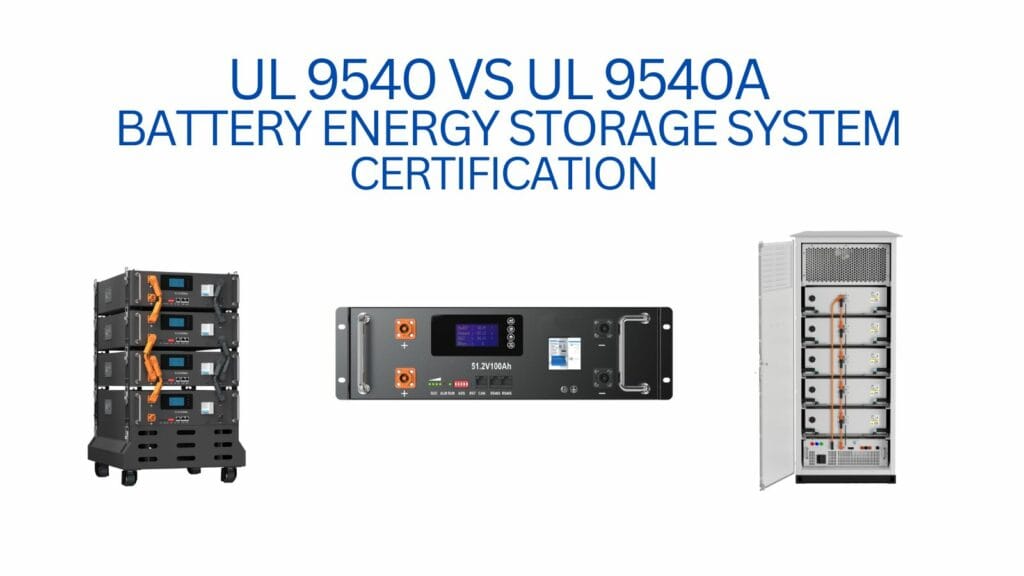
Your Battery System Can Save Lives—or Risk Them: Energy storage is powerful. It lights homes, powers vehicles, and backs up hospitals. But one mistake in choosing or certifying your system can cost not just money—but lives. That’s why safety is everything.And that’s where UL 9540 and UL 9540A come in. They sound similar, but they’re not the same.
Let’s break it down.
???? First, What Is UL?
UL stands for Underwriters Laboratories, a trusted global safety certification company. When a product is UL Certified, it means it’s been tested to meet strict safety standards.
For energy storage systems (ESS), UL 9540 and UL 9540A are the two big names everyone’s talking about. And for good reason.
✅ What Is UL 9540?
UL 9540 is the full-system certification for energy storage.
It looks at the whole battery system—including the battery packs, battery management system (BMS), inverter, cooling, controls, wiring—everything.
To pass UL9540, a product must prove:
- It works safely under normal use
- It doesn’t pose serious risks when something goes wrong
- It meets strict electrical, fire, and mechanical safety standards
Think of UL9540 like getting a driver’s license for your energy storage system. It says: “This complete system is safe and ready to go.”
???? What Is UL 9540A?
UL9540A is NOT a certification.
Let’s say that again: UL 9540A is not a certification.
It’s a test method—a very intense one. It’s designed to understand how a battery behaves if it catches fire or goes into thermal runaway.
UL9540A helps answer these life-saving questions:
- Will the fire spread to other cells or packs?
- Will there be flames, smoke, or explosions?
- How far will the heat go?
- Can fire suppression systems stop it?
This test doesn’t “pass” or “fail” your system. Instead, it gives detailed fire data. That data is often required by fire departments, building inspectors, and city authorities.
It’s like a crash test for batteries—showing what happens when the worst-case scenario hits.
???? Key Differences Between UL 9540 and UL 9540A
| UL 9540 | UL 9540A |
|---|---|
| Full certification | Test method only |
| Focuses on complete ESS | Focuses on fire behavior |
| Grants approval to sell/use | Provides data for safety review |
| Required for market entry | Required for fire code compliance |
| Like a driver’s license | Like a crash test |
???? Why Both Matter
If you’re a buyer, EPC, or investor in battery systems, don’t stop at just asking,
“Is this UL9540 certified?”
Also ask:
“Has it been tested under UL9540A?”
Why?
Because a system can be UL9540 certified—but still fail to meet local fire code unless UL9540A test data proves it’s safe during a fire.
Imagine installing a big system in a hospital, school, or mall—and the fire chief shuts it down because you skipped UL9540A testing.
That’s a nightmare you don’t want.
???? Real-World Example
A US-based integrator bought a containerized battery system that was UL 9540 certified. But during fire inspection, the AHJ (Authority Having Jurisdiction) asked for UL 9540A data.
There was none.
Result?
The project was delayed by 6 months.
Tens of thousands in losses.
Lost client trust.
All because they didn’t understand the difference.
???? Who Needs These?
If you are:
- Buying a home or C&I energy storage system
- Installing large containerized ESS for utilities
- Building a solar+storage project
- An EPC working in North America
You NEED to know this.
And your supplier MUST provide both.
???? Final Thoughts: Choose Safety. Choose Smart.
Battery systems are the backbone of the new energy future.
But fire doesn’t care about technology or price.
It only cares about safety.
UL 9540 and UL 9540A are not optional—they’re your protection.
Protection for your team, your site, and your reputation.
When you ask your supplier for these certifications, you’re not just ticking boxes.
You’re demanding safety, responsibility, and peace of mind.
And that makes you a smarter, stronger leader.
???? Need Help Sourcing Safe Battery Systems?
I help clients around the world find fully certified, tested, and compliant energy storage systems that save time, money, and lives.