
Tag: Website

The Best Methods to Optimize Cost per Acquisition in the Startup Environment


Most entrepreneurs will agree that successful startups are built upon three pillars: team, product and market. They usually emphasize the product/market fit as one of the most important factors that can make or break any startup.

However, while these three factors are crucial, they are not solely responsible for a startup’s success.

Some of the savviest startup leaders understand that continuously optimizing the cost of acquiring new customers, also known as cost per acquisition (CPA), is key to sustainable growth. 

That being said, let’s explore some of the best ways you can optimize your CPA.

  1. What is CPA and how to calculate it?

Cost per acquisition is a marketing metric based on which a business can accurately measure the cost of acquiring new customers.

This metric also allows businesses to see just how successful their marketing campaigns are.

To calculate your CPA, you divide the total campaign cost by the number of new customers it has generated.

So, if your campaign managed to bring in three new customers, one costing $2, the next $3, and the third $4, your average CPA for those new customers will be (2+3+4)/3=$3.

It’s important to note that your average CPA will be based on your actual CPA, or the actual amount of money you spent on acquiring new customers. With that in mind, your average CPA may sometimes differ from your target CPA.

Target CPA is a predetermined amount of money you wish to spend on acquiring new customers. Needless to say, if your average CPA exceeds your target CPA, this may indicate that you need to redesign your campaigns.

Ideally, every business – and particularly startups – should aim to keep their average CPA equal to or lower than their target CPA.

  1. How to optimize your CPA?

Now that we know what CPA is and why it is so important for sustainable growth, let’s look at some CPA optimization methods.

  1. Stay on top of your customer acquisition costs

To be able to drive your customer acquisition cost down, you need to track your CPA regularly. The only way to know if you are making progress, what is working and what is not, is to test and observe.

Here, you will also need to calculate the average purchase value which will tell you how much your customers end up spending on your products. 

Aside from this, you will need to determine the average lifespan of your customers, or for how long the customer is interacting with your business. This also contributes to customer loyalty. 

And finally, you will also need to determine your customer lifetime value, which will help you determine how much money your customers will spend on your business during their lifetime.

  1. Make sure your content is targeted and relevant

Long gone are the days of one-size-fits-all marketing strategies. To be competitive on digital channels, focus on developing targeted and relevant content.

Let’s take website content as an example and let’s assume that your office management business has branches across the US, but you want to target audiences in Illinois.  

You hire a Chicago web development and design agency that understands and can create content that targets your audience’s unique pain points such as maintaining outdoors under Chicago’s infamous winds.

If your audience sees their needs reflected in your content, they are more likely to convert.

It’s important to note that the longer it takes to turn a lead into a customer, the greater your CPA will be. So, to capture the right audiences from the get-go, you will need to determine your buyer personas and tailor your content to them. For example:

Segment your newsletters –Personalize your campaigns and offers based on audience segments to increase click-through
Target relevant keywords – By targeting relevant keywords, you will make it significantly easier for your audience to find your business. Not only will you boost your startup’s exposure on Google and Bing, but you’ll also offer more value to your customers as your solution will pop up when they need it, i.e., search for it.

Create educational content – Customers prefer businesses that offer value, aside from the products or services they’re trying to sell. What this means is that an average consumer prefers branded content that educates to that which simply tries to sell them on something. Going back to our earlier example, let’s assume you also want to reach audiences in LA and Hollywood; You can easily consult with professional Los Angeles web developers to create landing pages and blog content that targets LA clients’ unique office management needs.

  1. Develop a conversion rate optimization strategy

A conversion rate optimization strategy is a subset of consumer acquisition that focuses on converting prospects into customers.  

For example, you can funnel a lead to your website, but if your website doesn’t provide them with the information and easy conversion path, this lead will bounce and your acquisition rate will go down.

Some of the most effective tactics include:

Show social proof –About 81% of consumers check reviews before purchasing and/or are more likely to purchase if they see positive reviews. So, investing in online reputation, including programs to incentivize reviews, can affect your brand’s credibility and increase your conversion rate as a result.

Make your website accessible and easy to navigate – Your website is your main marketing tool. If it’s inactive, takes too long to load or is difficult to use, your leads will bounce; in other words, you will lose them.

Tell your audience their data is safe with you –Educate your users on the measures you take to keep the data they leave on your website safe, as well as how you will use their data, especially if you expect them to leave any type of personal information on your website.

  1. Turn customers into brand advocates

A sort of an end goal for all businesses, regardless of their size, is to turn their customers into brand advocates.

According to research, it’s about 5 times cheaper to retain an already-existing customer than it is to attract a new one. It’s also worth noting that word-of-mouth customers are even cheaper to acquire.

To encourage brand advocacy, you can:

Create a customer loyalty plan –By offering incentives to your most loyal customers, not only will you encourage repeat sales, but you are likely to inspire them to share their love for your brand with the people they interact with. This is free and, arguably, the most valuable exposure for your startup.

Be environmentally and socially responsible –Today’s customers, especially Millennials and Gen Z, are looking to support businesses that echo their values. Today’s consumer is much more critical of brands’ behavior and has more access into the behind-the-scenes to hold brands accountable. On top of that, 73% more Millennials are willing to spend a bit more on sustainable goods, while 62% Gen Z prefer to buy from sustainable brands.

Practice social listening – In the end, just as it is important to encourage your customers to talk about your business, you also need to listen to what they are saying. Your customers’ honest conversations about your brand are an excellent source of new ideas for improvement, as well as content creation.

  1. Test your landing pages

Finally, another great way to improve your conversion rates is to test your landing pages.

Create a few variations of your landing page and test them out to see which of these will bring in the most users as well as convert them.

Run A/B test by checking your users’ average time on page and click-through rates to determine the best layouts and messaging.

In doing so, you can make data-based observations and optimize your website for conversions.


  1. Recap

Every business, and particularly startups, need to understand the importance of their CPA and find a way to optimize it for maximum efficiency. In order to do this properly, one will need to:

  • Understand what CPA is and how to calculate it

  • Learn how to optimize their CPA by

  1. Monitoring their acquisition costs

  2. Creating relevant and targeted content

  3. Developing the right optimization strategy

  4. Turning their consumers into brand advocates

  5. Testing their landing pages

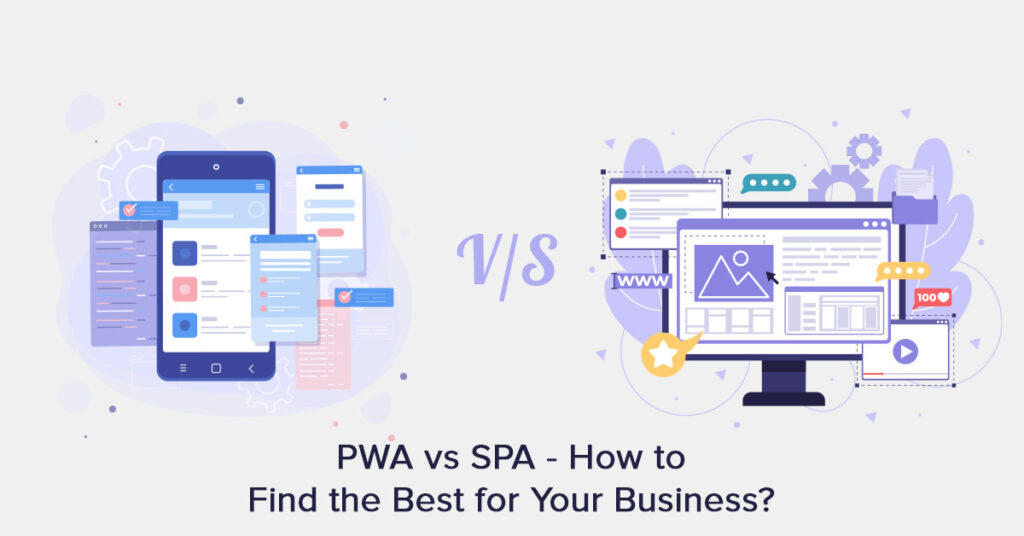
PWA vs. SPA – How to Find the Best for Your Business?

Mobile users are growing at a swift pace and transforming the face of digital evolution. Today we are in the era of mobile devices and every business is constantly attempting to target mobile users. Businesses set a goal to offer a better experience and services to mobile users first.

Optimization of web pages can be excellent for mobile users. But when users browse through your web content, and there is a problem while quickly loading web pages on the browser, you might lose some of your valued customers. Progressive Web Apps and Single Page Apps, both technologies will help your website to load the content much more rapidly.

Although users have confusion among PWA and SPA, this is why here we discuss the difference between the two.

Introducing PWAs and SPAs

PWA (Progressive Web Applications)

Built using advanced technology, the PWAs can be accessed in all standards-compliant web browsers along with offering an app-like experience for the users. It is a flexible cross-platform solution and supported by developers and web app manifests. They work like native apps and their user interface and functionalities are easy-to-use that makes them the best choice among developers.

SPA (Single Page Applications)

SPAs have all the content loaded at once. They are dynamic when it comes to generating content without refreshing a page. There is no need to run back and forth between a server and a browser with Single Page Applications. That is the reason user interaction got increased with SPAs. If a user requests for the new content, only partial content is updated rather than the whole page being refreshed.

Successful Progressive Web Apps Examples

#1. Flipkart – A largest eCommerce site updated its mobile site to PWA known as Flipkart Lite.

#2. Forbes – Top U.S. business magazines having plenty of finance, investment, industrial, and marketing articles have developed a PWA to deliver an intuitive user experience.

#3. Pinterest – To boost website experience and user conversion, Pinterest has developed a Progressive Web App that helps users to curate images, recipes, and products easily.

#4. TwitterLite – Twitter rolled out its PWA in the year 2017 to deliver a default mobile web experience to the users called “Twitter Lite”.

#5. AliExpress – A well-known eCommerce website owned by the Alibaba Group converted its mobile site to PWA.

Get the list of other top PWA That Can Inspire You!

Successful Single Page Apps Examples 

#1. Gmail – When a user clicks on an email in the Inbox, the browser stays on the same page but JS code hides the Inbox and displays the email body on the user’s screen.

#2. Twitter – This is also a SPA apart from when you click on pic.twitter.com.

#3. Facebook – The news feed page in Facebook enables users to scroll constantly through the feed along with watching videos and other facilities as well on the same page. No need to leave the news feed page.

#4. Netflix – With the use of React framework, this SPA helps users to continue streaming their preferred shows without any delay.

The Best Frameworks in 2021

#1. React JS

React is offering an extensive JavaScript Library, and that is the reason it is a popular choice amongst developers. The PWA development framework can build single-page and multi-page apps and assure that the content loads and updates within a single page. It uses JSX to provide functions to connect HTML structures and build a React Progressive Web App solution.

#2. Angular JS

AngularJS makes use of the JavaScript framing to develop robust and scalable Progressive Web Apps. JSON configuration is utilized to build PWAs. SO there is no need to develop an app from the beginning. It will simplify the process of web app installed on mobile devices.

#3. VueJS

It is an open-source front-end Javascript framework usually driven by the community. It is easy for developers to get rolling with the Vue as it simplifies the development process with salient features like routing, rapid MVP generation, and simplified coding for freshers.

Other frameworks For PWA are Ionic, Svelte, Polymer, PWABuilder.

Other frameworks For SPA are EmberJS, BackBoneJS library, Meteor.JS.

What’s The Difference between PWA and SPA?

People have a common misconception that a Progressive Web App is always a Single Page App, and that is very wrong. A Progressive Web Apps is just keeping a website that comprises all the better qualities that the Web can offer along with reliability, rapidity, and engagement.

#1. When Rapidity Concerns 

When it comes to speed, both are quite similar as both are leading-edge technologies. However, an advantage might go with Progressive Web Apps here as PWAs can leverage its service workers to render some work. An excessive Javascript overhead that Single Page Apps add to your web apps can be assigned to the service worker to reduce JS footprint. So PWA sites can pre-cache many site scripts, CSS, images, and markup before they are needed.

#2. When Expenses Concerns

Here’s where Progressive Web Apps consequently come with higher costs. The development of PWA usually takes a long time for weeks or months as it is not a simplified process compared to Single Page Applications. There are also different factors on which your overall development cost can depend such as your choices for features, the complexity of projects, developer’s rate, customization, and much more.

#3. When UX/UI Concerns  

Both offer an app-like interface to the users but PWA produces more user engagement and dependability even if the user is offline or there is a poor internet connection. That is the reason Twitter has developed the PWA called “Twitter Lite”. On the other hand, SPAs have their own limitations when it comes to delivering sufficient user experience on large websites, that is why it suits data-oriented sites.

 #4. When Security Concerns 

Most of the security concerns arise with Single Page Applications and its cross-site scripting (XSS) issue. Whereas Progressive Web Apps raised fewer issues as every connection undergoes a secure HTTPS source.

#5. When Accessibility Concerns

Progressive Web applications are usually easier to access compared to Single Page Apps especially when it comes to Chrome support for Desktop PWA. PWAs enable users to add app shortcuts on the desktop or home screen. When it comes to SPAs, it can leave their users in the middle of nowhere when the page updates. That can be very annoying.

Is it possible to turn SPAs into PWAs?

There is a lot of confusion between Progressive Web Apps and Single Page Apps and there is also a lot of news alleging that SPA can be turned into a PWA in the future. This is true, however, PWA’s visual aspects to offer an intuitive user experience are different and if you are thinking of converting your SPA into a PWA later, you have a strategy for it. Reconfiguring development architecture into another is a huge amount of work and is not just a piece of cake.

Summing Up

Have you ever thought a website can function just like an application? It might seem like a strange idea to some but the scope is too high! The creativity which can be presented by the developers is just beyond any restrictions. They are trending currently, each mobile app development company is fond of catching this trend to provide top-notch solutions to their clientele across different niche brands worldwide.

While picking one among PWA and SPA for your app development architecture, have a deep view of your business objectives and strategies. Search for a partner to address your goals and truly understand your business to build a successful web app.

What is Digital Marketing, Income, Career – Beginners Guide

Marketing

In simple words, digital marketing is a branch of marketing that uses the internet and electronic channels to promote the product and services.

Some of them are promoting through e-mail, social media, youtube advertising, and advertising on the website, etc. In recent years, there is a huge leap in internet users.

Almost all people around the World access internet which creates the opportunity for the brand to connect to their audience. Here digital marketing comes in the role.

Digital Marketing

In this era of cut-throat competition in every market, it is not easily possible to survive without advertising your product. It is also essential to have the Right marketing strategy.

Digital Marketing has the potential to reach and promote the product or services to a large audience. The job of a Digital Marketer is to engage with people in the digital space and present the intended product or services to the Right Audience with the right information and message.

Moreover, one benefit of digital marketing is that brands can promote their product to a large audience which is not possible in traditional marketing.

As it is based on digital technologies that make it highly volatile and dynamic because of rapid changes in digital technologies, a Digital Marketer has to keep himself aware of new changes in technologies.

Some of the digital marketing channels allow two-way communication like Facebook, Youtube sponsorship, and Instagram, etc which enables the targeted customers to share their opinion, thought, and experiences.

This two-way communication modal allows the brand to receive feedback about the product or services and build a strong customer support service.

Another benefit of digital marketing is that the brand can analyze the results of different marketing channels and change and direct its strategy accordingly.

Types of Digital Marketing

  • Internet-Based Digital Marketing
  1. Affiliate marketing
  2. E-mail marketing
  3. Social media marketing
  4. Influencer marketing
  5. Search engine optimization
  6. Search engine marketing
  7. Content marketing
  8. Website advertising
  • Non-Internet Based Digital Marketing
  1. Television marketing
  2. Radio marketing
  3. Mobile marketing through SMS and call

How much do digital marketing people earn?

It totally depends upon your creative skills and hardwork. Along with these, experience also plays a crucial role in bringing revenue for you. People providing Digital marketing services are often working as independent people.

If you are passionate about digital marketing, you can make lakhs in a month. On the other side, there are many people who earn around 20000 per month from digital marketing. So your skills and knowledge decide your income.

Career

As Digital Marketing will be the leading advertising modal in the future, everyone is rushing towards it. On the other side, it is creating employment opportunities for people.

People with sound knowledge of digital marketing are paid a good amount of salary. Digital Marketing, being a large space requires different digital marketers specializing in various job roles of digital marketing. Some of the roles are as follows.

Digital Marketing Manager

A Digital Marketing Manager must have knowledge and skills to manage various digital marketing functions such as SEO, SEM, e-mail marketing, and social media marketing, etc.

His job profile includes managing the budget for a campaign and spending them effectively. He is responsible for the execution of the marketing campaign.

He takes decisions regarding areas and volume to be targeted. In the end, he has to make a report on the performance of the campaign.

SEO specialist

The most crucial role in digital marketing is SEO specialist. Without an SEO specialist, it is almost impossible to successfully implement a marketing campaign. He is the person responsible for reaching a campaign effectively to the right audience.

The job profile of an SEO specialist requires good knowledge of ranking algorithms and SEO tools like google analytics, Similerweb, Search console, and SEMrush, etc.