
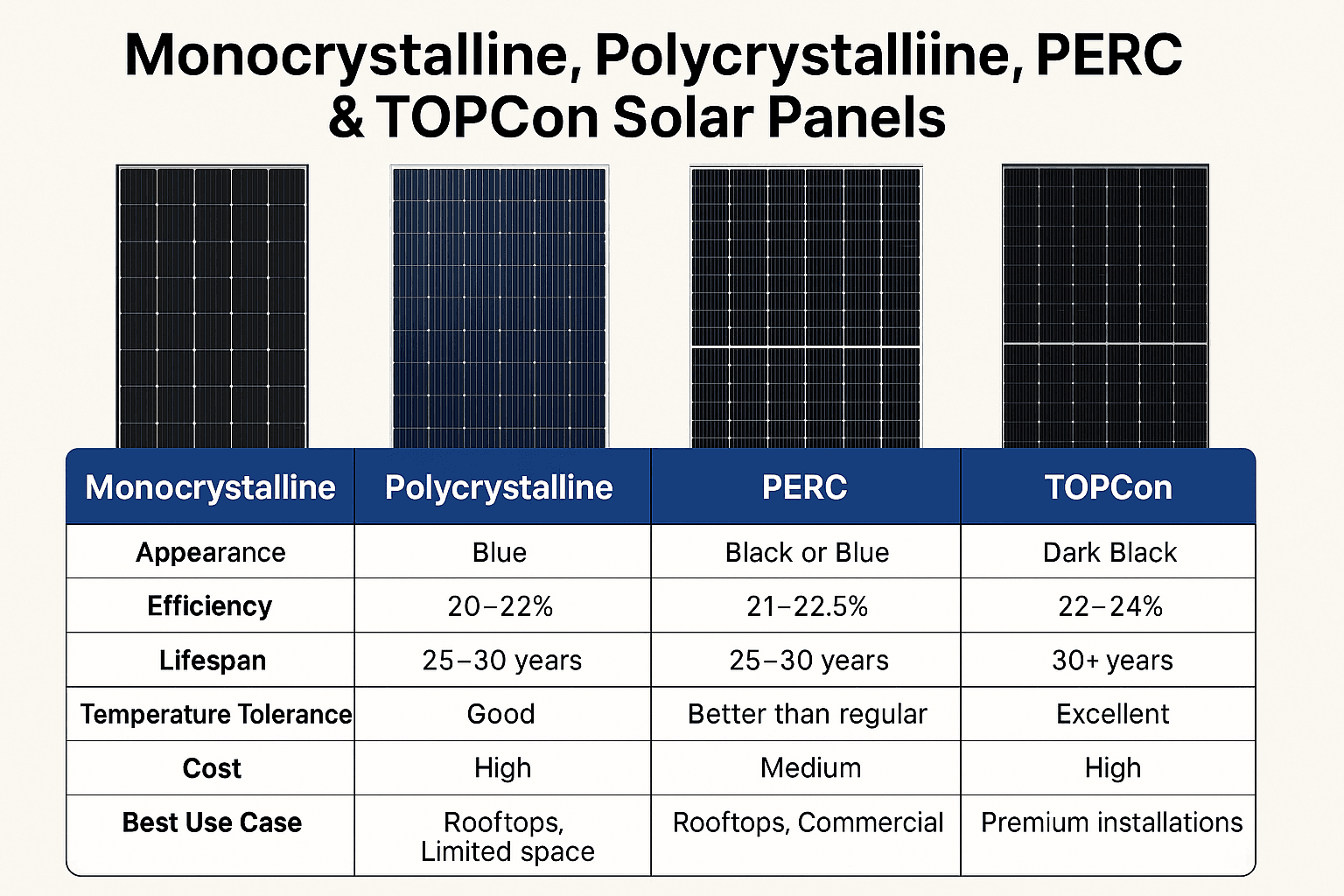

When planning a solar project, selecting the right type of solar panel is a crucial decision. With technologies like monocrystalline, polycrystalline, PERC, and the newer TOPCon, it can be confusing to know what fits your needs best. In this blog post, we’ll break down these four major types of solar panels, compare their features, and help you decide which one suits your project, climate, and budget.
📌 What Are Monocrystalline Solar Panels?
Monocrystalline panels are made from a single, continuous crystal structure. The silicon is sliced into thin wafers, and the cells appear black due to their high purity.
✅ Pros:
- High efficiency (20–22%)
- Longer lifespan (25–30 years)
- Better performance in low light and high heat
❌ Cons:
- More expensive to produce
- Can have a higher carbon footprint during manufacturing
📌 What Are Polycrystalline Solar Panels?
Polycrystalline panels are made from melted silicon fragments. They appear bluish due to multiple silicon crystals in each cell.
✅ Pros:
- Lower manufacturing cost
- Decent efficiency (16–18%)
- Affordable for large-scale installations
❌ Cons:
- Lower efficiency in heat
- Slightly shorter lifespan (20–25 years)
- Requires more space for the same output
📌 What Is PERC Technology?
PERC (Passivated Emitter Rear Cell) is an enhancement of traditional monocrystalline or polycrystalline solar cells. It adds a passivation layer on the back side of the cell to capture more sunlight.
✅ Pros:
- 1–1.5% higher efficiency than standard cells
- Works better in low-light and high-temperature environments
- Improved ROI due to better energy output
❌ Cons:
- Slightly higher cost than regular panels
- Not a separate type of panel but a technology applied to existing panels
📌 What Is TOPCon Technology?
TOPCon (Tunnel Oxide Passivated Contact) is the next-gen technology used primarily with monocrystalline panels. It uses a thin oxide layer and advanced contact structure to reduce recombination losses and improve efficiency.
✅ Pros:
- Very high efficiency (22–24%)
- Better temperature coefficient (performs well in hot climates)
- Long-term durability and higher energy yield
❌ Cons:
- Still relatively expensive
- Fewer manufacturers currently offer it (but growing)
🔍 Comparison Table
| Feature | Monocrystalline | Polycrystalline | PERC | TOPCon |
|---|---|---|---|---|
| Appearance | Black | Blue | Black or Blue | Dark Black |
| Efficiency | 20–22% | 16–18% | 21–22.5% | 22–24% |
| Lifespan | 25–30 years | 20–25 years | 25–30 years | 30+ years |
| Temperature Tolerance | Good | Moderate | Better than regular | Excellent |
| Cost | High | Low | Medium | High |
| Best Use Case | Rooftops, Limited space | Large open fields | Rooftops, Commercial | Premium installations |
🧠 Which Solar Panel Should You Choose?
Here are some simple guidelines based on your needs:
- Budget-Conscious Buyer: Go for polycrystalline panels if initial cost is a major factor and you have plenty of installation space.
- High Efficiency Needed: Choose monocrystalline PERC panels for a good balance between cost and performance.
- Premium Long-Term Investment: TOPCon panels are ideal for commercial or premium rooftop systems where maximum efficiency and ROI matter.
- Hot Climates: TOPCon or PERC performs better in high-temperature areas like Rajasthan, Gujarat, or Telangana in India.
🌞 Lifespan & Warranty
- Monocrystalline & PERC Panels: Usually come with 25-year performance warranty.
- Polycrystalline Panels: Often offer 20–25 years warranty.
- TOPCon Panels: May offer 30-year warranties, though this varies by brand.
A panel’s usable life can extend even beyond 30 years, though efficiency may gradually decline.
❓ Frequently Asked Questions
Q1: Are TOPCon panels worth the higher price?
A: Yes, if you need maximum efficiency and long-term value. Ideal for high-yield applications or space-constrained rooftops.
Q2: Do PERC panels degrade faster than mono or poly?
A: No, in fact, they often degrade slower due to their advanced rear surface design.
Q3: Can I mix panel types in one solar system?
A: It’s technically possible, but not recommended, as mismatched performance can reduce overall efficiency.
Q4: Are polycrystalline panels outdated?
A: They are still widely used, especially for budget projects, though their use is declining in favor of mono and advanced tech like PERC and TOPCon.
💡 Final Thoughts
The solar panel market has evolved significantly. While monocrystalline panels used to be the gold standard, technologies like PERC and TOPCon are pushing efficiency even further. Your choice should depend on your budget, available space, local climate, and expected energy needs.
Investing in high-quality panels ensures better performance, longer lifespan, and stronger ROI — a key part of building a sustainable future.





You must be logged in to post a comment.