
Sales & Marketing

🧠 People Don’t Buy What They Don’t Understand – Here’s Why It’s Costing You Sales

People Don’t Buy What They Don’t Understand

Don’t Buy What They Don’t Understand: Have you ever poured your heart into an amazing product or service, only to hear crickets when it comes time to close the sale? You’re not alone. One of the biggest mistakes businesses and professionals make is assuming that value speaks for itself.

It doesn’t.

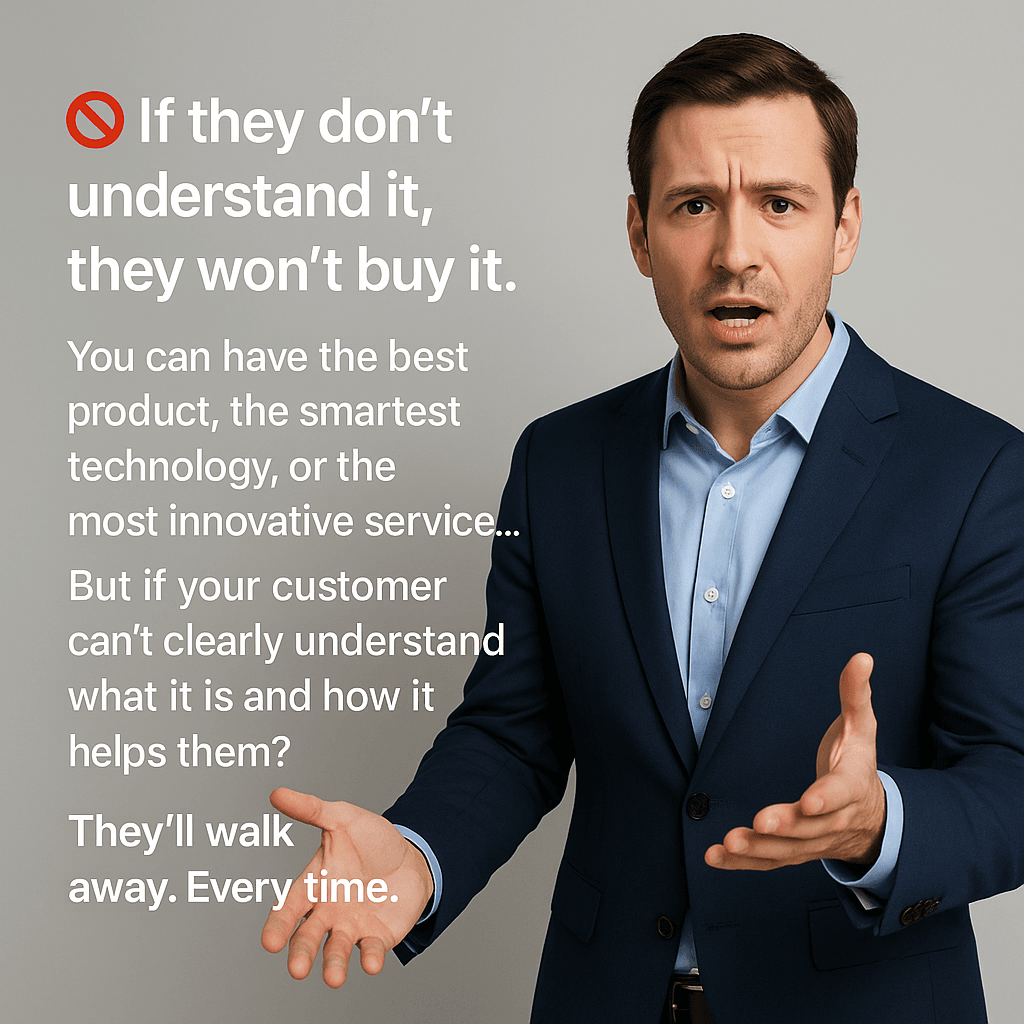
In reality, people don’t buy what they don’t understand. No matter how good your product is, if your customer can’t clearly grasp what it is, how it helps them, or why they need it—they won’t buy it.

Let’s break this down.


đŸš« Confusion Kills Conversion

Imagine walking into a high-end electronics store and seeing a futuristic device with glowing buttons, blinking lights, and a name like “XTR Quantum-7 System.” No explanation. No context.

Would you buy it?

Of course not. Because you don’t understand what it is.

This is exactly what happens when businesses bombard customers with technical jargon, vague language, or overly complex pitches.

Real Talk:

People won’t spend their money on something that makes them feel stupid. If your customer feels confused, they walk away. Every time.


đŸ§© Clarity = Confidence = Conversion

When a potential buyer understands what you offer and how it solves their problem, a few magical things happen:

  • ✅ They feel confident in their buying decision.
  • ✅ They feel safe because they “get it.”
  • ✅ They feel smarter, not overwhelmed.
  • ✅ They begin to trust your brand.

Clarity is not optional. It’s the foundation of trust and the fuel for conversion.


đŸ’„ The Power of a Simple Message

Let’s take a look at some winning examples:

  • Apple doesn’t say, “256GB flash storage, A17 Bionic chip with 16-core Neural Engine.”
    Instead, they say: “The world’s most powerful smartphone.”
  • Dropbox doesn’t say, “Cloud-based file synchronization and storage platform.”
    They say: “Your stuff, anywhere.”

Simplicity wins. Every time.


đŸ› ïž How to Make Your Message Clearer

Here’s a practical checklist to simplify your offer:

1. Use Simple, Everyday Language

Don’t say “sustainable lithium-ion energy storage solutions.”
Say “batteries that save energy and lower your electricity bills.”

2. Focus on Benefits, Not Features

Customers don’t care that your product has “military-grade aluminum.”
They care that “it’s tough enough to last a lifetime.”

3. Show, Don’t Just Tell

Use visuals, analogies, or quick videos. Demonstrations break down barriers and turn confusion into clarity.

4. Answer the “So What?” Question

For every feature or offer, ask yourself:
“So what? Why should they care?”


🧠 The Psychology Behind It

People make buying decisions based on emotion, not logic. But they justify those decisions with logic.

If you fail to help them understand what you do, their brain throws up a red flag:

“This might be a scam.”

“This feels risky.”

“I don’t get it
 I’ll think about it.”

Translation: No sale.

But when your message is clear, you help their brain say:

✅ “I get it.”
✅ “I see how this helps me.”
✅ “Let’s go for it.”


🔁 Confused Minds Don’t Convert

This quote by Donald Miller (author of Building a StoryBrand) says it best:

“If you confuse, you’ll lose.”

Your job isn’t to sound smart.
Your job is to make your customer feel smart for choosing you.


🔍 SEO and Clarity Go Hand in Hand

Clarity isn’t just for humans—Google loves it too.

When your messaging is simple, focused, and uses keywords your audience actually searches for, your content ranks better. That means more traffic and higher conversions.

🧠 Pro Tip: Use clear headlines, bullet points, and short paragraphs to help both your reader and the search engines understand your value.


🔄 Simplify to Multiply

Want to multiply your sales, impact, and brand recognition?
Start by simplifying your message.

  • Ditch the jargon.
  • Talk like a human.
  • Make your customer feel smart.
  • Solve one clear problem.

Because in the end, people don’t buy what they don’t understand. But when they do understand—they buy, they refer, and they come back.


đŸ—Łïž Final Thought

You might have the best solution in the world, but if you don’t express it in a way your audience understands, it will never reach its full potential.

So the next time you present your product, pitch your idea, or write your website copy, ask yourself:

“Would my customer understand this instantly?”

If not—rewrite it. Simplify it. Clarify it.

Because clarity doesn’t just lead to understanding.
Clarity sells.

đŸ”„ 11 Common Sales Mistakes New Salespeople Make — And How to Avoid Them

Common Sales Mistakes

Why do most new salespeople fail? It’s usually not because of a lack of opportunities—but because of basic, preventable sales mistakes.

Whether you’re just starting your sales journey or leading a team, avoiding these common sales mistakes is crucial. In this post, we’ll explore the biggest reasons why many new or unprofessional salespeople fail, and how to turn those errors into winning habits that boost sales performance.

1. Poor Client Greetings – A Bad Start

A weak or cold greeting is one of the first mistakes new salespeople make.

What’s the Sales Mistake?

Jumping into a sales pitch without a proper greeting or polite introduction. It shows a lack of people skills and professionalism.

How to Sell Effectively:

Always greet the client warmly, use their name, thank them for their time, and make the opening positive. This simple move sets the tone for trust.

2. Not Asking About the Client’s Business

One of the worst bad sales techniques is not understanding who you’re selling to.

Common Sales Mistake:

Failing to ask the client about their company, products, problems, or goals.

Sales Tip:

Ask thoughtful questions like:

  • What products do you currently use?
  • What’s your biggest sourcing challenge?
  • Who are your main customers?

Salespeople who ask smart questions close smarter deals.

3. No Research Before the Meeting

This is one of the most damaging sales mistakes to avoid.

Mistake:

Walking into a sales call or sending emails without researching the client’s company, website, or product range.

Fix:

Spend 15–30 minutes researching. Use tools like LinkedIn, the company website, or even Google Translate if there’s a language barrier. Knowing your client = earning their trust.

4. Can’t Promote Their Own Company

Just saying “We are factory, good price” is not a sales strategy. It’s a red flag.

Unprofessional Salesperson Habit:

They don’t know how to express their company’s unique value proposition.

Solution:

Learn to explain:

  • What makes your company reliable?
  • What certifications do you hold?
  • How are your products different?

This is a key part of sales training for new salespeople.

5. Never Highlight Product Advantages

Common Sales Mistake:

New reps forget to compare their products to competitors or show how they’re better than what the client is already using.

Fix:

Highlight benefits like:

  • Better quality
  • Faster delivery
  • Lower return rates
  • Customization options

This helps clients clearly understand why switching to your product is worth it.

6. Don’t Understand Their Own Product

Yes, it still happens. One of the most damaging unprofessional salesperson habits is not knowing the products they’re trying to sell.

Mistake:

They can’t explain the product’s features, benefits, or technical specifications.

Sales Tip:

Master your product. Know the advantages and limitations. Be ready to teach the client and answer questions confidently.

7. Know Nothing About Competitors

If the client knows your competitor better than you do—you’re already losing.

Common Sales Mistake:

Ignoring the competition or pretending they don’t exist.

How to Improve Sales Performance:

Study your top competitors. Know their pricing, quality, delivery times, and key selling points. Use that knowledge to position your offer more effectively.

8. Lazy Selling – Just Sending a Catalogue

Common Sales Mistake:

Sending a PDF and saying “Please check, let me know if you need anything.”

This is the definition of bad sales technique.

Fix:

Send the catalogue with personalized suggestions.

For example:
“Based on your market, I suggest looking at Model A, C, and D on pages 3–5. I can also send samples and pricing if you’re interested.”

This builds relevance and trust.

9. Weak or Negative Language

“If you need anything, contact us.”

These words show lack of confidence and motivation.

Common Sales Mistake:

Using soft, unsure phrases in sales conversations or emails.

Sales Tip:

Use confident, action-based language:

This change alone can double your response rate.

10. No Follow-Up = No Deal

The most deadly mistake: not following up.

Common Sales Mistake:

Many salespeople send one email and disappear. No updates. No reminders. No relationship.

Fix:

Follow up with value. Not just “Any update?”

Follow-up is where real sales happen.

11. Disappearing Mid-Chat Without Apology

Imagine you’re having a conversation with a supplier—asking questions, discussing details—and suddenly… they disappear. No warning. No “brb.” Just gone. Hours later, they’re back like nothing happened. No apology. No follow-up.

Mistake:

Unprofessional salespeople vanish during chats without explanation—and when they return, they never say sorry.

Why It’s a Problem:

This kind of attitude shows one thing clearly:
They don’t care about the client or the client’s business.

It breaks trust instantly. No client wants to work with someone who treats their time as unimportant.

How to Fix It:

Respect the conversation. If you need to step away, communicate:

“I need 10 minutes to check this info—will get back to you shortly.”

And if something urgent came up and you were pulled away, say:

“Apologies for the gap in our chat. Thank you for waiting.”

Sales is about relationships—and respect builds relationships.

Conclusion: Avoid These Mistakes, Sell Smarter

These 11 common sales mistakes can cost you deals, damage your brand, and destroy client relationships. The good news? Every one of them is easy to fix.

Start today by improving your greetings, client research, product knowledge, and follow-up habits. Make these changes, and you’ll not just improve your closing rate—you’ll earn long-term trust, loyalty, and referrals.

Beware of Bad Salesperson: The Hidden Dangers

Bad Salesperson

In the intricate world of commerce, the salesperson is your first point of contact with a company. Their role is not just to sell but to build trust, understand your needs, and guide you toward the best solutions. However, not all salespeople uphold these values. Dealing with a bad salesperson can be fraught with risks and complications.

The Red Flags of a Bad Salesperson

1. Lack of Basic Courtesy and Introduction:
A competent salesperson should greet you warmly, introduce themselves, and give you a brief overview of their company and products. If a salesperson skips these fundamental steps, it’s a glaring red flag. They fail to set a professional tone, making you question their credibility right from the start.

2. Poor Communication:
Timely responses are crucial in sales. A salesperson who never replies on time or disappears mid-conversation creates a sense of unease. Consistent communication is essential for building trust and ensuring a smooth transaction. When this is missing, it indicates a lack of commitment and reliability.

3. Inability to Understand Your Needs:
A good salesperson listens and recommends products that fit your requirements. In contrast, a bad salesperson might just send you a generic catalog without considering your specific needs. This approach shows a lack of interest in providing genuine value to the customer.

4. Unprofessionalism:
Professionalism is key in any interaction. Salespeople who exhibit unprofessional behavior, such as being late, dressing inappropriately, or speaking rudely, undermine the trust and respect essential in a business relationship.

5. Bad Attitude:
A salesperson with a negative attitude can turn the entire buying experience sour. Their lack of enthusiasm and dismissive nature can make you feel undervalued and unimportant.

6. Pushiness:
Overly aggressive sales tactics can be off-putting. A pushy salesperson pressures you to make quick decisions without giving you the time and space to consider your options, which can lead to regretful purchases.

7. Lack of Listening Skills:
Effective salespeople listen more than they talk. A salesperson who interrupts, talks over you, or fails to understand your needs is likely to miss crucial details, resulting in poor recommendations.

8. Lack of Social Skills:
Interpersonal skills are vital for building rapport. Salespeople who lack these skills may struggle to connect with you, making the interaction feel transactional rather than relational.

9. Lack of Technical Knowledge:
Salespeople should be knowledgeable about their products. Those who cannot answer your questions or provide detailed information demonstrate a lack of expertise, which can erode your confidence in the product.

10. Fear of Rejection:
Salespeople who fear rejection may avoid difficult conversations or fail to follow up, leaving you without the support or information you need.

11. Sense of Entitlement:
A salesperson with a sense of entitlement may act as if they deserve your business without earning it. This attitude can come across as arrogant and dismissive.

12. Focusing on Price Instead of Value:
Good salespeople emphasize the value of their products. Those who focus solely on price often fail to highlight the benefits and quality, leading to a less informed purchasing decision.

13. Making Promises They Can’t Keep:
Reliability is crucial. Salespeople who make grand promises but fail to deliver damage the trust and reliability essential in any business relationship.

The Broader Implications

The salesperson is not just an individual; they are the face of the company. If a company doesn’t ensure the quality of its sales force, it raises serious questions about the overall quality of the company’s products and services. Such companies might prioritize quick sales and profits over customer satisfaction and product integrity.

Quality Over Quantity:
A company that employs salespeople who exhibit poor communication and a lack of professionalism is likely more interested in making sales at any cost. They might not care about fostering long-term relationships with customers or maintaining high product standards. This can lead to a cycle of dissatisfaction and mistrust.

Conclusion

In the world of sales, the quality of interaction with a salesperson can make or break your experience. Be cautious when encountering a salesperson who displays any of the red flags mentioned above. Remember, a company that doesn’t invest in the quality of its sales force likely won’t invest in the quality of its products either. Your awareness and discernment are your best tools to avoid potential pitfalls and ensure a satisfactory purchasing experience.