

As the global demand for cleaner, more reliable, and more efficient energy solutions intensifies, Battery Energy Storage Systems (BESS) have emerged as a linchpin in the renewable energy revolution. But behind the scenes, a vital component ensures the seamless conversion of energy from one form to another—Power Conversion Systems (PCS).
Much like the heart in a human body, Power Conversion System plays a central role in managing energy flow within a BESS. It ensures that the energy stored in batteries can be used when needed and that excess energy from solar, wind, or the grid can be efficiently stored.
This article dives deep into the world of PCS, exploring what it is, how it works, the different types available, and why it is indispensable for the performance, safety, and profitability of modern energy storage systems.
What is a Power Conversion System (PCS)?
A Power Conversion System (PCS) is the core electrical interface in a BESS that converts direct current (DC) stored in the battery into alternating current (AC) for use on the grid or by electrical loads—and vice versa.
Power Conversion System includes inverters, rectifiers, control units, transformers, and protection systems. Its job is to handle the bi-directional flow of electricity, ensuring smooth transitions and stable power quality.
The Core Functions of Power Conversion System in BESS
1. DC to AC Conversion (Inversion)
When energy stored in the battery (DC) needs to be supplied to the grid or to AC loads, PCS converts it to AC. This is especially critical in grid-tied applications.
2. AC to DC Conversion (Rectification)
Power Conversion System also handles the charging process. It converts AC power from the grid or renewable sources into DC to charge the batteries efficiently.
3. Grid Stabilization and Support
Modern Power Conversion System units provide advanced functionalities like voltage and frequency regulation, reactive power support, harmonic filtering, and black start capabilities.
4. Load Shifting and Peak Shaving
PCS enables intelligent control of when to charge or discharge the battery based on demand, energy prices, or time-of-use tariffs, improving ROI and grid efficiency.
5. System Protection and Control
Built-in protections like overvoltage, overcurrent, short circuit, and anti-islanding ensure safety and compliance with grid codes.
Why PCS is Crucial in Energy Storage Systems
Without Power Conversion System, a BESS would be unable to interact with the outside world. Batteries store energy in DC, but the majority of our electric infrastructure runs on AC. PCS acts as the bridge, enabling:
- Grid compatibility
- Bidirectional energy flow
- High conversion efficiency
- Advanced control strategies
- Energy trading and arbitrage
Types of PCS in Battery Energy Storage Systems
1. Centralized Power Conversion System
A single large PCS unit handles the entire battery array. It’s efficient for utility-scale systems but can be a single point of failure.
Applications:
- Utility-scale solar + storage projects
- Industrial peak shaving systems
2. String Power Conversion System (Modular PCS)
Multiple small Power Conversion System units are distributed across the system. Offers redundancy and scalability, making it ideal for commercial and C&I systems.
Applications:
- C&I rooftop installations
- Microgrids
3. Hybrid PCS
Combines multiple energy sources (solar, diesel genset, grid) and integrates them with the battery system, offering maximum flexibility and resilience.
Applications:
- Off-grid systems
- Islanded microgrids
- EV charging stations with renewable input
Key Technical Parameters of PCS
When selecting a PCS, the following parameters should be carefully considered:
| Parameter | Importance |
|---|---|
| Power Rating (kW/MW) | Determines the load the PCS can handle |
| Conversion Efficiency | Affects overall system losses and ROI |
| Grid Compliance | Must meet IEEE, IEC, UL, or regional grid codes |
| Harmonic Distortion (THD) | Lower THD means cleaner power |
| Reactive Power Support | Helps with voltage regulation |
| Communication Protocols | Should support Modbus, CAN, or Ethernet |
| Cooling Method | Air-cooled vs. liquid-cooled for high-temp zones |
PCS in Action: Real-World Use Cases
1. Renewable Energy Integration
Solar and wind produce intermittent energy. PCS smoothens fluctuations by storing excess energy and releasing it when generation drops.
2. Microgrids and Remote Areas
PCS enables independent energy management in areas not connected to the main grid, reducing dependency on diesel generators.
3. Data Centers
PCS in BESS ensures zero downtime and clean switchover during outages, improving uptime and power quality.
4. EV Charging Infrastructure
EV fast chargers require high power. PCS helps balance grid load by storing and discharging energy during peak times.
PCS vs Inverters: What’s the Difference?
While Power Conversion System includes inverters, it is not limited to them. Power Conversion System is a complete subsystem encompassing inverters, rectifiers, filters, controllers, communication interfaces, and grid compliance features.
Inverter:
- Converts DC to AC only
- Typically unidirectional
Power Conversion System:
- Bidirectional conversion (DC↔AC)
- Includes multiple control and protection features
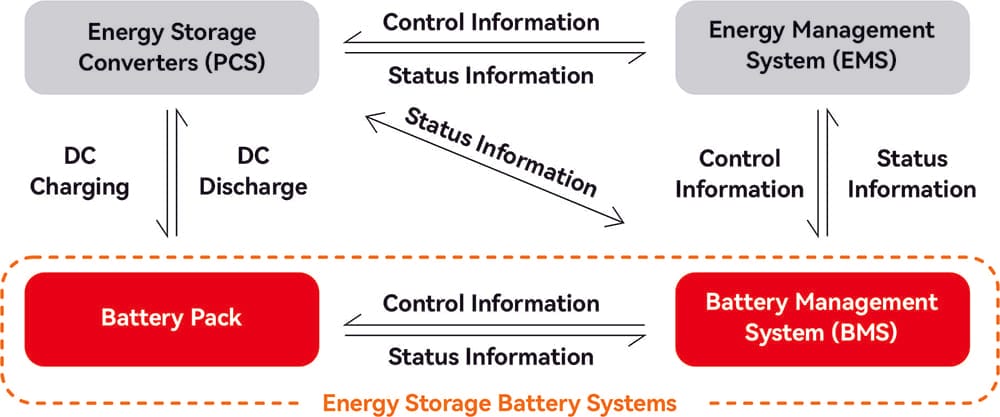
- Interfaces with EMS, BMS, and the grid
Integration of PCS with Other Systems
1. Battery Management System (BMS)
Power Conversion System works closely with the BMS to ensure safe charging/discharging by monitoring battery cell voltages, temperatures, and states of charge.
2. Energy Management System (EMS)
PCS executes the commands from EMS, managing power flow based on time-of-use tariffs, grid signals, and energy trading strategies.
3. Supervisory Control and Data Acquisition (SCADA)
In utility-scale installations, Power Conversion System sends real-time data to SCADA for performance monitoring and fault diagnostics.
The Rise of Smart PCS
Modern Power Conversion System systems come equipped with:
- AI algorithms for predictive analytics
- IoT integration for remote monitoring
- Cybersecurity protocols to prevent hacking
- Blockchain for energy trading in peer-to-peer networks
This evolution makes Power Conversion System not just a power converter, but a smart energy orchestrator.
Challenges in PCS Deployment
Despite its critical role, Power Conversion System deployment presents several challenges:
- High Initial Cost: Especially for large systems or hybrid configurations
- Thermal Management: Efficient heat dissipation is crucial
- Grid Compliance: Varying standards across countries complicate design
- EMI/EMC Compliance: Avoiding interference with other devices
- Space and Ventilation Requirements: Especially for indoor installations
Future of Power Conversion System in BESS
As the world shifts towards a decentralized and decarbonized energy model, Power Conversion System will take center stage in enabling flexibility, grid resilience, and cost-effective energy storage.
Emerging trends include:
- Wide Bandgap Semiconductors (SiC, GaN): Higher efficiency and smaller size
- Multi-port PCS: Handling solar, grid, and storage simultaneously
- DC-DC Isolated Power Conversion System: For safe and efficient integration of second-life batteries
- Vehicle-to-Grid (V2G): Power Conversion System will power bi-directional energy flow in EV charging networks
Conclusion
The success of any Battery Energy Storage System hinges on the performance and reliability of its Power Conversion System. PCS is more than a technical component—it’s the gateway, the translator, and the guardian of the entire energy storage ecosystem.
As energy systems evolve, PCS will remain at the forefront, ensuring that the power we generate, store, and consume is clean, stable, and smart.
Whether you’re designing a microgrid, deploying a utility-scale storage plant, or developing a smart city infrastructure, investing in a robust Power Conversion System is non-negotiable.
It’s not just a piece of equipment.
It’s the brain and backbone of modern energy transformation.






You must be logged in to post a comment.