⚡ The Guardian Inside the Battery: Why BMS Is the Silent Hero of Every Energy Storage System

BMS (Battery Management System).

Imagine a battery system without protection. No intelligence. No control. Just raw power waiting to overheat, short-circuit, or collapse. That’s what you get without a BMS (Battery Management System).

In today’s energy revolution—where homes, factories, EVs, and entire power grids are being electrified—BMS isn’t a luxury. It’s a lifeline. It’s the technology that prevents fires, extends battery life, and makes high-performance storage systems not just smarter—but safer.

This post explores what BMS is, why it’s critical, the types of BMS, and the differences between low-voltage and high-voltage applications—all in language that resonates with technical experts and decision-makers alike.


???? What is BMS (Battery Management System)?

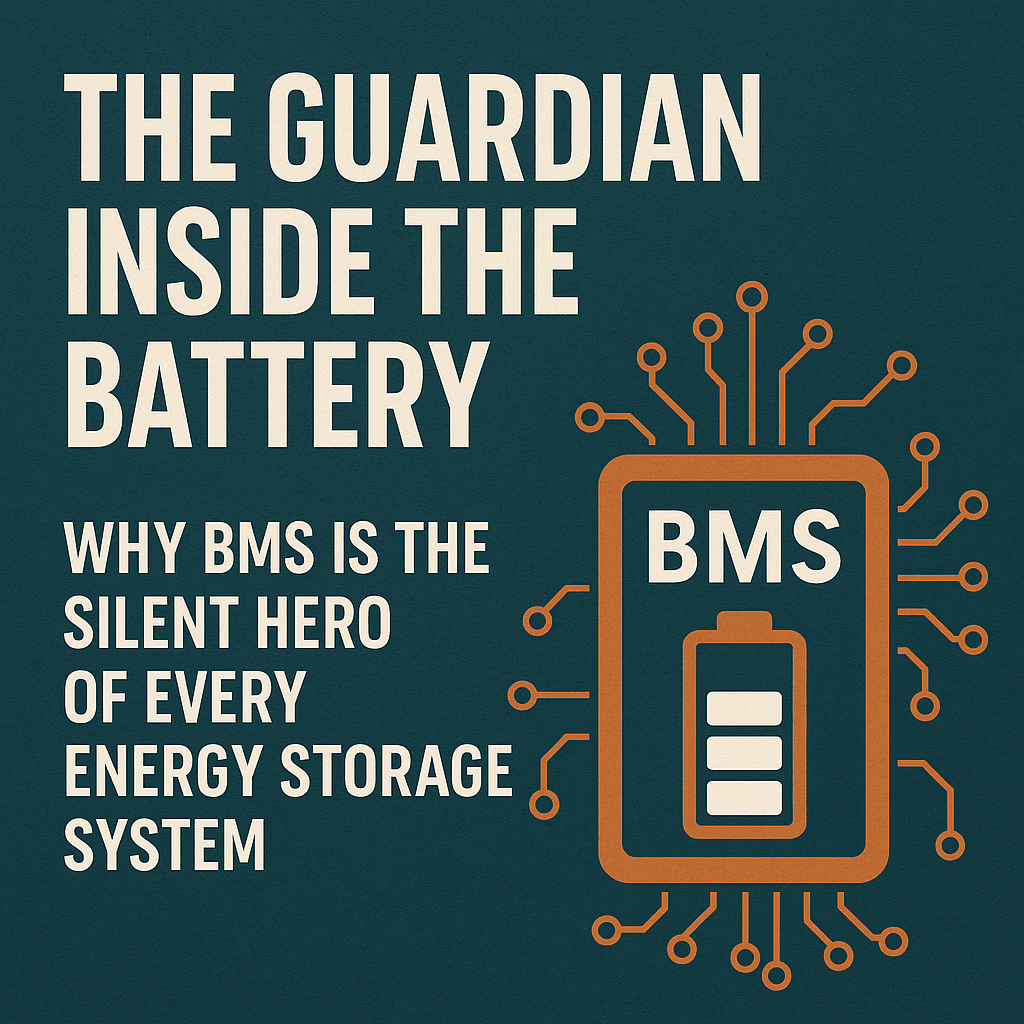
A Battery Management System (BMS) is the brain and bodyguard of a battery pack. It monitors, controls, protects, and balances each cell to ensure the battery performs safely and efficiently throughout its life.

Without a BMS, a battery is like a car with no brakes, no dashboard, and no steering.

Here’s what a BMS does:

  • Monitors each cell’s voltage, temperature, current, and state of charge (SOC)
  • Balances the cells to avoid overcharging or deep discharging
  • Protects against overvoltage, undervoltage, overcurrent, and overheating
  • Communicates with external systems like EMS, inverters, chargers, or the cloud
  • Logs data for diagnostics, warranty validation, and performance tracking

A good BMS doesn’t just keep a battery alive. It makes it thrive, delivering more cycles, more performance, and more peace of mind.


???? Why is BMS Critical for Energy Storage Systems?

Every battery—from your smartphone to a grid-scale energy storage plant—relies on a BMS. But the stakes are much higher in energy storage systems (ESS).

Why?

Because these systems:

✅ Operate at high voltages
✅ Involve large energy flows
✅ Power mission-critical infrastructure
✅ Run continuously for years

Without a robust BMS, the risks are real and severe:

  • Thermal runaway → fire or explosion
  • Unbalanced cells → early battery death
  • Overcharging → system failure or safety breach
  • Deep discharge → irreversible capacity loss

BMS acts as your first and last line of defense. It protects your investment, your equipment, and your people.


???? How Does a BMS Work?

At the core, BMS continuously monitors key battery parameters like:

  • Voltage of each cell and overall pack
  • Temperature across various points
  • Current flowing in and out
  • SOC (State of Charge) and SOH (State of Health)

If any of these values go outside safe limits, BMS will:

  • Cut off charging or discharging
  • Activate cooling or alarms
  • Communicate with external systems
  • Log and report the fault

Advanced BMS also includes:

  • Cell balancing (passive or active)
  • CAN bus or RS485 communication
  • Data logging and remote diagnostics
  • Firmware updates over-the-air (OTA)

In short, it watches, analyzes, reacts—and evolves.


???? Types of BMS: Choosing the Right Intelligence

Just like batteries come in many chemistries and sizes, BMS also comes in various architectures depending on system needs.

1. Centralized BMS

All monitoring and control circuits are located in one central board.

  • ✅ Cost-effective
  • ❌ Difficult to scale
  • ❌ Less fault-tolerant

Best for: Small battery packs, e-bikes, entry-level systems


2. Distributed BMS

Monitoring modules are placed on each cell or module, while control is handled centrally.

  • ✅ Easier to wire
  • ✅ Better thermal and voltage management
  • ❌ Still dependent on central unit

Best for: Medium systems like telecom towers or industrial UPS


3. Modular/Stackable BMS

Each battery module has a local BMS, and these communicate with a master controller.

  • ✅ High scalability
  • ✅ Redundancy and fault isolation
  • ✅ Perfect for high-voltage or large ESS

Best for: C&I, containerized ESS, EV fleets


4. Smart BMS with Communication

These BMS systems have integrated communication protocols like CAN, Modbus, or RS485.

  • ✅ Seamless EMS/inverter integration
  • ✅ Real-time monitoring and cloud sync
  • ✅ Remote diagnostics

Ideal for: Smart homes, solar-plus-storage, commercial buildings


???? BMS for Low Voltage Systems (12V, 24V, 48V)

Low-voltage systems are common in residential and small commercial use cases like:

Key Features of Low Voltage BMS:

  • Monitors small packs (1-16 cells in series)
  • Includes passive balancing
  • Protects against simple voltage/current faults
  • Compact and cost-effective
  • Often built into the battery pack itself

???? Low voltage doesn’t mean low risk. Even at 48V, an unbalanced or poorly managed pack can lead to swelling, thermal events, or capacity fade. That’s why a reliable, tested BMS is essential.


⚡ BMS for High Voltage Systems (100V to 1500V)

High-voltage battery systems are the backbone of:

Unique Challenges of High Voltage BMS:

  • Thousands of cells to monitor
  • Multi-layer fault detection
  • Complex communication with PCS and EMS
  • Need for precision balancing
  • Heat and fire risk is exponentially higher

What to Expect in High-Voltage BMS:

  • Modular design with stackable slave units
  • CAN/RS485 protocols with PLC or EMS
  • High-reliability MOSFET or relay protection
  • Multi-point thermal sensors
  • Isolation monitoring
  • Ground fault detection
  • Real-time diagnostics and AI prediction

???? In high-voltage systems, BMS isn’t just a monitor—it’s an intelligent command center.


???? What Happens When You Don’t Have a Good BMS?

Let’s be clear: skipping or downgrading BMS is not just risky. It’s reckless.

Here’s what can go wrong:

  • ???? Fire due to thermal runaway
  • ???? Explosions in high-voltage racks
  • ⚠️ Warranty voids due to lack of logging
  • ???? Regulatory non-compliance
  • ???? Downtime, recalls, and reputational loss

And worst of all? Total battery failure—years before expected.

A smart BMS doesn’t just save your battery. It saves your business.


???? Real-World Applications of BMS

Let’s look at a few live examples where BMS makes or breaks success:

  • EV Bus Fleets in China use modular BMS to manage 600V-800V packs with millions of cycles logged and balanced daily.
  • Off-grid hospitals in Africa rely on BMS-integrated solar storage to keep vaccines cold during blackouts.
  • Data centers use high-redundancy BMS in their UPS batteries to avoid catastrophic downtime.
  • Smart homes in California integrate BMS with EMS to sell solar power back to the grid during peak hours.

Each of these stories has one thing in common: reliability powered by intelligent battery management.


✅ Final Thoughts: BMS Is the Unsung Hero of the Energy Transition

Batteries may power the world, but BMS protects the dream.

It’s the difference between:

  • A battery that lasts 10 years… and one that fails in 2.
  • A system that runs safe… and one that catches fire.
  • Profitable ESS deployment… and an operational nightmare.

Whether you’re sourcing a 48V battery for your home or a 1000V rack for a solar farm, always ask:

“What kind of BMS does this system use?”

Choose wisely. Because inside every great battery system is a silent guardian.
That guardian is the BMS.


Need Help Sourcing the Right BMS or Battery System?

As a consultant and sourcing expert in the new energy space, I help clients worldwide choose the right batteries with intelligent BMS, tailored to their voltage, application, and business goals.

???? Let’s connect—your energy system deserves a brain that protects and performs.

BESS vs ESS: What’s the Real Difference?

BESS vs ESS

BESS VS ESS: In the world of new energy and power management, two terms are often used interchangeably — ESS and BESS. While they are closely related, understanding the difference is crucial for engineers, investors, project managers, and even end users.
Let’s break it down clearly and simply.


What is ESS (Energy Storage System)?

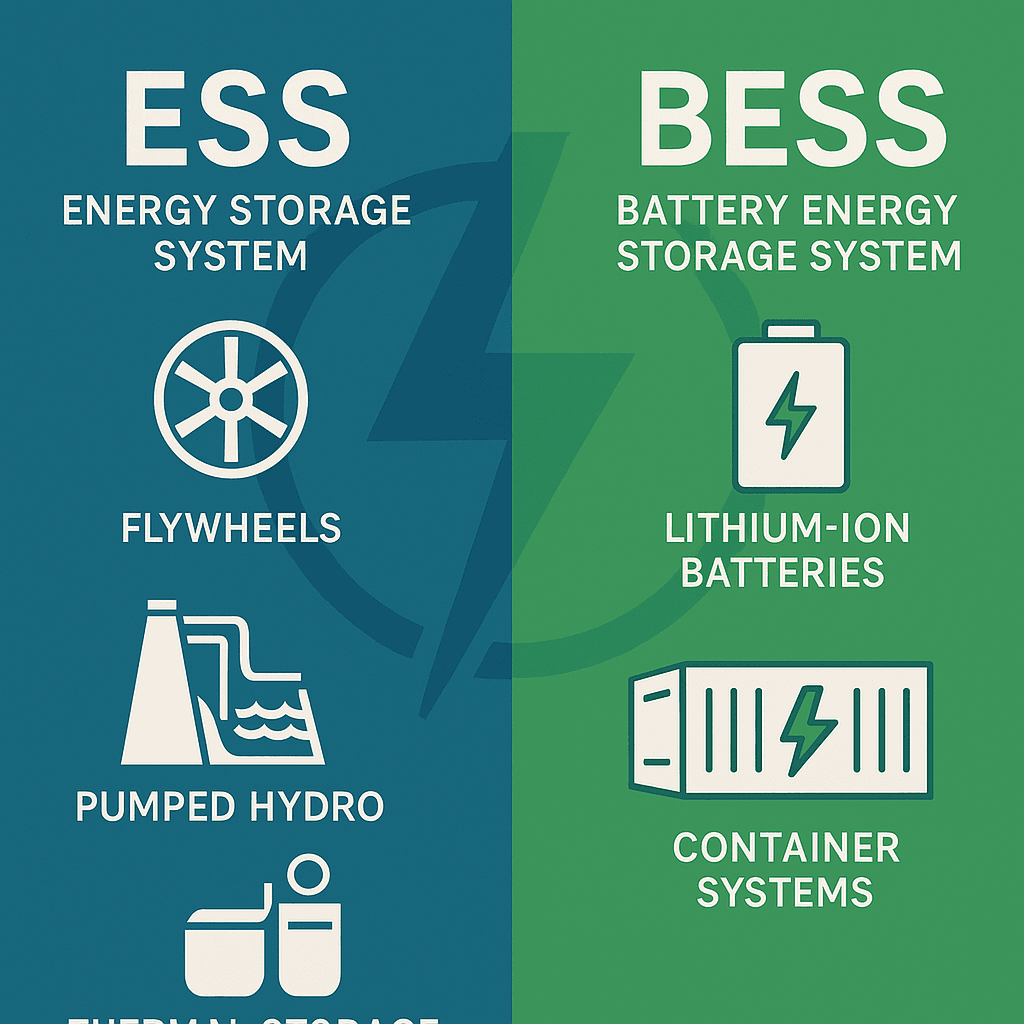
ESS, or Energy Storage System, is a broad term used to describe any system that captures and stores energy for later use.

An ESS can store energy in various forms, including:

  • Electrical (via batteries)
  • Mechanical (via flywheels, compressed air)
  • Thermal (via molten salts or hot water tanks)
  • Hydraulic (via pumped hydro storage)

In short, ESS refers to the general category of systems designed to store and release energy as needed.


Examples of ESS:

  • A hydroelectric dam that pumps water to an upper reservoir during off-peak hours.
  • A thermal energy storage system that stores heat during the day and releases it at night.
  • A grid-scale battery installation storing renewable solar or wind energy.

Read more here about Type for Energy Storage Systems


What is BESS (Battery Energy Storage System)?

BESS, or Battery Energy Storage System, is a specific type of ESS that uses batteries to store electrical energy.

BESS typically involves:

  • Lithium-ion batteries
  • LFP (Lithium Iron Phosphate) batteries
  • Semi-solid or solid-state batteries
  • Other emerging battery chemistries

BESS are highly popular today because they are scalable, modular, fast-responding, and perfect for integrating renewable energy sources like solar PV and wind power.


Examples of BESS:

  • A residential solar battery storage system (e.g., Tesla Powerwall)
  • A containerized grid-scale battery (e.g., 1MWh LFP Battery Container)
  • Battery backup systems for commercial and industrial facilities

Read more here about Types of Battery Energy Storage Systems


Key Difference: ESS vs BESS

FeatureESS (Energy Storage System)BESS (Battery Energy Storage System)
TypeBroad (any form of energy storage)Specific (only battery-based storage)
Storage MediaMechanical, Thermal, Hydraulic, ElectricalBatteries only (Li-ion, LFP, etc.)
ApplicationsDiverse (energy, heat, mechanical)Electrical energy storage
ExamplesPumped Hydro, Flywheels, Thermal StorageLithium-ion battery containers, Home storage units

Simply put:

  • All BESS are ESS,
  • But not all ESS are BESS.

Why This Matters

Understanding the difference between ESS and BESS is essential when planning energy projects, selecting technologies, or investing in storage solutions.

  • If you need fast response times, modularity, and easy scalability → BESS is usually your solution.
  • If you are looking for large-scale, long-duration, or specialized storage → broader ESS options may fit better.

Each has its place depending on the application, budget, and performance requirements.


Conclusion

In today’s rapidly growing energy market, being clear about the terminology can help you make smarter technical and investment decisions.

While ESS covers every method of storing energy, BESS specifically means storing electrical energy in batteries. As renewable energy adoption grows, understanding this distinction becomes even more critical for successful project development.


FAQ: Difference Between BESS and ESS

Q1: What does ESS stand for?

A1: ESS means Energy Storage System. It’s a general term for any technology that stores energy — including batteries, pumped hydro, compressed air, or thermal storage.

Q2: What does BESS mean?

A2: BESS stands for Battery Energy Storage System. It’s a type of ESS that specifically uses batteries (like lithium-ion) to store and release electrical energy.

Q3: Are BESS and ESS the same thing?

A3: Not exactly. All BESS are ESS, but not all ESS are BESS. ESS is a broad category; BESS is a battery-specific solution.

Q4: When should I say BESS instead of ESS?

A4: Use BESS when you are clearly talking about battery-based storage (like lithium-ion systems for solar). Use ESS if you mean any energy storage type.

Q5: Which one is better for solar and wind energy?

A5: BESS is the most common choice for storing power from renewable sources because it’s fast, modular, and easy to install.

Q6: Why is it important to know the difference?

A6: Using the correct term helps you plan your project correctly, communicate clearly, and choose the right technology for your needs.

Nut-Bolt cell based Battery Packs = Hidden Danger. Don’t Risk It.

Nut-Bolt Cells Based Battery Packs

Nut-Bolt cell based Battery Packs: In the high-stakes world of battery energy storage systems (BESS) and electric vehicles (EVs), one careless shortcut can lead to catastrophic failure.

Yet, shockingly, some manufacturers still assemble battery packs using outdated nut-bolt connections—a crude method that belongs in the past. These so-called “battery builders” cut corners, risking not just performance—but your investment, your reputation, and even human lives.

Let’s pull back the curtain on this dangerous practice and explain why laser welding isn’t a luxury—it’s a lifesaver.


???? What Are Nut-Bolt Cells Based Battery Packs?

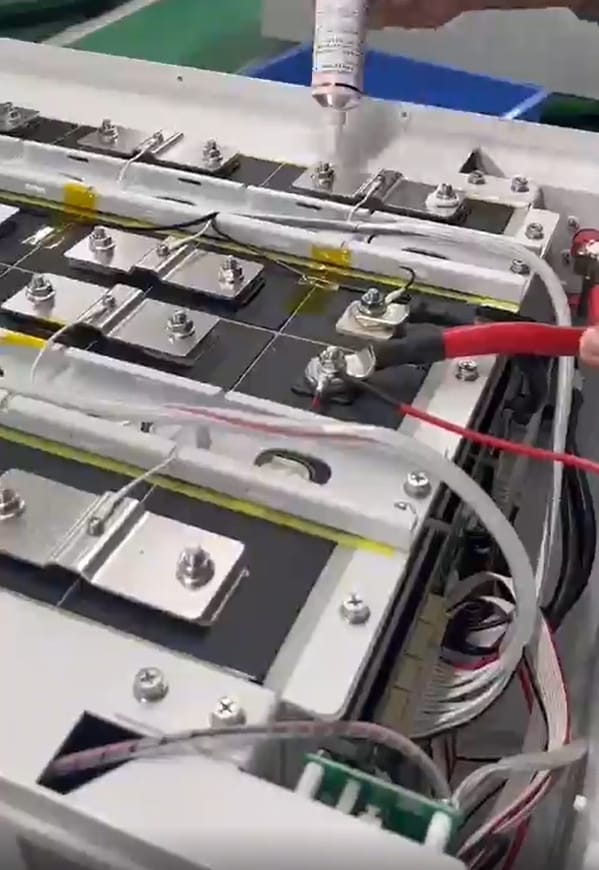
Nut-bolt battery packs involve fastening the terminals of cylindrical or prismatic cells with nuts, bolts, and metal busbars. It might sound simple and accessible—but simplicity comes at a steep, hidden cost.

Often used by small, inexperienced builders without the right equipment or training, this approach is prone to failure, heat build-up, and inconsistency. It’s a ticking time bomb hiding behind a low price tag.


Nut-Bolt Cells Based Battery Packs

???? The Ugly Truth: Why Nut-Bolt Cell Connections Must Be Avoided

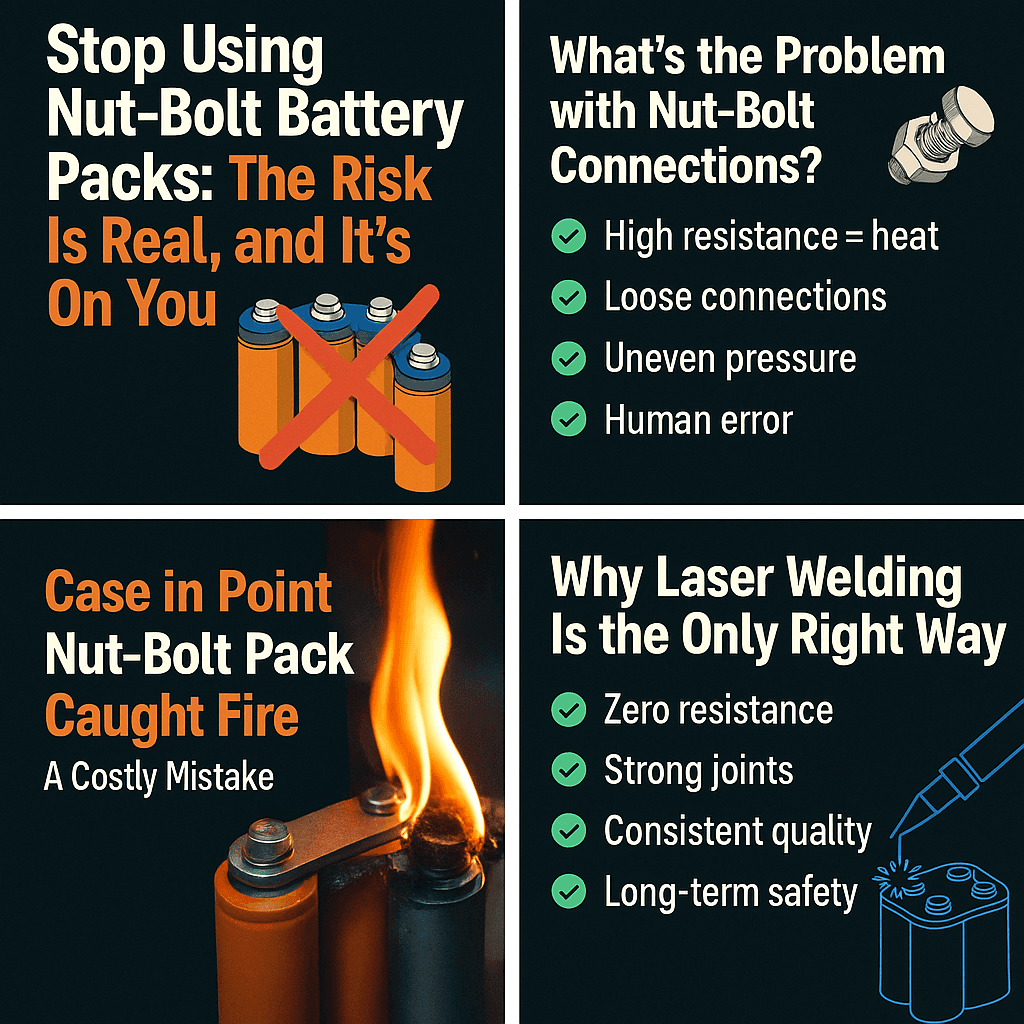
❌ 1. Heat Monster: Resistance Builds Up and Ignites Risk

Nut-bolt joints have high contact resistance. As current flows, resistance generates localized heat, which worsens over time due to vibration, corrosion, or loosening bolts. This heat doesn’t just degrade performance—it can start fires or cause thermal runaway in high-capacity battery packs.

❌ 2. Uneven Pressure = Weak Connections

Tightening bolts manually can never guarantee uniform contact pressure across all cells. Some connections are too loose, others too tight. The result? Poor conductivity, voltage imbalances, and system inefficiencies.

❌ 3. Unstable Over Time

Batteries naturally expand and contract with temperature cycles. Nut-bolt joints loosen, introducing noise, imbalance, and risk. What worked on day one becomes dangerous on day 90.

❌ 4. Catastrophic in Vibrating Environments

In EVs or transportable storage systems, vibration is constant. Nut-bolt packs are notorious for coming loose under stress—leading to sudden disconnection, arcing, or complete system failure.

❌ 5. Slow, Messy, Human-Error Prone

Unlike automated laser welding, manual nut-bolt assembly is labor-intensive, slow, and inconsistent. Human torque errors, missing washers, or uneven tightening can all lead to invisible weaknesses.

❌ 6. Made by Untrained, Shortcut-Taking Assemblers

Let’s not sugarcoat it—most nut-bolt battery packs are made by people or small companies without proper experience, tools, or responsibility. They use these primitive methods to save on laser welding machine costs—a decision that endangers your project, your team, and the end user.

They’re playing with your trust, your money, and people’s safety just to make a quick profit.

They don’t invest in the proper setup. They don’t understand thermal dynamics. They don’t care about long-term performance. And worst of all—they gamble with your future, not theirs.


???? Real-Life Case Study: A Dangerous Shortcut Backfired

In Southeast Asia, a local contractor installed a nut-bolt based battery system for a solar farm. Within 9 months, the client began noticing:

  • Overheating terminals
  • Burn marks
  • Unbalanced modules
  • Sudden capacity drops

Inspection revealed loose bolts, inconsistent joints, and dangerous heat buildup. The entire system had to be torn out and replaced. The damage cost tens of thousands of dollars—not to mention lost uptime and reputation damage.


✅ The Safer, Smarter Alternative: Laser Welding

Laser welding isn’t just “better”—it’s a quantum leap in safety, precision, and performance.

???? 1. Zero Resistance Joints

Laser welding fuses metal surfaces with micron-level accuracy, creating a seamless, permanent connection. No bolts. No loosening. No heat build-up.

???? 2. Superior Mechanical Strength

Welded packs withstand vibrations, shocks, and harsh environments—ideal for mobile storage, EVs, or industrial energy systems.

???? 3. Automation = Perfection

Laser welding is done by automated, calibrated machines, not by guesswork. That means repeatable, high-quality joints with no surprises.

???? 4. Higher Energy Density, Compact Packs

Laser welding allows for tighter, cleaner pack designs—saving space, improving thermal performance, and enhancing product aesthetics.

???? 5. Fast, Scalable, and Cost-Effective Long-Term

While the initial setup cost is higher, the ROI is clear: fewer failures, lower maintenance, longer lifespan, and happier clients.


???? Pro Tip: Ask This One Question Before Buying a Battery Pack

“How are the cells joined—nut-bolt or laser welded?”

If they say nut-bolt, run. You’re dealing with an amateur, not an energy solution provider.


???? Need a Trustworthy Battery Pack Partner?

As a New Energy Sourcing & Quality Consultant, I help clients worldwide source professionally welded, certified battery systems that meet international safety and performance standards.

I perform:

  • In-depth factory audits
  • Vendor qualification and certification checks
  • QC inspections, system testing, and FAT
  • Technical due diligence for BESS and EV battery projects

???? Final Verdict: Never Settle for Nut-Bolt Cells Based Battery Packs. Ever.

If you care about:

  • Safety
  • Performance
  • Long-term reliability
  • Professional reputation

Then say NO to nut-bolt battery packs. They’re outdated, unreliable, and often built by people who have no business touching energy systems.

???? Laser welding isn’t optional—it’s essential.
???? Your project deserves better. Your clients demand better. So do it right, or don’t do it at all.


???? Ready to Source Smart? I Can Help.

Whether you’re building a C&I storage project, developing an EV, or launching a containerized ESS—reach out now for safe, smart, and professional sourcing support.

???? Message me here or connect on LinkedIn.