Hybrid Inverter

What is an AC Coupled Energy Storage System?

AC coupled energy storage system

AC Coupled Energy Storage System: As the world rapidly shifts toward renewable energy, managing power generation, storage, and consumption efficiently is critical. Solar and wind power are clean but intermittent. That’s where energy storage systems (ESS) play a key role. Among the most practical configurations for integrating storage into existing systems is the AC coupled Energy storage system.

This blog explores AC coupled Energy storage systems in detail—what they are, how they work, their advantages, disadvantages, and where they fit best in modern energy infrastructure.


What is an AC Coupled Energy Storage System?

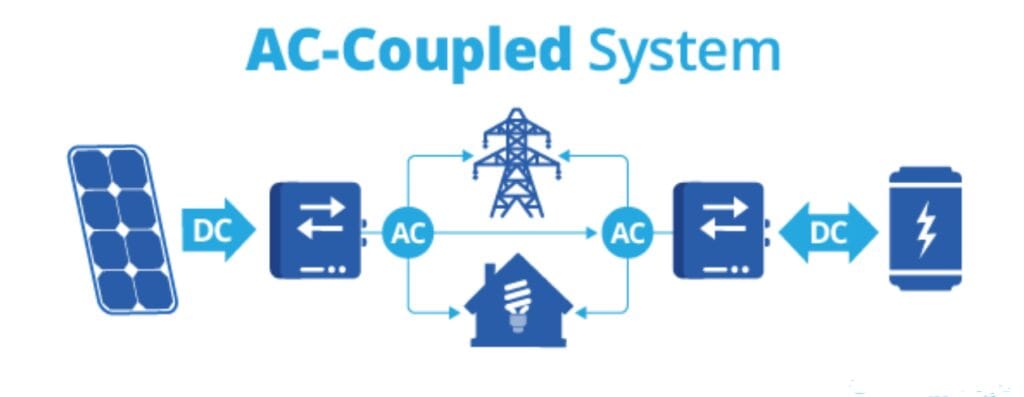
An AC coupled Energy storage system connects batteries to the grid or a solar PV system via an inverter on the AC side—as opposed to DC coupling, where batteries share a common inverter with the PV system.

In AC coupling, both the solar inverter and the battery inverter operate independently but feed into the same alternating current (AC) bus. This makes it easier to retrofit batteries into an existing grid-tied solar system or to operate in hybrid or microgrid environments.


How Does AC Coupling Work?

Here’s a simplified workflow of an AC coupled system:

  1. Solar panels produce DC power, which is converted to AC by a solar inverter.
  2. This AC power either goes to the grid or is consumed by local loads.
  3. A separate battery inverter (bi-directional) connects the battery system to the AC bus.
  4. The battery inverter handles charging (from grid or solar) and discharging (to supply power when needed).

The Energy Management System (EMS) coordinates energy flow, prioritizing self-consumption, peak shaving, or backup supply.


Key Components of an AC Coupled Energy Storage System

  • Solar PV System
  • String Inverter (or Microinverters)
  • Battery Storage Unit
  • Battery Inverter / Hybrid Inverter
  • Energy Management System (EMS)
  • Smart Meter / CTs
  • Grid Connection (optional in off-grid mode)

Advantages of AC Coupled Energy Storage Systems

Easy Retrofitting

AC coupling is perfect for adding storage to existing grid-tied PV systems. There’s no need to replace or modify the original solar inverter.

Modular & Scalable

Battery capacity and power rating can be scaled independently of the solar system. This flexibility is crucial for growing energy needs.

Higher Efficiency in Off-Grid Mode

In AC microgrids, AC coupling is more efficient because loads, generation, and storage all operate on the AC side—avoiding multiple DC-AC conversions.

Seamless Backup Power

With proper control systems, AC coupled setups can provide uninterruptible power supply (UPS) functionality during grid outages.

Technology-Agnostic

You can use different brands for solar and battery inverters, giving project owners freedom of choice.


Challenges and Limitations for AC Coupled Energy Storage System

⚠️ Multiple Conversions Lead to Losses

DC → AC (solar inverter) → DC (battery charge) → AC (load/grid) involves extra conversion steps, resulting in lower round-trip efficiency compared to DC coupling.

⚠️ More Complex Control & Synchronization

Two inverters must work in harmony. This requires advanced EMS and precise control algorithms, especially for grid-forming or islanding applications.

⚠️ Higher Upfront Cost

More hardware (separate inverters) and control systems can mean higher CapEx, though the ease of installation might offset some of these costs.

⚠️ Limited DC-Only Charging

You can’t charge batteries directly from the PV’s DC power. This could be a problem when grid power is down and solar output is high.


Use Cases of AC Coupled Energy Storage Systems

Residential Retrofits

Homeowners with existing solar PV systems can add storage without modifying their inverter setup.

Commercial Buildings

Businesses seeking peak shaving, demand charge reduction, or backup power benefit from the modularity of AC coupled systems.

Microgrids & Off-Grid Projects

Rural or island microgrids often use AC coupled configurations to manage multiple energy sources and loads.

Utility-Scale Hybrid Plants

Some utility-scale ESS installations use AC coupling to enable independent control of solar and storage assets.


AC Coupling vs. DC Coupling: Quick Comparison Table

FeatureAC CoupledDC Coupled
Inverter SetupSeparate solar & battery invertersShared hybrid inverter
EfficiencyLower due to more conversionsHigher due to fewer conversions
Retrofit FriendlinessExcellentPoor
ComplexityHigher (multiple devices)Lower (single device)
ScalabilityHighModerate
Charging from PV During OutageNo (unless advanced EMS)Yes
Battery Sizing FlexibilityHigherLimited to inverter capacity

Recent Technological Trends

  • Grid-forming inverters are now being integrated into AC coupled systems, allowing them to maintain grid frequency in island mode.
  • Smart EMS algorithms are improving system efficiency and coordination between inverters.
  • Hybrid inverters with AC-coupled inputs are emerging, combining the best of both worlds.
  • Battery vendors are offering plug-and-play AC coupled kits, making installations faster and more standardized.

Conclusion: Is AC Coupling Right for You?

AC coupled Energy storage systems offer unmatched flexibility, especially when integrating with existing solar setups or in microgrid environments. While the efficiency is slightly lower due to extra conversion steps, the ease of retrofitting, modular design, and robust backup power capabilities make AC coupling a strong contender in the energy storage space.

As the renewable energy landscape evolves, AC coupled systems will continue to play a crucial role—especially in applications where flexibility, scalability, and compatibility matter more than absolute efficiency.


Call to Action: Let’s Design the Right System for Your Needs

Are you looking to upgrade your solar system with energy storage? Or planning a microgrid project? I help clients in the new energy sector source, design, and implement optimal storage systems tailored to their goals—be it residential, commercial, or utility-scale.

???? Contact me today to explore whether AC coupling is the right choice for your project!

The Ultimate Guide: Installing the Axpert KING II TWIN 6KW Hybrid Inverter

Installing the Axpert KING II TWIN 6KW Hybrid Inverter requires careful attention to safety and following the manufacturer’s instructions. Here is a comprehensive, step-by-step guide to help you with the installation process:

Before you begin, ensure that you have read the user manual provided by the manufacturer. The manual will contain specific instructions and safety guidelines that you must follow.

Step 1: Safety Precautions

  • Ensure that the main power supply to your home or building is turned off before starting the installation process. This will prevent any accidents or electrical shocks.
  • Use proper personal protective equipment (PPE) such as gloves and safety goggles to ensure your safety while working with electrical components.

Step 2: Unpack and Inspect the Axpert KING II TWIN Inverter

  • Carefully unpack the Axpert KING II TWIN 6KW Hybrid Inverter and inspect it for any physical damage that may have occurred during transportation. If you notice any damage, contact the manufacturer or supplier for further instructions.

Step 3: Mounting the Axpert KING II TWIN Inverter

  • Select a suitable location for mounting the inverter. It should be a well-ventilated area with sufficient clearance for airflow and maintenance.
  • Ensure that the mounting surface is sturdy and capable of supporting the weight of the inverter.
  • Attach the mounting brackets to the inverter following the manufacturer’s instructions.
  • Securely mount the inverter on the chosen surface using screws or bolts. Make sure it is level and stable.

Step 4: Electrical Connections

  • Refer to the user manual for detailed electrical specifications, including wire sizes and connection diagrams.
  • Connect the DC input terminals of the inverter to the battery bank. Ensure that the positive (+) and negative (-) terminals are correctly connected.
  • Connect the AC output terminals of the inverter to the main distribution panel or load center. This will allow the inverter to supply power to your home or building.
  • If your inverter supports solar panel connections, refer to the manual for specific instructions on connecting the solar panels to the inverter.

Step 5: Earthing (Grounding)

  • Proper earthing (grounding) is crucial for safety and optimal performance.
  • Connect the earthing cable provided with the inverter to the designated earthing terminal on the inverter.
  • Connect the other end of the earthing cable to a suitable earth electrode, such as a grounding rod, as per local electrical codes.

Step 6: Configuring the Axpert KING II TWIN Inverter

  • Power on the inverter by switching it on according to the manufacturer’s instructions.
  • Configure the inverter settings as required. This may include parameters such as battery type, charging voltage, output frequency, and grid-tie settings.
  • Consult the user manual for detailed instructions on configuring the inverter. If you are unsure about any settings, it is advisable to seek professional assistance.

Step 7: Testing and Commissioning

  • Once the inverter is properly connected and configured, it’s time to perform a series of tests to ensure everything is functioning correctly.
  • Check the display panel of the inverter for any error codes or warning messages. Refer to the user manual to troubleshoot and resolve any issues.
  • Test the inverter’s functionality by connecting a load and ensuring it receives power from the inverter.
  • If you have solar panels connected to the inverter, check if the inverter is successfully harvesting energy from the solar panels and feeding it into the battery bank or the grid.

It is important to note that this guide provides a general overview of the installation process. The specific steps and requirements may vary depending on the model and specifications of the Axpert KING II TWIN 6KW Hybrid Inverter. Always consult the user manual provided by the manufacturer for detailed and accurate instructions. If you are unsure about any aspect of the installation, it is advisable to seek professional assistance from a qualified electrician or technician.

Why You Should Consider A Solar Inverter

Solar Inverter

If you’re thinking about going solar, you may wonder if a solar inverter is the right choice. In this blog post, we’ll discuss some of the benefits of solar hybrid inverters and why you should consider one for your home or business.

What Is A Solar Inverter?

A solar power inverter, also known as a PV inverter or solar converter, is a type of electrical converter that changes direct current (DC into alternating current (AC It is used to power equipment and appliances in homes and businesses that use AC electricity.

There are two main types of solar power inverters standalone and grid-tie Standalone inverters are not connected to the utility grid and are used in off-grid systems, while grid-tie inverters are connected to the utility grid

Solar hybrid inverters are a type of grid-tie inverter that can also be used in off-grid systems They are able to store excess energy in batteries for later use, making them ideal for backup power applications.

If you’re considering using solar power at your home or business, it’s important to understand the different types of solar inverters available so that you can choose the right one for your needs.

The Benefits Of A Hybrid Inverter

– The Pros and Cons Before making the switch to solar power, it’s important that you understand all of the pros and cons associated with this renewable energy source In this blog post, we’ll take a close look at the benefits and drawbacks of solar inverters so that you can make an informed decision about whether or not this technology is right for you.

If you’re considering making the switch to solar power, one of the most important decisions you’ll need to make is which type of inverter to use Solar inverters are devices that convert direct current (DC into alternating current (AC, making it possible for solar panels to generate electricity There are two main types of solar inverters string inverters and microinverters.

String Inverters String inverters are the most common type of solar inverter They work by connecting multiple solar panels together in “strings,” with each string having its own individual AC output The advantage of string inverters is that they are typically less expensive than microinverters, making them a good choice for those on a budget, However, string inverters can be less efficient than microinverters and may not work as well in shading conditions

Microinverters are smaller than string inverters and work by converting DC into AC on a per-panel basis This means that each panel has its own independent AC output, which can increase efficiency and allow your system to better handle shading conditions Microinverters also tend to be more expensive than stringed counterparts, so they may not be the best option if you’re working with a tight budget.

Why You Should Consider A Solar Hybrid Inverter

– Advantages of a Hybrid Inverter

A solar hybrid inverter can provide many advantages over a traditional power inverter.

A hybrid inverter is more efficient and can save you money on your electric bill.

A hybrid inverter is better for the environment and will help reduce your carbon footprint.

A hybrid inverter is easier to install and maintain than a traditional power inverter.

A hybrid inverter can provide you with backup power in case of an outage or other emergency situations.

How A Solar Hybrid Inverter Works

A solar power inverter is a device that converts the DC (direct current output of a photovoltaic (PV solar panel into an AC (alternating current voltage that can be fed into the electrical grid A solar hybrid inverter performs this same function, but also includes a battery backup system to provide power during periods of extended cloudy weather or when utility power is unavailable

Solar hybrid inverters are becoming increasingly popular as more homeowners and businesses look for ways to reduce their dependence on the grid There are many advantages to using a hybrid inverter, including

Increased energy independence – With a solar hybrid inverter, you can continue to produce power even when the grid is down, giving you a greater degree of energy independence

Reduced environmental impact – Solar power is a clean and renewable source of energy, so by using a solar hybrid inverter you can help to reduce your carbon footprint

Cost savings – A solar hybrid inverter can save you money by offsetting your electric bill with solar-generated electricity during times when utility rates are high

The Different Types Of Solar Hybrid Inverters

Basics The Different Types Of Solar Hybrid Inverters

As the use of solar power increases, so does the need for solar inverters A solar inverter is a device that converts DC (direct current electricity from your solar panels into AC (alternating current electricity, which is what your home or business uses There are different types of solar hybrid inverters available on the market, each with its own advantages and disadvantages

The three main types of solar hybrid inverters are string, microinverters, and central inverters String inverters are the most common type of solar hybrid inverter and are typically less expensive than other types Microinverters are less common but offer a higher efficiency rate and more flexibility when it comes to installation Centralized inverters are the most expensive option but offer the highest efficiency rate and allow for multiple inputs from different sources

When choosing a solar hybrid inverter, it is important to consider your specific needs and budget String and micro inverters are typically best for smaller installations, while central inverters are better suited for larger installations Be sure to consult with a professional to find the best option for your needs