Technology

Integrating VR and AR in E-Learning: Enhancing Learning Experiences in the Digital Age

In recent years, the educational landscape has witnessed a revolutionary transformation with the integration of Virtual Reality (VR) and Augmented Reality (AR) into e-learning platforms. These immersive technologies have opened up new frontiers for educators to engage learners and deliver dynamic, interactive, and meaningful learning experiences.

In this article, we explore the principles behind VR and AR integration, their diverse use cases, the perks they offer, and the potential drawbacks that educators must consider while embracing this cutting-edge technology.

Principles of VR and AR in E-Learning:

Virtual Reality (VR) and Augmented Reality (AR) are two distinct but related technologies that share the common goal of providing users with an interactive and immersive experience. The principle behind VR lies in creating a computer-generated environment that users can interact with through specialized hardware like VR headsets. On the other hand, AR overlays digital elements onto the user’s real-world environment, enhancing their perception of reality through smartphones, tablets, or AR glasses.

Use Cases of VR and AR in E-Learning:

1. Simulations and Training: VR and AR can simulate complex real-life scenarios, offering learners a risk-free environment to practice skills, such as medical procedures, engineering tasks, or hazardous operations.

2. Historical and Cultural Exploration: Through VR, students can visit historical sites, museums, or ancient civilizations, while AR can augment textbooks with interactive 3D models, making history and culture come alive.

3. Language Learning: VR can immerse learners in a virtual environment where the target language is spoken, fostering practical language skills through real-life interactions.

4. Science and STEM Education: VR and AR enable students to visualize abstract scientific concepts, such as molecular structures or celestial bodies, promoting a deeper understanding of complex topics.

5. Virtual Laboratories: VR and AR can replicate laboratory experiments, allowing students to conduct hands-on experiments without physical resources.

Perks of Integrating VR and AR in E-Learning:

1. Enhanced Engagement: VR and AR captivate learners by offering interactive and experiential learning opportunities, promoting higher engagement and knowledge retention.

2. Personalized Learning: These technologies enable adaptive learning experiences, tailoring content to individual preferences and learning styles, ensuring an optimized educational journey.

3. Improved Skill Development: The immersive nature of VR and AR simulations allows learners to practice skills repetitively, leading to enhanced proficiency in real-world applications.

4. Real-Life Application: By bridging the gap between theory and practice, VR and AR empower learners to understand how knowledge translates into real-life scenarios, encouraging practical application.

5. Global Accessibility: VR and AR can democratize education by reaching learners worldwide, irrespective of geographical boundaries, enhancing inclusivity and access to quality education.

Drawbacks and Considerations:

1. Cost and Infrastructure: VR headsets and AR devices can be expensive, and integrating these technologies requires significant initial investments in hardware and software.

2. Learning Curve: Some learners may face challenges in adapting to VR and AR experiences, potentially hindering the learning process.

3. Health and Safety Concerns: Prolonged use of VR headsets can cause discomfort, and AR usage may distract learners in certain environments, necessitating moderation and breaks.

4. Limited Content Availability: While the technology is advancing rapidly, there might be a lack of specialized VR and AR content in certain subject areas.

Conclusion:

Integrating Virtual Reality (VR) and Augmented Reality (AR) in edTech offers an exciting opportunity to revolutionize education and learning experiences. By adhering to sound principles and leveraging diverse use cases, educators can harness the perks of immersive technologies to create engaging, interactive, and effective learning environments. However, it is essential to be mindful of the potential drawbacks and considerations to ensure that VR and AR integration is implemented thoughtfully and responsibly, ultimately enhancing the learning journey for all learners in the digital age.

Component Technologies Revolutionizing Tomorrow

Introduction

As the world hurtles into the future, the backbone of technological advancement lies in the continuous evolution of component technologies. These are the building blocks that drive innovation across various industries, laying the foundation for groundbreaking breakthroughs and shaping the future of technology. From artificial intelligence and robotics to biotechnology and renewable energy, the possibilities enabled by component technologies are limitless. In this article, we delve into the significance of component technologies and explore how they are poised to transform our lives and reshape industries in the years to come.

Understanding Component Technologies

Component technologies refer to individual technological elements or units that can be combined to create complex systems or solutions. These elements are often interchangeable, making it easier to upgrade and enhance existing systems, driving efficiency, and fostering innovation. Examples of component technologies include microprocessors, sensors, actuators, memory modules, communication chips, and various software frameworks.

  • IoT and Connectivity

The Internet of Things (IoT) represents one of the most influential applications of component technologies. By embedding sensors and communication chips in everyday objects, we can create a network where devices can communicate with each other and with users. This connectivity empowers smart homes, smart cities, and industrial applications like Industry 4.0. The future of IoT is even more promising as low-power, high-performance components enable greater automation, data analysis, and seamless integration with other technologies like artificial intelligence and blockchain.

  • Artificial Intelligence (AI) and Machine Learning

AI and machine learning are transforming industries across the board, from healthcare and finance to transportation and entertainment. The development of more powerful processors and specialized hardware, such as graphics processing units (GPUs) and tensor processing units (TPUs), has significantly accelerated AI capabilities. These component technologies enable rapid data processing, deep learning, and the training of complex neural networks, ushering in a new era of AI-driven innovation

  • Quantum Computing

While still in its infancy, quantum computing holds immense potential to revolutionize problem-solving and computation. Quantum bits or qubits, the fundamental building blocks of quantum computing, can represent multiple states simultaneously, leading to exponential computational power. As scientists and researchers overcome various technical challenges, quantum computers using components such as superconducting circuits and trapped ions are inching closer to real-world applications in cryptography, drug discovery, and optimization problems.

  • Renewable Energy and Storage

The future of technology heavily relies on sustainable energy sources to mitigate climate change and reduce our dependence on fossil fuels. Component technologies play a crucial role in advancing renewable energy solutions. High-efficiency solar cells, innovative wind turbine designs, and advanced energy storage systems are all made possible through the continuous evolution of materials and component technologies.

Conclusion

The future of technology is intertwined with the evolution of component technologies. From the Internet of Things and artificial intelligence to quantum computing and renewable energy, these building blocks lay the groundwork for transformative innovations across various industries. As these technologies continue to advance, they will not only improve our quality of life but also address some of humanity’s most pressing challenges. Embracing and investing in the development of component technologies will undoubtedly be the catalyst for ushering in a brighter, more sustainable, and technologically-driven future.

Direct Zimbra Email Migration to Office 365 with Other Items

Are you planning to move to Office 365 account from Zimbra? Need to transfer some critical Zimbra emails to Office 365 environment for official reasons? Wondering how to directly and accurately perform Zimbra email migration to Office 365? Looking for the best approach to perform the process? If yes, then it is suggested to go through the article discussed here in which you will find a solution that allows direct Zimbra email migration to Office 365 with contacts, calendars, and briefcases.

Zimbra is a popular collaboration software that was formerly known as ZCS i.e. Zimbra Collaboration Suite. It includes both client and server components with a desktop version whose services are now unfortunately stopped. But, Zimbra Web Client and Zimbra Server are still in use by users.

The most common reason why users nowadays are performing a migration to Office 365 is that the cloud-based applications are offering more flexibility and security than desktop-supported apps.

Why Zimbra Email Migration to Office 365 is required?

Zimbra is a simple solution that is quite useful for small projects. But once the requirements are extended then it became a problem for organizations whose businesses are exceeding day by day.

It is a very lightweight communication tool that does not possess many features as a full-size email suite. Some users might even find its GUI outdated as well as old-fashioned especially if they have tried other available email service providers. Moreover, the filters and searches are comparatively not up to the mark in flexibility as compared to other leading email clients.

However, the drawbacks of Zimbra can be overlooked by small organizations but these are the major deficiencies in large businesses.

Apart from the above-mentioned shortcomings, some users also experienced synchronization as well as account configuration issues. Therefore, Office 365 plays an important role here. It takes care of all issues perfectly and is designed in a way that fulfills the entire needs of an organization.

What is the Best Way to Perform Zimbra Email Migration to Office 365?

With the help of CubexSoft Zimbra to Office 365 Migration Tool, users can directly perform Zimbra email migration to Office 365 with contacts, calendars, and briefcases. The application provides a simplified platform that is easily operable by technical and novice users. The steps are also minimum and capable to implement the required task in a minimum time.

Moreover, the software contains many features that allow executing the migration task as per requirements to get the desired output. However, the free demo of the utility is also available through which one will be able to check the process for free.

Working Steps for Direct Zimbra Email Migration to Office 365

Step 1. Download, launch, and open CubexSoft Zimbra to Office 365 Migration Tool. Select the first option if you have Zimbra on-premises mailboxes in TGZ file. Select the second option if you want migration of Zimbra webmail emails and click on Next.

Note. The following operational steps are now discussed according to the first option (Zimbra on-premise mailboxes).

Step 2. Go to Add File(s) and add required Zimbra mailboxes on the application using Add TGZ File(s)/Add Folders/Add Extracted TGZ items.

Step 3. The tool will start the scanning of Zimbra mailboxes and start listing all the items one-by-one with checkboxes on the tool.

Step 4. You can select the required item and view the data of its files with the help of the Preview window.

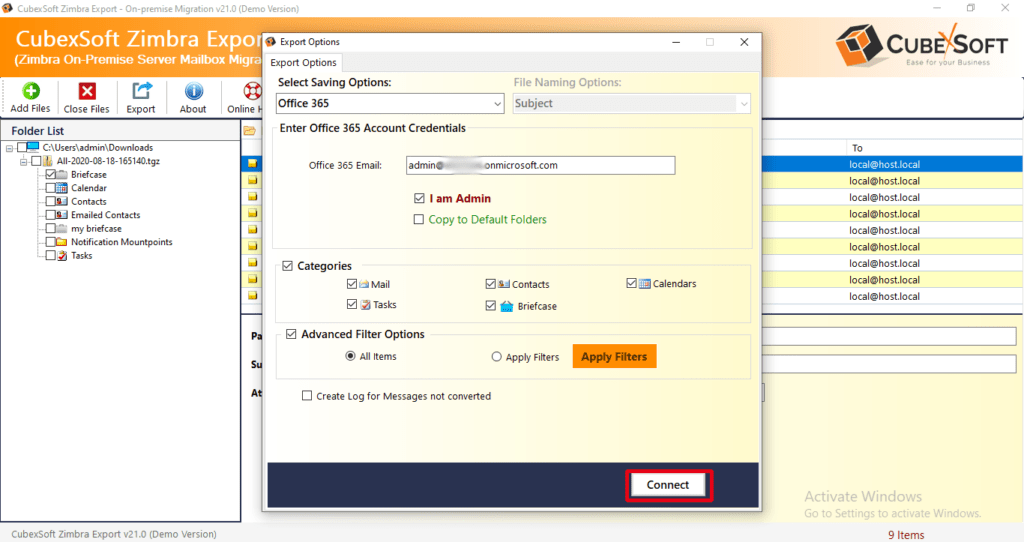
Step 5. Go to Export and select Office 365 option from the list.

Step 6. Enter Office 365 email ID. Select the I am Admin option if you are carrying admin account details. Set Categories and Filters as per requirements and click on Connect.

Step 7. Provide the password of the specified Office 365 email ID in the Microsoft login screen.

Note. If admin credentials are added, then clicking the Connect button will show a Mailbox Mapping window that will help in batch Zimbra email migration to Office 365. If single user details are added, then clicking Connect will right away start the migration process.

Step 8. Now, the tool will display the ongoing migration progress and then show a message confirming Conversion Completed Successfully to users. Click on the OK button and go to your Office 365 account to check the migrated emails.

However, you will see that the migrated Zimbra emails are appearing with 100% accuracy. And, even the formatting properties are preserved throughout the process.

Conclusion

The blog has discussed an ultimate technique for carrying out direct Zimbra email migration to Office 365 process. The CubexSoft Zimbra Converter is a secure, trusted, and fast solution that safely performs the process and delivers accurate output within seconds. It is introduced with a free demo with the help of users who can check the operational steps of the tool for free. They can also migrate the first 25 files from each Zimbra mailbox to Office 365 free of cost.